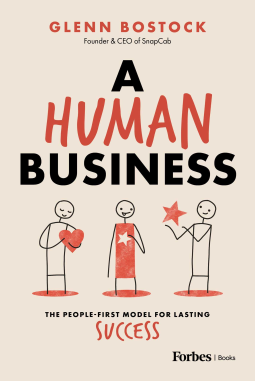
A Human Business
The People-First Model for Lasting Success
This title was previously available on NetGalley and is now archived.
Send NetGalley books directly to your Kindle or Kindle app
1
To read on a Kindle or Kindle app, please add kindle@netgalley.com as an approved email address to receive files in your Amazon account. Click here for step-by-step instructions.
2
Also find your Kindle email address within your Amazon account, and enter it here.
Pub Date Jun 16 2026 | Archive Date Jun 16 2026
Talking about this book? Use #AHumanBusiness #NetGalley. More hashtag tips!
Description
For too long, business leaders have operated under the assumption that maximizing profit requires minimizing humanity. The result is widespread employee disengagement, toxic workplace cultures, and organizations that drain rather than energize their people.
A Human Business challenges this paradigm with a proven alternative. Drawing from forty years building SnapCab from a small cabinet shop to an international manufacturing company, Glenn Bostock demonstrates how modeling your organization after the human body creates communities where people thrive.
Inside, you will discover:
- how to create a foundation of caring that attracts and retains exceptional talent
- identify and leverage what you and your team genuinely love doing
- shift focus from profit-chasing to value-creation through usefulness
- build interdependent systems where every department serves shared intentions
Through vulnerable personal stories and practical business applications, Bostock reveals how dyslexia and learning disabilities became unexpected assets in building a company culture that values accessibility over expertise, collaboration over competition, and purpose over profit alone.
Whether launching a startup or transforming an established organization, A Human Business provides the framework for creating workplaces where people want to spend their days—and where sustainable success follows naturally.
Advance Praise
“Great students make great leaders. People who are perpetually in studious observation will always stop the people around them with insights others have missed. In Glenn’s new book, A Human Business, page after page, you will find yourself saying, ‘I didn’t see that!’ I know firsthand the incredible company that Glenn and his team have created, and it is the essence of Humans in Flow.”
—Paul Akers
Author, 2 Second Lean
“Glenn and his team have led an extraordinary journey in their production facility, embracing what is possible in an efficient, effective, and conscientious fashion. In my role, I regularly bring other companies’ senior leadership teams to view their facility, listen to their story of discovery and of a people-based mindset—and they all leave the tour impressed and changed. I readily recommend that you listen and read, and if possible, visit Glenn and see for yourself the dramatic difference he has made.”
—Steve Holmgren
Manufacturing Consortium Manager, Eastern Ontario
“In an age of AI—when what we crave most is real humanity—Glenn Bostock’s Human Business model reminds us of what so many corporations have lost: the simple powers of caring, connection, and purpose. This book shows that being truly human isn’t just idealistic; it’s essential for creating workplaces where people can genuinely thrive.”
—Susie Ogihara
Strategic Project Manager, Panasonic R&D Company of North America
“A Human Business shows, through real stories and experience, that businesses work best when people truly come first. Respect, purpose, and care aren’t soft ideas, they are practical principles that build strong, resilient companies. It’s a timely reminder that when you focus on serving the customer and respecting the people doing the work, everything else follows.”
—Ryan Tierney
Managing Director, Sperrin Metal; Founder, Lean Made Simple
“No fluff here—Glenn shares the practical blueprint from his lifelong experiential learning discovering the cultural DNA best suited to see a Human Business thrive! His insights into creating a business system where people flourish through meaningful work will help companies be more innovative, resilient, and profitable.”
—Marc Kuzik
Board Member, Association for Manufacturing Excellence
“We all have business questions. And thanks to this book, Glenn shows us we all also have the answers. Your thought process will never be more accurate. Design your business after the most impressive invention on earth… the human body.”
—Brad Cairns
Founder, STOLBEK
“Glenn Bostock has shown—through what he’s built at SnapCab—what’s possible when you lead with respect for people and a deep commitment to serving others. A Human Business is an inspiring, down-to-earth, and practical guide to building a workplace where caring, learning, and true ‘communities of usefulness’ come before metrics—and results follow. His example was one of the sparks that pushed us to begin—and deepen—our own people-first Lean journey, and we’re grateful to Glenn for lighting that spark.”
—Leonidas Avgerakis
CEO, Elviomex
“An inspiring book that will help you discover and coax the best qualities out of your employees. When employees understand what they have to offer and are encouraged to demonstrate it regularly, hidden potential will blossom. Your employees have more to give than they realize, more talent than they understand. A Human Business will not only teach you how to cultivate this in every employee, it will teach you how to harmonize every person’s talent so the ‘Human Business’ can reach its full potential.”
—Brannon Burton
Division Manager, Bridgesource
“As a friend and admirer of Glenn, his personal growth and success are heartwarming. The message in this book is powerful for all who believe and strive for continuous growth in their personal and career lives.”
—Dick Brickman
CEO, The Brickman Group
“Glenn’s perspective on workplace culture—rooted in genuine connection, trust, and supporting people—is exactly the approach businesses need for lasting success. We share these values by strengthening both leaders and employee growth with emotional intelligence. His message resonated deeply and inspired our community to take action.”
—Jennefer Griffith
Executive Director, Food Processing Skills Canada
“A Human Business is a refreshing reminder that work doesn’t have to drain us. This book shows how caring for people first creates healthier teams, stronger businesses, and more meaningful lives.”
—Josh Barnes
Owner, Barnes Welding Inc.
“Glenn Bostock possesses a rare quality of leadership: the ability to transform adversity into opportunity with genuine conviction. In A Human Business, he shows readers how challenges serve as powerful invitations for innovation, growth, and the opportunity to create solutions. Glenn has proven these principles, not only on these pages, but through his own distinguished career.”
—Peter Rhodes
Author, Observing Spirit
“In a business world where artificial intelligence and industrial robots are threatening to replace human interaction and genuine caring, A Human Business has arrived at exactly the right time. It is a break-through blueprint that eloquently and movingly describes the timeless principles that should guide ethical enterprise.”
—Ray Silverman, PhD
Professor Emeritus of Religion and English, Bryn Athyn College; author of the introduction to Helen Keller’s How I Would Help the World
“A Human Business is a powerful reminder that companies are, first and foremost, communities of people. The book inspires readers to once again see work as a place of purpose, responsibility, and mutual support.”
—Jan-Michel Schüsler
Lean Project Manager, Tridelta Meidensha GmbH
“Glenn Bostock is a creative, inquisitive, self-examining, and self-aware entrepreneur whose vision for his company has always been forward-thinking, unique, productive, efficient, and compassionate. From all the improvements he has made over the decades, comes this metaphor of a business needing to be a human business. Read A Human Business to learn new business concepts, cultivate out-of-the-box thinking, and inspire your leadership vision.”
—Susan B. Smith
Founder and president, LooptyHoops; Chair emeritus, Vistage Worldwide
“A Human Business reflects Glenn Bostock’s uncommon ability to unite disciplined business thinking with genuine care for people. It is practical, grounded, and shaped by decades of lived leadership.”
—Bruce Hamilton
Sr. Advisor, GBMP Consulting Group
Available Editions
| EDITION | Other Format |
| ISBN | 9798887507972 |
| PRICE | $29.99 (USD) |
| PAGES | 176 |
Available on NetGalley
Available to Buy
Buy on Amazon Buy on BN.com Buy on Bookshop.orgAverage rating from 12 members
Featured Reviews
 Demetris P, Reviewer
The Company That Learned to Feel Pain
Glenn Bostock’s “A Human Business” turns workplace care into an anatomy of memory, repair, and useful work.
By Demetris Papadimitropoulos | May 17th, 2026
Many workplace books treat care as a scented candle: agreeable, inexpensive, and dutifully placed near the reception desk. Glenn Bostock’s “A Human Business” is more tactile, and more substantial, because it understands that care, if it is to survive an ordinary Tuesday, needs hardware. Boards. Files. Meetings. Hiring filters. Words for repair. Its best argument is not that leaders should be kinder. True enough, but insufficient; one might as well advise a factory to be sunnier. Bostock’s harder claim is that kindness becomes real only when it is built into the way a company remembers, notices, thanks, teaches, corrects, forgives, and, when necessary, shows someone the door with care.
Bostock, founder and CEO of SnapCab, writes like a man taking inventory: mistakes on one shelf, repairs on another, second chances wherever there is room. The book is a shop manual for memory: how a culture keeps its promises when no one has time to feel inspired. It is also a Lean-inflected operations guide and a succession document wearing the cardigan of a humane manifesto. Its premise is simple: businesses should be organized less like machines for profit and more like living bodies, with distinct parts serving one shared purpose. At SnapCab, that purpose is to create “communities of usefulness” for customers and employees. At first, the phrase sounds as if it might prefer herbal tea to hard decisions. But Bostock gradually bolts it to the floor. Usefulness, in his telling, is love under discipline. It is where what one cares about meets what someone can actually use.
Bostock begins not with a conquering entrepreneur but with a child being erased in plain sight. He writes about dyslexia, shame, hives, low energy, classroom dread, and the particular loneliness of being treated as a problem to be managed. The most affecting early passage is a fourth-grade teacher’s report, which describes a boy made sluggish, silent, and detached by a classroom speaking in a language he cannot use. After individualized tutoring, another child begins to return: more cheerful, more responsive, more willing to try. The report becomes the book’s first working drawing. Bostock’s theory of business is, at some deep level, an answer to that classroom. What kind of room, teacher, shop, system, or company lets a person come back to life?
“A Human Business” then moves by correction: from woodworking to manufacturing, from pride to service, from anger to repair, from a founder’s shame to a company’s operating habits. Bostock’s love of making things begins in childhood, in woodshops and junkyards with his friend Greg Glebe. It matures into fine woodworking and custom cabinetry, but passion alone proves too slender a bridge. He wants to make beautiful furniture; the market, with cruelly practical manners, declines to support the dream at the scale his growing family requires. The stillbirth of his first child, Anne, gives the book one of its most unsoftened passages. Bostock does not convert grief into an easy lesson. He lets it mark the collapse of a younger fantasy: that personal love, personal talent, and personal admiration are enough. Life asks for utility, not applause. So do bills, children, customers, mourning, and the plain, unforgiving envelope where idealism meets rent.
His pivot into elevator interiors is the book’s cleanest turn of the lathe. An elevator interior, he realizes, is essentially an inside-out cabinet. Custom woodworking had left customers admiring what they would not pay enough to sustain; elevator remodeling solves a specific problem for a specific market. Elevator maintenance companies need interiors that mechanics can install efficiently. Mechanics, not architects or abstract end users, become the crucial customers. The lesson is humbling and exact: love becomes durable when it finds a usable shape.
The argument sharpens when craft stops being romance and starts becoming process. SnapCab grows; the shop becomes chaotic; individual cabinetmakers work more like solitary artisans than members of a manufacturing team. Bostock reads “The E-Myth Revisited” by Michael E. Gerber and recognizes that he must work on the business, not only in it. He begins building repeatable systems: work cells, visual tool placement, shared instructions, cleaner handoffs. The results are startling. Less experienced workers, supported by systems visible enough to use, can produce high-quality work faster than the old expert-dependent process allowed. Here the book offers a quiet rebellion against the romance of the indispensable genius. Expertise matters, but when knowledge lives only inside one person’s head, the company becomes hostage to memory, mood, absence, and the occasional locked drawer.
Bostock is not gentle with his earlier self, and the book needs that candor. When an employee named Bob ships a flawed job to Mexico, Bostock yells at him publicly. Bob quits. Bostock races back, apologizes, asks him to stay, and even gives him a raise. Later, when Bob makes another costly mistake involving a ceiling shipped to Hawaii, Bostock responds differently: he sends Bob and his wife to Hawaii so Bob can repair the issue, then uses the mistake to improve the system. The contrast is almost suspiciously tidy, but it works because the lesson is not cheap forgiveness. Shame hides errors; trust puts them on a board. Visible errors can be fixed. Hidden errors become culture.
The Lean material gives the book’s humane language a factory floor. Turnbacks, Gemba boards, countermeasures, kaizen practices, shadow-boxed tools, sticky notes, carnival tickets for admitting mistakes: these are not merely management devices. In Bostock’s hands, they become moral machinery. “The gold is in the problems” may be the book’s most portable sentence, even when the prose around it grows repetitive. A mistake is not a stain on the person. It is a signal from the system. A healthy company listens before the pain spreads.
Here the book stops sounding admirable and starts becoming usable. Plenty of entries on the crowded shelf of kindness-and-culture books say generous things about workplace life. Bostock shows culture failing when it is not protected by practice. His account of SnapCab’s United States operation drifting away from its original model is the book’s least sentimental case study. While Bostock focuses on expanding into Canada, the home operation becomes busier and more profitable, but also more feverish. Four standard elevator models swell into dozens of custom variations. Sales, engineering, and manufacturing pull in different directions. The company begins serving architects’ appetite for complexity instead of elevator mechanics’ need for simple, one-day installation. Money arrives while the one-day promise disappears. Profit, here, is not evil. It is worse than evil: it is distracting.
That diagnosis gives “A Human Business” a sharper edge than its gentle wrapper suggests. Bostock is not only criticizing hard-hearted corporations somewhere out there, safely beyond the reader’s affection. He is diagnosing the drift inside his own company. SnapCab becomes the thing it was meant to resist: a business tempted away from usefulness by sales, complexity, expertise, and seductive growth. His recovery of leadership is partly inspiring, partly complicated. He realizes that shame over his lack of formal credentials has led him to defer too much to leaders who do not share his vision. He stops outsourcing his own authority.
And here the charged hinge begins to turn. Bostock’s model is collaborative, warm, and anti-extractive, but it is not flat. In the human-body image, the leader functions as the brain. Departments become organs, nerves, cells, and protective systems. The image is powerful because it clarifies interdependence; it is risky because it can make hierarchy seem natural, almost anatomical. A body does not negotiate with its lungs about strategic disagreement. A company, however caring, remains a place of power, money, ownership, authority, and consequence. Who receives the signals? Who makes the call? Who decides whether a worker is inside or outside the body? Bostock addresses some of this through coaching, role clarity, cultural boundaries, and performance improvement plans. Still, the metaphor sometimes tidies what working life leaves messy. To call the leader the brain may be honest in a company still shaped by one animating will. It is also the sort of honesty that deserves a raised eyebrow, if only to keep the rest of the face awake.
The book is most persuasive when it stops treating kindness as a mood and makes it face the unpleasant work of clarity. Its discussion of performance improvement plans is revealing. A worker who intimidates new employees, spreads false rumors, or damages the culture cannot be protected by a vague commitment to niceness. Bostock’s answer is not instant punishment but a structured attempt to coach, clarify, train, and assess fit with the company’s practiced way of working. If the person cannot or will not change, leaving may be the humane result. This is one of the book’s least sentimental recognitions: a culture of care must protect people from cruelty, including cruelty disguised as expertise, seniority, or high output.
The prose is not where the book keeps its gold. Bostock writes plainly, earnestly, and often repetitively, with the air of a founder who wants the lesson on the whiteboard before anyone leaves the room. He sometimes explains an anecdote after the anecdote has already carried the point across. The values vocabulary – kindness, authenticity, usefulness, alignment, care, love, purpose – returns so often that certain words begin to lose their edges. Yet the repetition is not merely a flaw. The book wants to be used as a pegboard of working terms; it speaks in language meant to be reached for during meetings. Its style is not polished to a literary gleam. It is sanded smooth for handling.
When the prose is concrete, it wakes up. A desk enclosed by a folding screen. A boiler room where tutoring becomes warmth. A Fiat rolling into a ditch. A grocery store where money stress becomes tears. A work cell with tools outlined in their proper places. A Gemba board thick with sticky notes. A prototype pod drawn over a weekend. These images do more for the argument than any number of statements about purpose. Bostock’s language convinces most when it stays close to matter: wood, metal, panels, tools, boards, bodies under stress.
The architecture of the book is more graceful than much of its prose. The five principles do not feel like arbitrary consulting categories. They follow Bostock’s life. Each grows from a specific wound or correction: childhood need, craft, market pressure, anger, marriage, mistakes, Lean practice, and the challenge of scaling a company without losing its purpose. The late glossary matters because it confirms the book’s ambition: not simply to persuade, but to equip. Terms such as turnback, countermeasure, Gemba, napkin sketch, employee development plan, customer, head knowledge, RACI, and ruling love become parts with handles. This is not only a set of chapters. It is a kit for a company trying to speak itself into better habits.
The ending tidies the workshop rather than discovering a new room. The conclusion gathers the five principles and reminds the reader that everything starts with caring. Its most appealing moment is its cheerful refusal of paradise: “Welcome to a lifetime of problems!” The epilogue, written from Wolfe Island at sunrise over the St. Lawrence River, distills the message to contribution rather than self-display. It is not about you, Bostock says; it is about what you can contribute. That line catches the book’s moral center. The final pages also intensify one of its risks, presenting the Human Business model as more than a framework, even as a way of life. For some readers, that will feel generous and necessary. For others, it may make work feel as though it is being asked to become church, neighborhood, family, workshop, therapy room, operating system, and lightly supervised monastery. A pleasant office, perhaps. A lot to ask of the break room.
The review need not pin relevance to the book; the relevance is already wearing work boots. It speaks naturally to disengagement, strained managers, psychological safety, succession, and the hunger for work that does not make people smaller. Bostock is not writing a trendy future-of-work book. He is writing from a manufacturing company, a place where work still has weight, parts, sequence, motion, and error. That physical grounding is part of the book’s appeal. In an era when many companies talk beautifully about culture while leaving employees to walk through values-fog, Bostock insists on boards, meetings, files, filters, and repair. His answer to abstraction is not another abstraction. It is a checklist with a heart beating somewhere beneath it.
Its neighboring books are easy to name, though Bostock brings more sawdust than most of them: “The E-Myth Revisited” by Michael E. Gerber for the founder’s passage from craft to system, “2 Second Lean” by Paul A. Akers for the dignity of continuous improvement, and “Conscious Capitalism” by John Mackey and Raj Sisodia for the belief that business can serve more than owners alone. Bostock is less systematic than Gerber, less purely Lean-driven than Akers, and less broad in capitalist theory than Mackey and Sisodia. His contribution is narrower and more personal: he shows how one company tried to make care durable without pretending that a cared-for employee cannot still be proud, tired, defensive, or wrong.
The book’s accomplishment is to rescue care from softness by making it answer to a schedule, a board, a file, and a consequence. The cost is that its structure depends heavily on shared belief in the founder’s vision and vocabulary. The book’s warmth is genuine; so is its governing metaphor. Its intelligence lies in the tension between the two. A company can be human and still need authority. It can be caring and still need consequences. It can prize authenticity and still require coherence. It can reject profit as purpose and still discover, painfully, that revenue can anesthetize disorder as easily as it can signal success.
I would rate “A Human Business” 84/100, or 4/5 stars. The rating preserves the right heat: admiration, tempered. This is a warm, useful, imperfectly disciplined book, more procedurally alive than its familiar people-first language initially promises, yet limited by repetition, a summarizing conclusion, and unresolved questions about authority, fit, and how much belonging a workplace should ask of the people inside it.
But the book’s best image remains not the perfectly healthy body, nor the radiant workplace where everyone loves every task and nobody races for the door. Its best image is plainer and more durable: a flawed organism learning to feel pain quickly, send the signal clearly, stop blaming the bruise, and begin the repair.
Readers who liked this book also liked:



Tony Castro
Biographies & Memoirs, Entertainment & Pop Culture, Nonfiction (Adult)



Tim Leatherman; Chris Kornelis
Biographies & Memoirs, Business, Leadership, Finance