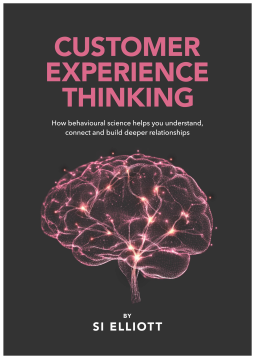
Customer Experience Thinking
This title was previously available on NetGalley and is now archived.
Send NetGalley books directly to your Kindle or Kindle app
1
To read on a Kindle or Kindle app, please add kindle@netgalley.com as an approved email address to receive files in your Amazon account. Click here for step-by-step instructions.
2
Also find your Kindle email address within your Amazon account, and enter it here.
Pub Date May 21 2026 | Archive Date May 20 2026
Talking about this book? Use #CustomerExperienceThinking #NetGalley. More hashtag tips!
Description
In a modern world where we are obsessed with clicks, impressions and conversions we are losing focus on what's important: the human experience and connection. This new book by Si Elliott will help to show how we can bring this back, and make the person the centre of the world, not technology.
We’ve never been more connected, yet authentic connection feels increasingly rare. In a digital world, modern business has mastered reach, automation and optimisation. But in the pursuit of efficiency, many brands have unintentionally diluted the very thing that builds trust and loyalty: meaningful human relationships.
In Customer Experience Thinking, Si Elliott combines over 20 years of marketing and customer experience leadership with behavioural science to reveal what really drives trust, loyalty and decision making.
Through 8 practical customer experience principles and 34 key behavioural biases, you’ll gain a clear framework for designing brand experiences that reduce friction, strengthen customer relationships and create meaningful emotional connection.
Customer Experience Thinking is the essential, practical guide to building deeper customer relationships in an increasingly digital world. It will challenge how you think about experience, encourage you to serve more meaningfully, and help you create connections that feel less transactional and more human.
A Note From the Publisher
As co-owner of creative agency Diversity and founder of customer experience consultancy Fabricx, he combines behavioural science with practical strategy to design experiences that genuinely resonate.
An award-winning guest lecturer at Nottingham Trent University, the
University of Nottingham and the Communication University of China, Si also serves on academic advisory boards, working closely with the next generation of marketers and psychologists. His work sits at the intersection of digital progress and human connection.
He is driven by a simple belief: when we truly understand how people think and focus on serving them better, we create stronger relationships, better businesses and greater outcomes for everyone.
Advance Praise
"Customer Experience Thinking is a relevant, highly practical guide for anyone working in marketing, branding or customer experience.
The author, Si Elliott, has the gift of being able to take complex behavioural science and translate it into clear, usable insight. Rather than overwhelming the reader with theory, the book focuses on application, showing how small, intentional changes can have a meaningful impact on how people experience and engage with a brand.
The emphasis on simplicity, emotional connection and understanding real human behaviour feels particularly relevant in today’s super-fast, tech-led, digital landscape, where it’s all-too-easy to prioritise metrics over meaning. The frameworks are easy to grasp and, importantly, easy to apply (great to inspire discussion in the next marketing team meeting!).
A strong addition to the growing body of work around behavioural science, sitting alongside Thinking, Fast and Slow and Nudge, but with a more practical, business-focused lens."
“Si is one of the most engaging communicators I’ve had the pleasure to work with. His ability to bring complex behavioural ideas to life through storytelling is exceptional. This book captures that same energy. It’s practical, entertaining, and human.”
Dr Kelly Yarnell, Nottingham Trent University
“A thoughtful, behaviourally smart guide to customer experience. Si doesn’t just tell you what to do, he helps you understand why it matters. A powerful read for anyone who wants to build stronger, more memorable connections and relationships.”
Josh Apiafi, Rewards4Racing and Sky Sports
Marketing Plan
Marketing and media enquiries: helenlewis@literallypr.com
Marketing and media enquiries: helenlewis@literallypr.com
Available Editions
| EDITION | Hardcover |
| ISBN | 9781918428179 |
| PRICE | £18.50 (GBP) |
| PAGES | 256 |
Links
Available on NetGalley
Available to Buy
Buy on BN.com Buy on Bookshop.orgAverage rating from 2 members
Featured Reviews
 Demetris P, Reviewer
Where the Warmth Leaked Out
Si Elliott’s “Customer Experience Thinking” and the Business Case for Making Care Procedural
By Demetris Papadimitropoulos | April 29th, 2026
A customer journey is not a queue of touchpoints. It is weather. It gathers in the room before the customer knows what to call it: the unclear form, the oddly timed email, the apology with no pulse, the app that behaves beautifully until the one moment when a human being is needed, the final bill landing like a cymbal crash at the end of an otherwise lovely meal. One polished interaction cannot save a climate of low-grade irritation. One friendly chatbot cannot redeem a service built to duck the customer while claiming to serve them. There are only so many times a brand can say “your call is important to us” before the sentence begins to sound like it has never met a call.
The most useful idea in “Customer Experience Thinking” is that the weather gathers. Si Elliott’s book is a companionable, applied guide for brands that have optimized the warmth out of themselves. Its governing wager is simple enough to carry into a team meeting and stubborn enough to keep returning: in dashboard-lit commerce, the customer has too often become a metric in transit rather than a person trying to get something done. Elliott does not reject technology. He is not waving a wooden spoon at the server farm. He knows which machines are already humming behind the counter. But he keeps asking the question many dashboards politely avoid: what does all this efficiency feel like to the one on the receiving end?
The answer, too often, is faster, smoother, and somehow less seen.
Elliott builds the book as a two-part engine: first the path a customer travels, then the mind carrying them through it. The first half offers eight customer experience principles, moving from detail, expectations, personalization, autonomy, and reduced effort into emotion, relationship, and sensory design. The second half turns to choice under pressure, grouping 34 behavioural biases into categories such as anxiety, context, memory, simplicity, social influence, and value. The scaffolding is not ornamental; it is built for margin notes, team tables, and the queasy moment when a business realizes customers keep disappearing for reasons no dashboard has named. This is not a book that wants to sit handsomely on the shelf while everyone continues sending baffling onboarding emails. It wants to be opened before a workshop, after a poor survey score, during a journey-mapping session, or at the precise moment someone says, with dangerous serenity, “I think the customer will understand.”
The ordering is part of the argument. Elliott begins with the encounter before moving into explanation. He first asks what a better journey might look and feel like, then later explains why people respond to certain cues, frictions, comparisons, memories, and social signals. That sequence keeps the book from becoming a bright little cabinet of influence instruments. Behavioural science is not presented as a cleverer way to make people click, spend, subscribe, or stay longer than they meant to. It is meant to support a larger practice of customer experience as the choreography of being understood: timing, handoff, expectation, recovery, permission, and memory.
The prose wears no lab coat: it is plain-spoken, companionable, and deliberately easy to enter. Elliott writes like a practitioner leading a generous workshop rather than a theorist guarding a locked drawer of concepts. His sentences are usually short to medium-length, built for clarity and momentum. He likes a clean claim, a familiar case, then a friendly aside. His recurring “Si-track” digressions – his name for his own tangents – give the book its house style. They charm until they loiter. A reader who wants maximum compression may occasionally wish for a brisker guide and fewer scenic routes. But the informality is part of the method. Elliott wants the reader to feel guided rather than instructed, nudged rather than pinned to a whiteboard.
His vocabulary is workshop-ready and morally tuned: trust, connection, service, relationship, meaning, humanity. These words are the book’s compass, and sometimes its wallpaper. When they are attached to an actual scene, they work. A hotel leaves a bottle of wine and a handwritten note. Wagamama explains its food-arrival rhythm before the customer can misread it as chaos. Zappos responds to a grieving customer not with policy language but with a prepaid return and flowers. Uber removes the old taxi ritual of haggling, cash machines, and payment awkwardness from the end of the ride. A supermarket rearrangement turns Elliott’s ordinary errand into a tiny expedition of male pride, missing meat, and accidental step count. When the book simply repeats that business should feel more human, the language goes gauzy. When it shows what that means in practice, it sharpens.
The first principle, “consider every detail and how they work together,” quietly governs the whole book. Elliott draws on Sir Dave Brailsford’s marginal gains philosophy and James Clear’s “Atomic Habits” to argue that a journey is not rescued by one flourish if the rest of the path is clumsy. A single delightful moment can even make surrounding incompetence more visible, like a tuxedo jacket over pajama trousers. The customer journey map becomes the working spine: stages, contact points, present-state service, emotional mapping, and future vision. Here the method earns its keep. “Be more human” is not a strategy until someone has asked what the customer sees, hears, feels, expects, fears, misunderstands, resents, and remembers at each stage.
The book’s decisive exhibit is St. Louis CITY SC. The case study arrives under the sensory principle, but it does more than illustrate sight, smell, taste, touch, and sound. It reveals the whole argument as a working habitat. The club’s app, stadium design, food vendors, accessibility provisions, sensory rooms, supporter groups, payment systems, pre-game rituals, partner onboarding, fan surveys, music, scent, and local culture all touch one another. Elliott describes a venue where people arrive early not simply because a match is scheduled, but because the surrounding encounter has been arranged as belonging. The case lifts the book because it shows customer experience as logistics with a pulse. The app is not separate from the food. The food is not separate from the smell. The smell is not separate from anticipation. The accessibility measures are not an add-on to the “real” experience; they are evidence of whether the experience means what it says.
In that stadium sequence, the book stops recommending care and starts showing care with procedures attached. Its best pages understand that customers do not encounter organizations in neat departmental columns. They encounter them as sequence, mood, microclimate, and memory. A confusing form is not just a UX problem; it is a small humiliation. A hidden delivery delay is not just a logistics problem; it is an expectation problem. A request for shoe size, phone number, or birth date without explanation is not just a personalization problem; it is a permission problem. A final bill arriving as the emotional endpoint of an otherwise good meal is not just payment; it is the last note of the song.
Elliott is especially good on effort. He treats simplicity not as aesthetic minimalism but as care. Modern customers are tired, interrupted, over-notified, tracked, prompted, sorted, and asked to make decisions before breakfast that would once have required a committee and biscuits. In that condition, every extra click, every buried term, every confusing menu, every “simple” form designed by someone who already knows the answer becomes another small tax on patience. Reducing friction is not merely a conversion tactic. It is respect. This is why the bias material works best when it returns to ordinary pressure: decision fatigue, the pain of payment, the paradox of choice, the fear of making the wrong call, the comfort of social proof, the relief of knowing what happens next.
The second half also shows the price of making a book so hospitable: some rooms are familiar before Elliott opens the door. His discussion of behavioural biases is lucid, ready for the team table, and often helpful, but much of the terrain has already been well thumbed. Readers who have spent time with “Thinking, Fast and Slow” by Daniel Kahneman, “Nudge” by Richard H. Thaler and Cass R. Sunstein, “Predictably Irrational” by Dan Ariely, “Alchemy” by Rory Sutherland, or “The Choice Factory” by Richard Shotton will recognize many of the ideas: loss aversion, anchoring, the peak-end rule, social proof, scarcity, the IKEA effect, the power of free. Elliott’s originality is not discovery. It is a useful act of fastening familiar bias material to the practical work of journey design.
That fastening has value. The ideal reader is not hunting for new theory; they are staring at a complaint report and wondering where the warmth leaked out. Elliott is writing for the marketer, founder, customer experience lead, brand strategist, agency team, business owner, or student trying to understand why customers hesitate, abandon, complain, forgive, return, recommend, or vanish without ceremony. For that reader, Elliott’s categories are usable. The repeated pattern of definition, explanation, research note, brand case, and practical prompt makes the book easy to revisit. It is less a river than a set of clearly marked canals. You can navigate it; you may not always feel swept along.
Read straight through, the second half can feel more indexed than argued. One bias follows another, each competently explained, each attached to a recognizable case, each ending with a question the reader can take back to work. The clarity is real. So is the slight flattening. The first half expands the meaning of customer experience. The second half supplies useful instruments, but the instruments sometimes remain in their foam-lined slots.
The moral hinge is more interesting than the companionable surface first suggests. Elliott repeatedly insists that behavioural science should be used to serve customers, not trick them. He warns against manipulation, creepy personalization, data appetite, false urgency, and attention-based design that creates dependency or anxiety. These reminders matter. Without them, the book could become a cheerful manual for better-mannered coercion. But the ethical treatment is often guardrails rather than excavation. Elliott’s answer is usually intention, transparency, customer benefit, and long-term trust. Those are sound principles. They are also easier to declare than to protect inside commercial machinery built to optimize growth, retention, upsell, data capture, and spend.
That tension does not damage the book; it pressurizes it. “Customer Experience Thinking” is really about preserving human agency inside systems built to anticipate, steer, and monetize behavior. Its stated topic is CX. Its deeper subject is whether brands can become more intelligent about people without becoming more efficiently invasive. When does guidance become handling? When does personalization become surveillance with better manners? When does frictionless design remove stress, and when does it remove the pause in which a customer might reconsider? Elliott does not answer every hard version of those questions, but he is right to place them near the center of the work.
The outside world does not need to be dragged in; it is already standing at the service desk. AI service layers, first-party data strategies, chatbot triage, loyalty ecosystems, and scrutiny of manipulative design have made customer experience sound less like a soft business phrase and more like a test of regard: what does a company believe people are for? Elliott’s book is reactive to that world, but more importantly diagnostic. It names what has gone wrong when brands become faster but less considerate, more personalized but less trustworthy, more connected but less capable of recognition. It does not predict the next era of customer experience so much as point to the unease already sitting in the waiting area.
Elliott’s temperament remains optimistic, at times almost insistently sunny. He worries about digital life, AI, screen time, and the possibility that technology becomes master rather than tool, but he is not writing a lament. He is repair-minded. He believes small design choices can reduce stress and build confidence. He believes companies can ask for data honestly, personalize respectfully, guide without trapping, and use behavioural insight to make people feel capable rather than managed. Skeptical readers may find this faith too bright by half. More generous readers may find it refreshing precisely because it refuses fashionable despair.
By the end, the opening sentence has acquired weight: we are more connected, yet often lonelier. “Connection” no longer means mere access, reach, or contact. It means a designed condition in which people feel understood, respected, and free to move through an encounter without unnecessary confusion or pressure. Elliott closes by asking what if one’s greatest impact is not what one builds, but how one makes people feel along the way. It is a large question, yes, but not a decorative one. The whole book has been moving toward the claim that experience is not only what happens. It is what remains.
There are books with finer instruments on behavioural science, books with stranger electricity on marketing, and books with more rigorous methods for service design. “Customer Experience Thinking” does not try to elbow them off the shelf. It earns its place beside them as a workbench companion: less dazzling, more immediately ready to help. Compared with “Alchemy” by Rory Sutherland, it is less mischievous and less aphoristic; compared with “The Choice Factory” by Richard Shotton, less compact and more relationship-focused; compared with “The Experience Economy” by B. Joseph Pine II and James H. Gilmore, less sweeping but more usable for teams. It is ready to be taken back to the team. A reader can finish it and know where to begin.
My final rating is 82/100, which maps to 4/5 stars: a strong, warm, and well-organized guide whose practical clarity and person-scaled systems view outweigh its familiar examples, occasional repetition, and lighter ethical probing.
For Elliott, a good experience is not a trumpet blast. It is closer to a room whose light has been thought about, a note left where it will be found, a payment moment made less painful, a stadium filling with the smell of food before the first whistle. Customers rarely remember the org chart, the conversion funnel, or the cleverness of the targeting model. They remember whether the promise was kept, whether the ending was graceful, whether the details seemed to have met one another before they met the customer. The best experiences do not announce that they are human. They simply receive us as if someone had remembered we were coming.