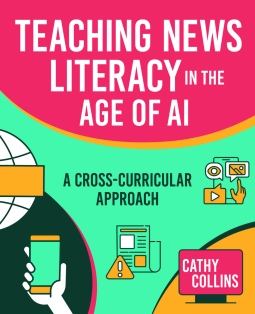
Teaching News Literacy in the Age of AI
A Cross-Curricular Guide for Educators
This title was previously available on NetGalley and is now archived.
Send NetGalley books directly to your Kindle or Kindle app
1
To read on a Kindle or Kindle app, please add kindle@netgalley.com as an approved email address to receive files in your Amazon account. Click here for step-by-step instructions.
2
Also find your Kindle email address within your Amazon account, and enter it here.
Pub Date Jan 16 2026 | Archive Date Jul 23 2026
Independent Book Publishers Association (IBPA), Members' Titles | International Society for Technology in Education (ISTE)
Talking about this book? Use #TeachingNewsLiteracyintheAgeofAI #NetGalley. More hashtag tips!
Description
In a world where information moves faster than ever—and where AI can generate news, images, and even entire narratives—students need more than just access to information. They need the skills to question it, verify it, and understand how it’s produced.
Teaching News Literacy in the Age of AI offers educators a practical, classroom-ready approach to helping students navigate today’s complex information landscape.
This book brings together journalism practices, media literacy, and AI awareness in ways that are immediately usable across subject areas. Through real-world examples and adaptable strategies, educators will find ways to help students:
*Ask stronger questions about the information they encounter*Verify images, videos, and claims using accessible tools*Recognize misinformation, bias, and AI-generated content*Understand how algorithms shape what they see and believe*Engage in informed, evidence-based discussionsDesigned with both teachers and school librarians in mind, this cross-curricular guide includes lesson ideas, discussion prompts, and flexible activities that can be used in English, social studies, STEM, and beyond.
Whether you are introducing foundational media literacy concepts or helping students make sense of an AI-influenced news environment, this book provides practical entry points and strategies you can use right away.
A Note From the Publisher
Ebook: 9798888370391
Advance Praise
"The emergence of generative AI marks a massive disruption to an already frenetic and confusing information environment. Cathy Collins provides a clear-eyed assessment of the technology's impact across key areas of news literacy instruction, including the practice of journalism, the attention economy and the production of low-quality "slop" and viral misinformation. This is an insightful and important book for any educator interested in sharpening their understanding of media literacy education." –Peter Adams, Senior Vice President of Research and Design at the News Literacy Project
"Democracy depends on a generation that knows how to question what they see and hear. Critical thinking is one of the most important skills of the twenty-first century, and Cathy Collins has given us a roadmap for how to think about information in the age of algorithms. This book equips students, teachers and parents with the critical tools they'll need to uphold truth in an AI-driven world." –Safiya U. Noble, Ph.D.; Author, Algorithms of Oppression; Professor, UCLA
"Educators are on the front lines of the misinformation crisis. Teaching News Literacy in the Age of AI provides them with practical, classroom-ready strategies to help students think critically, verify responsibly, and engage with confidence. Dr. Cathy Collins, with her background as a library media specialist and teacher, is well equipped to take on this vital subject; the result is both excellent and important." –Margaret Sullivan, Columnist at the Guardian (US edition) and author of Ghosting the News: Local Journalism and the Crisis of American Democracy
"Teaching News Literacy in the Age of AI stands apart: Media literacy isn't about telling students what to believe but showing them how to think. Grounded in classroom realities yet attuned to AI's ethical challenges, this book helps educators cultivate discernment, curiosity, and courage in a noisy information age. Cross-curricular lessons, lateral-reading routines, and bias-aware AI activities are classroom-ready. Checklists and case studies make verification feel doable and even fun. If you want students who are curious, ethical, independent thinkers, you'll actually use this book in the classroom. A refreshing, deeply principled contribution to the work of teaching critical thinking with integrity." –Vanessa E. Greenwood, Ph.D.; Professor, College of Communication & Media, Montclair State University
"In a media ecosystem dominated by algorithms and AI-generated content, Cathy Collins reminds us that the most powerful tools we can equip students with are discernment, curiosity, and conscience. Teaching News Literacy in the Age of AI is both a rallying cry and a roadmap for educators committed to cultivating critical thinkers and informed citizens." - Ed Madison, Ph.D.; Associate Professor, University of Oregon; Executive Director, Journalistic Learning Initiative
Available Editions
| EDITION | Paperback |
| ISBN | 9798888370414 |
| PRICE | $34.99 (USD) |
| PAGES | 140 |
Available on NetGalley
Available to Buy
Buy on Amazon Buy on BN.com Buy on Bookshop.orgAverage rating from 17 members
Featured Reviews
 Reviewer 1374288
Teaching News Literacy in the Age of AI by Cathy Collins is a practical guide for helping young people make sense of the current information landscape. I picked this up because I am preparing to home educate my son and wanted a strong resource around which to teach news literacy, which I think is extremely important in this era of fake news and AI-generated content.
The book is clearly structured and easy to use. It moves from the foundations of what news literacy is and why it matters, to misinformation, bias, conspiratorial thinking, AI-generated content, and the role of journalism itself. The key focus is not on telling students what to think, but rather on teaching them how to question and evaluate information for themselves. The book contains lesson ideas, guiding questions, reflection prompts and practical activities that would make it a very useful classroom ressource. I liked that each topic includes suggestions for teaching both primary and secondary students as well as lots of links to exercises online (including hoax websites).
A recommended read for educators and parents looking for practical ways to teach media literacy and responsible engagement with news in the age of AI.
Thank you to NetGalley and the International Society for Technology in Education (ISTE) for providing me with a digital copy of this book in exchange for an honest review.
 Michaela P, Reviewer
A wonderful book for teaching news literacy. It picks you up from the beginning and explains important terms and the context of media literacy. It's easy to understand and written in a very engaging and encouraging way. Additionally there are tons of resources listed as well as project ideas and lesson plans.
I'm still shocked by the 82% of middle learners who can't differentiate sponsored content from news articles but it emphasizes how important this book and the teaching of media literacy are.
Reviewer 2056150
Interesting book, explains clearly the definition of modern terms in the digital world and why they matter. Covers the role journalism and the issues with Ai-generated content and misinformation.
The book is a helpful tool for educators and its aim is to teach children and young people news/media literacy in a world of AI. Lots of helpful lesson ideas and activities too. I enjoyed reading this and would recommend to anyone who wants to help children navigate the age of AI, I also found it helpful as an adult.
Librarian 2053724
Teaching News Literacy in the Age of AI: A Cross-Curricular Approach by Cathy Collins is a practical, engaging resource for K–12 educators. The activities are flexible and easily adaptable across age groups. I found myself considering how many could translate directly into my own instruction.
As an academic librarian working with college students, I see firsthand how critical early exposure to news and media literacy can be. Many students arrive navigating a complex information landscape without a strong foundation in how news is produced, framed, and evaluated. This reflects the complexity of today’s information environment and the pace at which it continues to evolve.
One of the strengths of this book is its emphasis on developing students as lifelong learners. Collins encourages educators to start with how students already engage with news, especially through social media, and build from those habits rather than dismiss them. I especially appreciated the discussion of citizen journalism and the responsibilities that come with reporting and sharing information. Framing students not just as consumers, but as participants in the information ecosystem, is an empowering approach that resonates strongly with today’s learners.
I also found the chapter on emerging careers in journalism, media, and AI particularly valuable. Students are already thinking about their futures, often through aspirational or economic lenses, and that can create pressure to perform or make premature decisions early on. Including this topic in a book for this audience serves as an important reminder that we need to be having these conversations with students earlier and more intentionally. It reinforces the idea that there is no single path to a successful career and that students benefit from seeing a range of possibilities. That kind of framing supports flexibility and resilience, which are essential as students navigate an uncertain and evolving future.
My main critique is the use of URLs to point to specific online resources, as these may become outdated over time. Even so, the underlying concepts and activities remain strong.
Overall, this is a valuable resource for educators looking to build news literacy in a way that is relevant, adaptable, and empowering. I would recommend this to the pre-service teachers I work with as a resource for developing curriculum that aligns with standards for digital and media literacy.
 Lauren B, Reviewer
A really really fantastic book that I think should be taught to kids and adults of all ages. I learned so much from this book, and i think it was structure so well to be able to provide informative, thoughtful information that teaches you how to think about news and literacy rather than just prescribing you things to memorize to look out for.
 Rachel C, Educator
Thank you NetGalley for providing this copy to me.
This was informative and helpful for a classroom teacher dealing with the influx of AI with both planning and student use.
 Linda S, Librarian
TEACHING NEWS LITERACY IN THE AGE OF AI by Cathy Collins, an award-winning library media specialist, is an excellent resource. I wish that more schools made this topic (helping students to "recognize quality journalism, spot deepfakes, challenge misinformation, and critically analyze conspiracy theories") a priority, but Collins has done a great job of compiling suggestions of resources (including multimedia tools and learning standards) related to these issues. A few examples (not all of which are free) include: Checkology (including several of their helpful posters); The News Literacy Project; ISTE (she extensively references their standards); PBS Learning Media; and Newsela. Some of her information is revealing, but from a decade ago and warrants updating, as do her references to Stanford History Education Group, now called Digital Inquiry Group. However, the more I read, the more excited and interested I became. It does take a while to get to the section on "Learning Activities," but that is filled with ideas related to Social Studies, Science, Health, Mathematics and more. Also, this text could work well in a secondary newspaper class – an entire lesson could review the Code of Ethics for the Society of Professional Journalists or the eight factors (e.g., timeliness, proximity, interest, conflict) which Collins lists that "news organizations might use to evaluate whether to cover a particular event." There are multiple Appendices, including a News Literacy Glossary. As Collins writes, "The future of informed citizenship is less about passively consuming information and much more about actively interrogating it. ... Teaching them to question what they see, seek diverse viewpoints, and practice self-regulated attention is more important than ever."
A few Relevant Links:
https://checkology.org/
https://newslit.org/
https://iste.org/standards
https://www.inquirygroup.org/
https://newsela.com/
https://klru.pbslearningmedia.org/
https://www.spj.org/spj-code-of-ethics/
Sarah H, Reviewer
As educators in the time of AI becoming increasingly more prevalent, it is important to consider strategies to assist our students to think critically, verify sources, and engage with news media. The book includes not only suggested resources but activities that are grouped by academic level and aligned with ISTE standards as well as cross-curricula suggestions. I was particularly interested in possible applications for my High School English course and Newspaper Club. News literacy is a must have skill to navigate media outlets. This book is a good resource for any teacher.
Thanks @Netgalley and @Independent Book Publishers Association for the Advanced Digital Copy.
 Lauren H, Reviewer
Thank you to NetGalley for the ARC in exchange for an honest review. This book tackles the difficult reality teachers face in an AI-saturated world.
This book presents an excellent approach to teaching literacy and critical thinking in the age of artificial intelligence. Media literacy is not just about spotting obvious mistakes in AI-generated images. It is about understanding the purpose of an article, evaluating sources, and thinking critically about the message being presented. These skills will become increasingly important moving forward.
No matter a teacher’s stance on artificial intelligence, they will have to teach about it, work around it, and interact with it in some capacity. This is a must-read for educators.
 Jessica G, Educator
This wasn't quite for my demographic, but I did think my college students could benefit from some of what was presented here. I think that teaching some of this younger can help as we navigate murky waters. I have recommended the book to a few colleagues.
Librarian 2078075
News literacy is vital for understanding current events and the world around you. In a world where AI is rapidly influencing and effecting the reality and how everyone interacts with people, technology, and products, understanding what is real and what is not verifiable and artificially made is becoming increasingly difficult for people not consistently researching AI and technology. With AI touching so many facets of everyday life- drive thru ordering, social media, search engine responses, face recognition and tracking, books and articles fully written by AI- news literacy is imperative for people understanding reality. I normally only see AI training and education presented as "how to use AI" not "how to identify AI". This book does a great job at breaking down the different ways AI has been integrated into everyday life and information seeking. It also breaks down terminology in a clear and concise way. I think this book will quickly become an essential tool for educators, librarians, and even parents in moving forward on how to find accurate, verifiable, information and news.
Reviewer 294918
A vital resource for educators navigating the challenges of misinformation and AI-driven media. Cathy defines news literacy as the ability to evaluate the trustworthiness of news and journalistic content, distinguishing it from media and digital literacy. She emphasises teaching students how to think, not what to think, fostering critical analysis and healthy scepticism.
The book explores AI’s role in shaping news consumption, from algorithm-driven feeds to AI-generated content. Cathy provides practical lesson plans, such as analysing news habits and evaluating sources, making the content actionable for classrooms. She highlights the importance of librarians and media specialists in guiding students through the complexities of modern media.
A key theme is the connection between news literacy and civic engagement. Cathy argues that informed news consumers are more likely to participate in democracy, and she includes activities to help students explore press freedom globally. She also addresses the mental health impact of constant news consumption, encouraging mindful media habits. Cathy’s balanced approach—acknowledging AI’s challenges while recognising its potential—makes this book a standout.
While a deeper discussion on confirmation bias would have been welcome, Teaching News Literacy in the Age of AI is an essential guide for anyone committed to fostering critical thinking in the digital age. It’s a call to action for educators to empower students as discerning, engaged citizens.
Readers who liked this book also liked:


We Are Bookish
General Fiction (Adult), New Adult, Romance

We Are Bookish
LGBTQIAP+, Romance, Sci Fi & Fantasy

Mark Bittman
Cooking, Food & Wine, Health, Mind & Body, Nonfiction (Adult)

Susanna Reppert-Brill; Tina Sams
Health, Mind & Body, Home & Garden