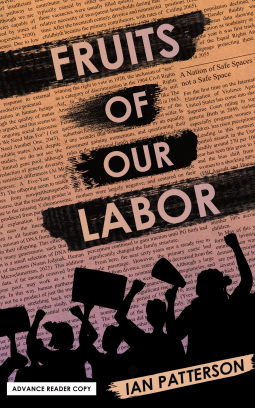
Fruits of our Labor
Sign In or Register Now to see if this title is available for request.
Buy on BN.com Buy on Bookshop.orgSend NetGalley books directly to your Kindle or Kindle app
1
To read on a Kindle or Kindle app, please add kindle@netgalley.com as an approved email address to receive files in your Amazon account. Click here for step-by-step instructions.
2
Also find your Kindle email address within your Amazon account, and enter it here.
Pub Date Aug 25 2026 | Archive Date Oct 31 2026
Description
**A new world is emerging, one parthenogenetic birth at a time.**
In a near-future America where women have just gained access to asexual reproduction, Samara yearns for freedom from her dying relationship, and a child of her own—*fully* her own.
As parthenogenetic birth takes hold and the role of men in the survival of the species diminishes, protest and outcry sweep across the nation. Sierra, one of the first “partho babies”, is bullied relentlessly as she grows up and seeks her place in this new pressure cooker of changing gender roles and norms.
And in the aftermath of the “Days of Horror”, a period of violent backlash from displaced men, a professor of history looks back on the rise of PG birth in an attempt to understand the impact of this era of upheaval on the world.
Together, these three converging perspectives tell the story of a profound societal transformation that asks who gets to have autonomy, who gets to write the future, and who that future is for.
Available Editions
| EDITION | Paperback |
| ISBN | 9781970458091 |
| PRICE | $18.99 (USD) |
| PAGES | 178 |
Available on NetGalley
Available to Buy
Buy on BN.com Buy on Bookshop.orgAverage rating from 26 members
Featured Reviews
 TheNovel N, Reviewer
This is speculative fiction doing exactly what the genre does best—taking one radical shift in reality and following it, unflinchingly, to its social, political, and deeply personal consequences.
What makes this novel so compelling is that its premise is provocative, yes—but it’s the questions underneath that give it weight. What happens when reproduction is no longer tied to men? What happens to power when biology no longer reinforces long-standing structures? Who resists change, who embraces it, and who gets caught in the violent middle of transformation?
The novel understands that no societal upheaval arrives cleanly. Progress and backlash move together. Liberation and fear become tangled. New freedoms create new tensions. That complexity gives the book real bite—it refuses easy binaries or simplistic answers.
And that’s where it feels most sharp: in its examination of autonomy.
Not autonomy as slogan, but autonomy as lived reality—messy, contested, exhilarating, and dangerous. The story interrogates what people do when long-held assumptions about gender, family, inheritance, and social order are suddenly destabilized. It explores both the possibility of reinvention and the ugliness that often erupts when power feels threatened.
The multi-perspective structure adds richness, allowing the story to feel both intimate and sweeping. You get the personal yearning, the generational consequences, and the broader historical reckoning all at once. It gives the novel the feeling of reading not just a story, but the anatomy of a cultural shift.
What lingers most is how plausible much of it feels—not in its scientific leap alone, but in its portrayal of reaction, fear, ideology, and the struggle over who gets to define the future.
Bold, unsettling, and intellectually alive, this is a thought-provoking exploration of gender, power, and self-determination that doesn’t merely imagine a different world—it asks what humanity might become when the old one is forced to change.
 Vera Kelly A, Reviewer
If you'd like to read this review with the spoilers censored, make sure to view it on Goodreads (@thereadingfrogg) or Storygraph (@the_reading_frog).
Thank you to Ian Patterson, Shiraki Press & NetGalley for this free ARC in exchange for my honest review
Rating: 3.75/5 ⭐
A list of uncensored CWs is included at the end of this review.
⋆⁺₊⋆ ━━━━⊱༒︎ • ༒︎⊰━━━━ ⋆⁺₊⋆
“Maybe it’s evolution, maybe it’s divine influence, but at the end of the day, does it matter? I’ll let you in on a secret: I don’t think I’m special at all. I’m just the first woman to figure out she didn’t need a man to have a baby. I bet you we’re all capable of it, of self-birth. And if every woman out there focused on it like I did, I think we’d find our true power. And it would change everything.”
⋆⁺₊⋆ ━━━━⊱༒︎ • ༒︎⊰━━━━ ⋆⁺₊⋆
'The fruits of our Labor' is a speculative exploration of sexism, power structures and bodily autonomy.
When women gain the ability to reproduce asexually, through a process called parthenogenesis, it kickstarts a rapid change in power structures and societal norms.
While women carefully start to celebrate their new independence, men begin to feel lost in a world that no longer seems to have any need for them.
When parthenogenic birth support grows louder and louder, resistance appears to grow quieter.
But never forget, even the loudest of acts can be born from the quietest of whispers.
⋆⁺₊⋆ ━━━━⊱༒︎ • ༒︎⊰━━━━ ⋆⁺₊⋆
Representation
╰┈➤ Queer Characters
✴︎ Multiple confirmed queer, implied Bi/Pan female main and side characters
✴︎ One main character is questioning her sexuality
╰┈➤ Queer Dynamics
✴︎ Multiple WLW dynamics between main characters and side characters, including one older couple
✴︎ Mention of poly family structures
╰┈➤ BIPOC Characters
✴︎ Unspecified BIPOC main and side characters
✴︎ Latinx/Mexican main and side characters
✴︎ Latinx/Hispanic side character
Themes
Activism, (bodily) autonomy, conservatism vs progressivism, control, deconstruction, dependence, emotional labour, extremism, feminism, gender roles/expectations, indoctrination, "it takes a village", misandry, misogyny, parthenogenetic births, patriarchy, polarisation, politics, radicalisation, reactionary (political) movement, religion, toxic masculinity.
Tropes/What to expect
❥ Dystopian or utopian, depending on the POV
❥ Nuanced exploration of contrasting political ideologies
❥ Unconventional format
❥ Multiple timelines
❥ "Good for her"/ "I support women's rights and wrongs"
❥ Speculative fiction as a medium to explore contemporary themes
⋆⁺₊⋆ ━━━━⊱༒︎ • ༒︎⊰━━━━ ⋆⁺₊⋆
What I liked/loved
✧ What I really enjoyed was how the ability to asexually reproduce isn't based on some type of magic system but on a real-life biological phenomenon. For those who don't know, "Parthenogenesis is a form of asexual reproduction where an embryo develops directly from an unfertilized egg cell without male fertilisation." It's quite common in nature, but hasn't been found in mammals.
Parthenogenesis, being a natural occurrence, made it really easy for me to treat this story like something close to our reality. If this book were a high-fantasy story, I probably wouldn't have connected to it so easily.
Of course, there is some part of it that is more mystical. Reproducing asexually in this universe is something some believe is achieved through meditation, manifestation and is described as a deliberate choice. Focusing on that intentional aspect is a great way to explore bodily autonomy. Highlighting agency and autonomy in reproductive processes.
✧ For only being 159 pages long, this novella really dives into some deep social and political discourse/commentary. It's short, but it packs a punch. Some of the themes explored are as follows:
✵ How fear breeds violence, especially when a once secure position is threatened
✵ Polarisation and reactionary (political) movements. How, when one end of the spectrum gets louder, so will its counterpart.
✵ Radicalisation and how the face of extremism isn't just a pixelated picture of a perpetrator shown during a news segment on a TV screen. It can be your regular neighbour, a family member, a classmate or colleague, or even your partner. It isn't something that only exists far away as a concept or something mystical.
✵ The danger of generalisation and specifically the vilification of a whole group.
✵ (Justified) anger and how it can escalate in ways where one could ask if its justifications even matter when they lead to such horrifying tragedies.
✵ The horseshoe theory, how extremism on both ends of the political spectrum tend to be more similar to each other than one might expect
✵ Religion and its influence on social norms and politics
✧ The format is quite unconventional; multiple timelines, sometimes being unsure whose POV you're reading from, the inclusion of data, research and articles, but there is a thought-through reason for it that gets revealed at some point. Which made me appreciate its format a little more.
✧ Some of the different timelines we follow:
✵ The period shortly before, during and after the legislation of pathogenic births.
✵ A period of violent resistance against pathogenic births and female (political/social) dominance, referred to as 'The Days of Horror'.
✵ A time where the world adjusts to the first pathogenic children/teenagers taking part in society.
✵ An age where the first generation of pathogenic babies have become full-grown adults, some having children of their own.
✧ Some of the research and (news) articles included, I believe, are made up, while others refer to real-life essays and theories.
I was surprised to see some familiar names and titles I've encountered during my critical studies major, which was quite fun.
✧ There is a certain character I didn't think much of, but their unexpected character arc became significant to the themes explored and was really a happy surprise to me as a reader. A certain scene where this character interacts with one of the main characters was really intriguing to me.
✧ It's very female, queer-centred and even turns queer normative at some point.
✧ This book would be great for a book club or critical theory enthusiasts. There's lots to discuss here!
What I didn't like/felt lacklustre about
Disclaimer: I believe most of these points won't bother the regular reader. Feel free to skip!
✦ For a book so centred on gender, I had expected a less binary depiction of it.
I get why it was done. It creates two camps, opposites, a very clear "them" and "us". But I kept wondering about trans people, intersex people, non-binary people, gender non-conforming people, gender-queer people, two-spirit people, etc., especially because queer people in general tend to have a big presence in political/activist movements and spaces. Some of these groups also simply cannot be categorised as male or female.
Aside from a rise in the percentage of people who identify as non-binary and/or transgender noted in one of the research chapters, they didn't really have a presence in this book.
Now, a quick disclaimer, I read a lot on gender and queerness. So, once again, that certain representation that I missed might be a non-issue to another reader.
✦ Though I appreciated the format once I finished reading, I had a bit of a hard time with it at the start. Regardless of my immediate interest in the concept and worldbuilding, I didn't really get immersed on a narrative level or feel personally connected to the characters until later.
Mainly because the POV switches and articles/research gave me the same feeling that anthologies and collections do, at least at the start. A certain distance or disconnection between the segments.
After a certain point, the connection between these different segments became clearer, which made my reading experience way more enjoyable. This might have been the result of reading this book after a streak of anthologies and needing a break from them, but do know that this doesn't read like a regular, straightforward narrative, if that impacts your choice of books.
✦ I can't clearly pinpoint why, but the way violent misandry and violent misogyny were depicted and resolved made me feel a bit weird about it.
Maybe because misandry and misogyny seemed weighed against each other as equals. Which I get, because yes, all gender-based violence is wrong. But the fact that misandry in this universe, regardless of its horrifying nature, reigned for a period, while misogyny had reigned for centuries, with tons of history associated with it, made me think twice about this framing.
The idea that women might become as violent toward men as men have been toward women also made me pause a little. Which the writer might be totally right about! Maybe women would be just as violent. Maybe I'm just a bit too soft to immerse myself in this possibility.
I can’t fully explain what exactly about it bothered me, but I wanted to mention it regardless.
I will say, the author's note at the start was a very respectful, tasteful explanation of his identity while taking ownership of what this means for writing a story not based on his own lived experience. I can only applaud and commend someone for such acknowledgements and being self-aware.
Conclusion/Notes
Regardless of my 'dislikes' of this read, I actually think this is a great book! The fact that I have mixed feelings about it kind of seems like the exact point of it all.
I feel like this book was written for discussion. To have debates about in book clubs. To make you question your own views, even if an uncomfortable confrontation. To linger. To hold up a mirror. To feel disturbed, delighted or a weird mix of the two. To maybe dislike what's happening during the events of this book while simultaneously acknowledging that these events aren't outside of our world's possibilities. That some of them even closely mirror our current reality.
I believe Patterson created something really special here.
'The fruits of our Labor' is like a thought experiment turned fiction. It explores themes, thoughts, and ideas one would find in critical studies, feminist works and gender theory, but accessible to readers who might not be familiar with such works. (Or readers who don't want to read a sentence five times before comprehending its meaning. I love theory, but damn, can it be hard to process sometimes.)
This was a very unique, experimental and fascinating read. Thematically right up my alley. Dystopian and utopian at the same time, with a great exploration of polarisation, radicalisation and politics in general. I would love to discuss with anyone who has read or plans to read this book, since there are probably way more aspects that I have missed or perspectives different from mine that would provide some interesting conversations.
'The fruits of our Labor' is set to be released on the 25th of August 2026, and is available to pre-order. Make sure to add it to your TBR!
⋆⁺₊⋆ ━━━━⊱༒︎ • ༒︎⊰━━━━ ⋆⁺₊⋆
These fruits of our labor are fragile flowers. We cannot let this first frost kill them in the opening days of spring. We cannot pollute the soil with hate. We must tend and nurture them to create a more just future.
⋆⁺₊⋆ ━━━━⊱༒︎ • ༒︎⊰━━━━ ⋆⁺₊⋆
Content warnings
Explicit | Death, (gun) violence, murder, sexism
Moderate | Blood, domestic abuse, femicide, injury description, misandry, misogyny, (past) child abuse
Mild | Cheating, intimate partner violence, mention of alcoholism, mention of dubious consent, mention of femicide, mention of police brutality, mention of rape, mention of violence against women. mention of murder of babies and pregnant women, non-descriptive sex scene
 Ganesh A, Reviewer
“There was no rational basis for this, no evidence that wasn’t fabricated, but it fit a narrative. It allowed a segment of the population to argue irrationally for a world that was slipping through their fingers. If we examine the root of that, or who benefits from it, it’s the people that were currently in power.”
Thank you to the author and Netgalley for the ARC.
I am not quite sure how to review this book because of its unique structure. I will say though that this book again cements why we need speculative fiction authors. From challenging the status quo, to imagining how different our society can be, to provoking critical discussions about social issues and helping people understand and process complex social fears- this book does it all wonderfully. We need someone to dream the future we want to work and create after all. I was immediately reminded of Arthur C. Clarke’s quote after I finished the book:
“The only thing we can be sure of about the future is that it will be absolutely fantastic. So, if what I say now seems to you to be very reasonable then I’ll have failed completely. Only if what I tell you appears absolutely unbelievable have we any chance of visualizing the future as it really will happen.”
Coming to the book, it is a story about how our world will be after women start having parthenogenetic births (natural type of asexual reproduction where an embryo grows from an unfertilized egg without any male sperm.) How the world deals with this new normal is explored across three different future timelines including one being the perspective of a parthenogenetic baby. This is a great choice because it lets the reader imagine not just how tomorrow will be but how the day after tomorrow will be. In the highest of complimentary way, it is a very Ursula K. Le Guin kind of book. It is a very positive, hopeful kind of book too. I cannot say much about the other elements of this book as it is an experiment that is designed to make the reader think. I will say that it is written in a very accessible and concise style.
Some minor quibbles for me include- the book being very short to convey the really ambitious futuristic story it wants to and the book presenting a lot of research articles, historical aspects, and news facts in the narrative. There is a reason for this though as two of the main characters are a museum curator, and a history professor but after a while it wasn’t something I could connect to and dragged my enjoyment down a little.
These are my subjective opinions though and another reader’s mileage might vary. With ‘Fruits of our labor’, it feels like Ian Patterson had wanted to create something that will challenge the minds of his readers and had something he wanted to say about the world. He’s done both.
Readers who liked this book also liked:




We Are Bookish
General Fiction (Adult), Literary Fiction, Women's Fiction