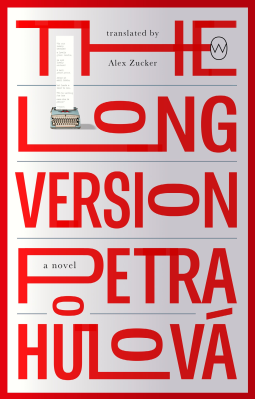
The Long Version
This title was previously available on NetGalley and is now archived.
Send NetGalley books directly to your Kindle or Kindle app
1
To read on a Kindle or Kindle app, please add kindle@netgalley.com as an approved email address to receive files in your Amazon account. Click here for step-by-step instructions.
2
Also find your Kindle email address within your Amazon account, and enter it here.
Pub Date Sep 8 2026 | Archive Date Aug 11 2026
Talking about this book? Use #TheLongVersion #NetGalley. More hashtag tips!
Description
In her early fifties, Czech author Sylvie Novak looks back on her successful career. As she embarks on a tour to promote her book of feminist essays—which she’s not convinced has captured the nature of gender inequality—her teenage daughter Judita finds her journals from her youth, discovering the intimate relationship she had with a much older writer. Judita is convinced the experience scarred her for life, whereas Novak considers her daughter’s views to be ignorant and absolutist, however critical she is towards the deep-seated machismo of Eastern European dissident cultures. Meanwhile, the man she loves has found a new, younger object of desire, leaving Novak to reflect on the decline of her sex appeal.
In The Long Version, we become spectators of Novak’s tightrope walk, balancing between the old generation and the new, love and desire, and above all the myriad interpretations of the past. Like Hůlová, Novak seeks not to lay blame or win sympathy, but to explore the shifting meanings of feminism at a time of polarized thinking and, perhaps, discover a path towards reconciliation.
Advance Praise
Praise for The Long Version
“Petra Hůlová has written a book of disillusionment and reconciliation with passionate feminism, with a particular focus on the body’s physiology.” —PETR FISCHER, literary critic and columnist
“A striking piece of self-criticism that packs a punch. A harsh, bruising and fierce confession of the heroine—an ageing intellectual, mother of two children and lover of many men—uttered in one breath. And so it reads.” —ALENA MACHONINOVÁ, Russian studies scholar
“Petra Hůlová’s novel gives us the opportunity to experience the changing of two generations, during which the younger group goes into a blind frenzy and sets off on a crusade to condemn the older generation.” —S. D. CH., playwright
Praise for The Movement
“One part Animal Farm, one part The Handmaid’s Tale, one part A Clockwork Orange, and (maybe) one part Frankenstein, Czech writer Hůlová’s novel dismantles the patriarchy and replaces it with a terrifying alternative.” —Kirkus Reviews
“A thought-provoking and disturbing dystopian tale of a feminist revolution.” —Publishers Weekly
Marketing Plan
- Advance galleys and digital reader copies
- Digital assets including trailer & author video
- Signed book plates available
- National TV, radio, print, and online review campaign
- Consumer-facing national advertising campaign on Shelf Awareness, Lithub, NPR, Foreword Reviews, Goodreads
- Virtual or in-person author events
- Book club discussion guide
- Bookstore co-op available
- Excerpt placement
- Social media campaign & Goodreads Giveaway
- Multi-city US tour with support from the Czech government, confirmed stops NYC, Boston, Toronto, Washington
Available Editions
| EDITION | Other Format |
| ISBN | 9781642861693 |
| PRICE | $19.99 (USD) |
| PAGES | 218 |
Available on NetGalley
Available to Buy
Buy on BN.com Buy on Bookshop.orgAverage rating from 17 members
Featured Reviews
 Gauri R, Reviewer
This book is difficult for me to review, because I don't think I understood it. Maybe it was the translation or maybe it's how it is in Czech, but so many sentences just didn't make any sense to me.
However there were elements of it I liked:
1) The exploration of two generations with our protagonist and her daughter
2) The repeat of Jan and our protag through David and Edita
3) The second half was much better than the first and the whole idea of finally bridging the generational gap for women
Dislikes:
1) The protagonist is not very reliable (she might say I'm behaving like Judita by accusing her of unreliability) and so anything and everything she says has to be taken with ample amounts of salt
2) The writing was slightly confusing because of the way it ran on.
 Reviewer 1694782
This novel follows a female author right after a recent book release. She’s ageing past 50 and her relationship with her works and as a public figure are changing. One day her two teenage children find her journals and snoop through them, finding out the questionable circumstances of how her career started. Her daughter is not letting it go, to great anger of the protagonist. It’s a painful confrontation that makes it clear that, (deliberately or not), if her daughter ever has to deal with something like that in her own life, she’ll have to deal with it on her own.
This was a fascinating character study. I love reading unlikable main characters, but this really pushed the limits and almost made me reconsider. Probably because she’s so realistic, an everyday variety of frustrating person that completely got under my skin. In her thoughts she compares everyone, belittles others, is very negative about her children and freely admits how much she lies. She genuinely never misses an opportunity to snark on anyone and is so judgemental. This open view into her mind is difficult to bear.
The protagonist’s hypocrisy is also through the roof. She writes about female solidarity, but looks down on every woman and caters to the men in her life. She promotes motherhood, but is never interested in the development of her own children. She moves in the circles of intellectuals but laughs at almost any kind of knowledge and true discussion of ideas. She literally gives speeches about things she has never acted on herself. As a reader younger than the protagonist and with more sympathy for her daughter than for her, this is like looking at an older generation and being completely baffled by their self-assuredness in the face of the terrors they've helped create. How is she this full of herself? How is she so reflective and self-aware for some subjects, but also somehow not at all for most of the things in her life?
I thought the second half of the book was the strongest half. I spent enough time with the protagonist to get more insight into the why and how of the way she acts. How she can’t handle conflict with any serious depth to it, how she can’t even deal for one second with any subject that truly would hit an emotion buried deep inside. How her coping relies on lying and looking away, never questioning the ideas and worldview she's grown up with. The story doesn’t force any kind of redemption arc for the main character onto the reader. It just feels sad, the way things go sometimes, even whole lives.
Would recommend if you enjoy reading books about terribly flawed people, or like reading about topics like metoo, generational differences, women’s sexuality and invisibility as they age, family dynamics. Very well written, but I’m so glad to be out of this woman’s head now.
 Dana W, Reviewer
I enjoy reading literature from around the world, and I was excited to discover The Long Version by Czech author Petra Hůlová. The book is interesting, nostalgic, and beautifully written, but the protagonist is prickly and bordering on unlikeable; but what is great about this character study is that she is always fascinating. She has multiple lovers and a fraught relationship with her two teenage children, and a truly inflated ego. These factors made the book a bit challenging to read, but I am ultimately happy I got a chance to read an advanced copy.
Our narrator Sylvie is a successful middle-aged Czech author who has just published a book of essays on gender. Her kids have unearthed her journals and are using the information inside against her. In the first part of the novel, she's on a book tour in Poland with her male author friend and faces questions about feminism and gender equality each night. Some of the discussions were hard for me to follow, and I don't know if it is because of the translation or just something I couldn't grasp. The second part of the novel happens after she returns home and faces her children again. Sylvie's relationship with her daughter is the most interesting part of the story for me, and I enjoyed watching them interact. Similarly, Sylie's friend Irena was a delightful addition to the cast. I also enjoyed the author's insights on female aging and the role of older women in society. It was a hard read but ultimately worthwhile.
Thanks to NetGalley, the publisher, and the author for providing a review copy in exchange for my honest opinion.
Readers who liked this book also liked:

Zhang Guixing. Translated by Christopher Rea and Julie M. Wang
General Fiction (Adult), Historical Fiction, Literary Fiction

Kenneth Womack; Scott Freiman
Entertainment & Pop Culture, Nonfiction (Adult)

Will Kaufman
Entertainment & Pop Culture, Nonfiction (Adult), Politics & Current Affairs

Judi Dench; Brendan O'Hea
Biographies & Memoirs, Nonfiction (Adult)

Dave Boling
General Fiction (Adult), Literary Fiction, Women's Fiction

Josephine Riesman
Arts & Photography, Biographies & Memoirs, Religion & Spirituality