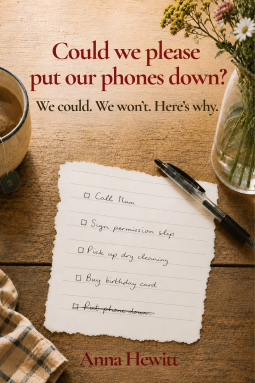
Could we please put our phones down?
We could. We won't. Here's why.
Sign In or Register Now to see if this title is available for request.
Buy on BN.com Buy on Bookshop.org Buy on KoboSend NetGalley books directly to your Kindle or Kindle app
1
To read on a Kindle or Kindle app, please add kindle@netgalley.com as an approved email address to receive files in your Amazon account. Click here for step-by-step instructions.
2
Also find your Kindle email address within your Amazon account, and enter it here.
Pub Date Jun 12 2026 | Archive Date Dec 15 2026
Stephan van Elderen | Mullion Wallace Press
Talking about this book? Use #CouldWePlease #NetGalley. More hashtag tips!
Description
On the 9th of January 2007, Steve Jobs held up a small black rectangle and called it a revolution. Anna Hewitt thought: how nice, an iPod you can also use to make calls.
Like most of us, she didn't understand what she was looking at. But eighteen months later she had one herself, and a year after that she couldn't quite remember how she'd managed without it. And at a moment she still cannot identify, it ended up on the table.
Could we please put our phones down? is not about technology. It is about what happened next. About how a device that began as a solution quietly became something we invited in freely and now cannot quite ask to leave. About its impact on family life, healthcare and politics. About what she has tried, and what she has to show for it.
Anna Hewitt writes about something almost everyone recognises and almost no one says out loud. With the sharpness of a good journalist, the warmth of someone who is fully in it herself, and the honesty of someone whose phone is, even now, on the table.
Marketing Plan
Could we please put our phones down? launches with a coordinated international campaign across India, the US/Canada, and the UK/Ireland, running in parallel. The book speaks to a conversation now underway worldwide, including school phone bans across Europe and Australia, growing debate over social media and adolescent wellbeing, and India's 2026 Economic Survey flagging digital addiction as a national health concern. The book is available in ebook and paperback through Amazon KDP, Kobo, Ingram Spark, and Draft2Digital, with global paperback distribution via Ingram. Outreach spans trade reviewers and library and institutional networks across all three regions, covering thousands of institutions: India's DELNET and INFLIBNET, public library systems and consortia in the US/Canada, and CILIP and public library networks in the UK/Ireland, alongside readers of comparable titles such as Stolen Focus, Digital Minimalism, and The Anxious Generation. The book is made available for review and consideration to all interested book professionals, and library and institutional acquisition is the primary long-term growth channel across all markets.
Available Editions
| EDITION | Ebook |
| ISBN | 9789083727905 |
| PRICE | $8.99 (USD) |
| PAGES | 210 |
Available on NetGalley
Available to Buy
Buy on BN.com Buy on Bookshop.org Buy on KoboAverage rating from 2 members
Featured Reviews
 Elle M, Reviewer
I enjoy a good thought-provoking book, and certainly there's no shortage of issues and questions and confusion about technology these days. Are we addicted to our phones? Just to social media? Should we be relying in AI to answer our general questions and/or to ease our loneliness? Does "screen-free time" actually work?
The author's first question, though, is a great one: do you even realise how much time you're spending on your phone? I think most of us don't, not anymore. It quickly became normalised to always have your phone on hand; if not actively using it, then sitting beside you or in your pocket, able to check it every few minutes if needed, kept close by "just in case". Lately I've been noticing more when checking my phone - or more accurately, there are days I don't use it much and I notice those and wonder if more of my days shouldn't be like that. I'm lucky in that my job finishes at a set time and I'm done - I'm not on call, unlike several family members. I meet friends in personal regularly, so there's not a huge amount of texting to stay caught up, just a few messages in group chat during the week to organise the next gathering. If I'm not receiving that many calls or texts, I shouldn't need to check my phone as often as I do, right? It's an interesting thought, and I think I'll be mulling it over for a while.
There's not much new to say in this novel about social media - I think most of us know the studies and problems already, and if we're using it we also know the benefits. I did appreciate the author detailing the science and marketing of socmed addiction, how it's not really our fault for getting addicted, it's just our brains doing what they were made to do, and various someones (in marketing and app design) taking advantage of that. The sections involving the author's children were well handled, with a thick layer of non-detail for extra privacy for her family members. Her children's thoughts and needs, as kids growing up never not having had phones and social media, are very removed from those of adults and interesting to see. But I was impressed that the author isn't exploiting her kids for content or revealing explicit details of their lives - they felt well-protected from public scrutiny, as much as can be when discussed in a book.
This book definitely made me think harder about my phone, computer, and screen-time use. It was already on my mind, which is why I was interested in picking up this novel, but it asked questions I hadn't thought about yet. It also took pains to present both sides of the issues it raised, giving the benefits as well as the drawbacks. It made me think about the times I grew up in, and how glad I am that I didn't go through primary school and high school with social media.
This would have been an easy 4 stars if not for the author's closing remarks that she wrote the novel with AI, needing its help to focus arguments, check her logic, etc. I'm sorry but if you want to write a book about phone addiction, current technology problems, and AI, then you ought to be able to have your own thoughts and logic planned out already. A real "writer" doesn't need AI to fix their work for them or turn their disparate thoughts into a polished draft. If I'd known this was written with AI, I would not have requested it.
Rating: 3 stars -- Thought-provoking questions & observations of current phones and AI, self-admittedly with no real answers, but unfortunately written with AI assistance.
 Reviewer 1997277
Gave it a 4.5 on Pagebound. And a 4 on Goodreads (because they do not do half stars). The title immediately captured my attention because right now I feel like I am in a season of self reflection as my daughter is a toddler and is both analyzing and repeating things that I am doing, constantly. It’s like a mirror of my best and worst traits that I get to see on a daily basis. A hard thing at times, but it’s opening me up to my failures and forcing me to change. Or else I risk the kind of relationship I want with my kids, the kind of parent I want to be, the kind of human being I want my kids to grow up and be. This book focuses a ton on how phones affect children now that children are being given phones so early in the name of safety.
I highlighted so much from the very beginning of this book to the end. Some of the informational and scientific things that Hewitt wrote about were not exactly new information but dove deeper into things I already knew. She definitely did a ton of research and touched on many more topics than I would initially think were applicable, even things like how phones and social media build a weird and not always accurate bubble based on politics, and also AI, but this is the entire point… our phones are everything now. And so much was eye opening. I really loved Hewitt’s heart for her children and her admittance of not being entirely sure what the future looks like if we continue in the same trajectory of phone usage and allowance in our homes.
I will say I think she was a little weak on giving us everyday “consumers” of phones the blame we should very likely get. She placed more blame on those that designed the phones/technology/apps etc to be so addictive than on us. And I do recognize that’s probably how it all started. But I think there’s still some responsibility on us as consumers.
But ultimately my very favorite parts were parts where Hewitt brought in her children’s behaviors and reactions that were one of the biggest alarms to her about screen time and phone time specifically. Why were they my favorite parts? Because that’s ultimately what has sparked my feelings and now devotion to cutting screen time of my own and really, reading this book to motivate me to do so. Hearing about Hewitt’s regrets when it came to phone time and her observations of how it affected her and also how it affected her children (both her own phone use affected her children and her children’s phone use), is solidifying my decision to put off phones for as long as possible and when the time does time to look at alternative options like ones that come without Internet access. It also is encouraging me to watch my own phone tjme and to just leave my phone and not worry about it. Easier said than done, but it’s a work in progress. Really good read. I want to dive more into ethical reads on children and phones.