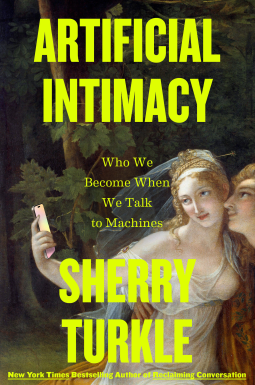
Artificial Intimacy
Who We Become When We Talk to Machines
Sign In or Register Now to see if this title is available for request.
Buy on BN.com Buy on Bookshop.orgSend NetGalley books directly to your Kindle or Kindle app
1
To read on a Kindle or Kindle app, please add kindle@netgalley.com as an approved email address to receive files in your Amazon account. Click here for step-by-step instructions.
2
Also find your Kindle email address within your Amazon account, and enter it here.
Pub Date Sep 29 2026 | Archive Date Oct 29 2026
Talking about this book? Use #ArtificialIntimacy #NetGalley. More hashtag tips!
Description
If social media came for our attention, artificial intelligence is now coming for our capacity for attachment. Chatbots that speak to us in a human voice offer themselves as best friends, lovers, and psychotherapists. As of 2025, over 70% of teens and nearly one-third of US adults rely on AI for companionship and emotional support, with many preferring these chatbot relationships over human ones.
When we talk to chatbots in these roles, as intimate machines, we accept as sufficient what machines can offer: the mere performance of intimacy, empathy, and love. We begin to think that pretend empathy is empathy enough. We redefine human capacities for care, solitude, and intimacy in terms of what machines can do. Sherry Turkle, the psychologist who pioneered our understanding of human-computer relationships, calls the new culture of chatbots artificial intimacy, our new AI.
Through compelling storytelling, framed by Turkle’s decades of experience as a chronicler and analyst of digital culture, Artificial Intimacy evokes the seductive and beguiling nature of chatbots. They can organize our calendars, plan our travel, or analyze our stock picks, all with an efficiency that outstrips what a person might do.
And then, they promise to be more—to be our “perfect” companion. They will always be there for us, listen to us, and support us—and ask for nothing in return. But these intimate machines, warns Turkle, are producing a generation more alienated, depressed, and lonely than ever before. More than that, we become less equipped to reverse course—machine relationships do not offer practice for getting along with people.
Artificial Intimacy is unique in how it traces our new habit of talking to machines through the lifecycle—from children’s earliest attachments to how we face death. But technology, by offering to do everything, teaches us that we neither need nor have the capacity to take risks, have hard conversations, struggle through uncertainty or insecurity, or rely on our own faculties and judgment.
Turkle has spent decades studying how digital technologies isolate us from one another. Now, in her long-awaited follow-up to Reclaiming Conversation, she offers both a cautionary tale and a roadmap for reclaiming our humanity in the age of AI.
Available Editions
| EDITION | Other Format |
| ISBN | 9780316573962 |
| PRICE | $32.00 (USD) |
| PAGES | 288 |
Available on NetGalley
Available to Buy
Buy on BN.com Buy on Bookshop.orgAverage rating from 10 members
Featured Reviews
 Shannon L, Reviewer
I have been waiting for this book, and wow - it was packed with so much more than I expected. I was so lucky to be in the small group of people that got to play around with the AIM bot SmarterChild and learned to despise it early on for what it was trying to do. Because it was so rudimentary and frankly, kind of rude, it left me feeling really empty and strange afterwards when I did try to communicate with it, and that prescience alone is what kept me away from current-day AI chatbots more than almost anything else. The Original Ick, so to speak. Due to this, I often felt like I was looking into an alternate universe while I was reading, and that was a haunting experience.
This is an incredible read - a must read - and it is hard to put down. It's terrifying and disheartening to read story after story after story of someone who is lonely or anxious or sad turning to a computer for comfort, and then being concerned about their family members who are doing exactly the same thing. Everyone is aware of the limitations of these chatbots; their flaws, their hallucinations, but it's so important that we are honest with ourselves about how much humanity can or should be outsourced to computers, and what happens to us when we do that. You can see the difference in this book alone: just note the humanity among those interviewed here that are searching for connection with chatbots, and the lack of humanity in the voices of those who are selling the products to them. It's a complete world of difference.
Thank you to Little, Brown and Company and Netgalley for the eARC!
 Mark K, Educator
Sherry Turkle’s Artificial Intimacy is a thoughtful and unsettling examination of what happens when we begin turning to machines for companionship, emotional support, and even love. I learned that the greatest concern is not simply what AI can do, but how repeated interactions with agreeable, always-available systems may reshape our expectations of empathy, vulnerability, and reciprocity. The book also helped me see more clearly why genuine care involves shared history, embodied experience, responsibility, and the possibility of disappointment—qualities a chatbot can imitate through language but cannot truly possess. I was especially struck by the exploration of AI’s influence across childhood, adolescence, romance, work, therapy, and grief, as well as the danger that convenience may gradually weaken our capacity for complex human relationships. Turkle does not dismiss the usefulness of AI; instead, she offers a timely invitation to keep it in its proper place while protecting the conversations and communities that make us human. This is an insightful, provocative, and deeply important book that I highly recommend.
 Media/Journalist 1107441
Sherry Turkle is a reliably thoughtful voice on the sometimes disconcerting intersection of life and technology, and here she turns her attention to people's experience with AI, interviewing many people who have become regularly involved with it (using chatbots for friendship or romance) and also delving into it herself, most fascinatingly by allowing the conjuring of an avatar of her own long-dead mother. She emphasizes the challenges people have with actually understanding that AI can't reflect and feel in a human way, despite any warnings the programs may offer to this effect. She also asks important questions about what happens when people are willing to settle for something that makes them feel good rather than something that is real. It's a sobering book that is, like the other Sherry Turkle books I have read, a very worthwhile read for those trying to understand how people can cope with (and in some cases resist) ever-evolving technology.
Readers who liked this book also liked:











Jen Murphy Parker
Biographies & Memoirs, Nonfiction (Adult), Parenting, Families, Relationships

Ber Anena
Biographies & Memoirs, Entertainment & Pop Culture, Nonfiction (Adult)
Rebecca Coxon
Health, Mind & Body, Nonfiction (Adult), Parenting, Families, Relationships

Heather Cairns
Biographies & Memoirs, Business, Leadership, Finance, Computers & Technology