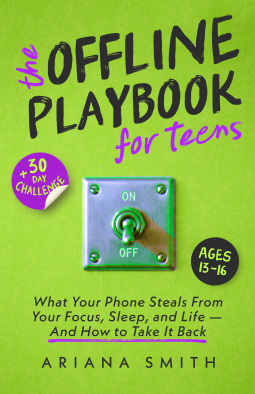
The Offline Playbook for Teens
What Your Phone Steals From Your Focus, Sleep, and Life — And How to Take It Back
This title was previously available on NetGalley and is now archived.
Send NetGalley books directly to your Kindle or Kindle app
1
To read on a Kindle or Kindle app, please add kindle@netgalley.com as an approved email address to receive files in your Amazon account. Click here for step-by-step instructions.
2
Also find your Kindle email address within your Amazon account, and enter it here.
Pub Date May 12 2026 | Archive Date Jul 25 2026
Talking about this book? Use #TheOfflinePlaybookforTeens #NetGalley. More hashtag tips!
Description
The book that finally gives your teenager the manual they've never had.
Most books about screen time talk to parents. This one talks directly to teenagers — honestly, without lectures, and without asking them to give anything up.
The Offline Playbook for Teens by Ariana Smith explains how digital platforms are engineered to capture attention, what smartphones are actually doing to focus, sleep, and real-life habits, and what changes when teenagers understand the mechanism and take back control on their own terms.
Written for readers aged 13–16 in a peer-level voice that respects their intelligence. Includes a complete 30-Day Challenge workbook.
"The author writes for teenagers and does not underestimate their intelligence... Ariana Smith's answer is to provide information rather than prescriptions." — Marie-Claire Blin, Readers' Favorite
Perfect for: school librarians, educators, parents, and anyone working with teenagers navigating screen time and mental health.
A Note From the Publisher
Available Editions
| EDITION | Ebook |
| ISBN | 9789908836218 |
| PRICE | $4.99 (USD) |
| PAGES | 122 |
Links
Available on NetGalley
Available to Buy
Buy on Amazon Buy on KoboAverage rating from 6 members
Featured Reviews
 Katy R, Reviewer
★★★★★ (5/5)
As a high school nurse, I cannot recommend The Offline Playbook for Teens highly enough. Every single day I see students struggling with chronic sleep deprivation, anxiety, difficulty focusing, and constant overstimulation, and this book perfectly captures the role smartphones and social media often play in those challenges—without coming across as judgmental or unrealistic.
What I appreciated most is that the author doesn’t simply tell teens to “put the phone away.” Instead, she explains why their brains respond the way they do and offers practical, achievable strategies to help them regain control. The advice feels empowering rather than preachy, which is exactly what today’s teenagers need.
I found myself nodding along throughout the entire book because it reflects what I see in my health office every day. Students frequently tell me they’re exhausted because they were scrolling until 2 a.m., can’t focus in class because they’re constantly checking notifications, or feel overwhelmed by the pressure of social media. This book validates those experiences while providing realistic tools to create healthier habits.
I genuinely believe this should be required reading for middle and high school students—and honestly, for parents and educators as well. It opens the door to important conversations about digital wellness, sleep, mental health, and finding balance in a world that’s constantly demanding our attention.
An incredibly relevant, insightful, and hopeful read. I’ll be recommending this to students, families, and fellow educators without hesitation.
Readers who liked this book also liked: