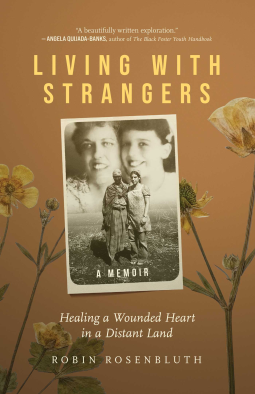
Living with Strangers
Healing a Wounded Heart in a Distant Land—A Memoir
This title was previously available on NetGalley and is now archived.
Send NetGalley books directly to your Kindle or Kindle app
1
To read on a Kindle or Kindle app, please add kindle@netgalley.com as an approved email address to receive files in your Amazon account. Click here for step-by-step instructions.
2
Also find your Kindle email address within your Amazon account, and enter it here.
Pub Date Oct 27 2026 | Archive Date Sep 19 2026
Caitlin Hamilton Marketing & Publicity | She Writes Press
Talking about this book? Use #LivingwithStrangers #NetGalley. More hashtag tips!
Description
Eager to leave her life as a foster child behind, Robin Rosenbluth travels to a remote village in northern Kenya called Songa in 1973. As a white college student, she arrives in a desert-like environment to teach elementary school to Samburu and Rendille children. While befriending the residents, she learns to live in a mud hut, survive without modern conveniences, skin a cow, and kill a chicken for dinner.
Robin weaves stories about the challenges she faced growing up—her mother’s early death, her father’s abandonment, and her years in foster care—with her account of her time in Songa. As the only Jewish resident in a village influenced by Christian missionaries, she strives to fit in: adapting to the intense heat, endless insects, and close encounters with wild animals. Over time, she develops close friendships with a local teacher and a woman who becomes her surrogate mother, participates in local customs, and makes a place for herself in Songa.
Offering vivid insight into why a love-starved nineteen-year-old from New York City would choose to relocate to the other side of the world, Living with Strangers is a poignant chronicle of one young woman’s search for a place to belong.
A Note From the Publisher
Advance Praise
“She deftly merges the two parts of her life story—her early life and her Kenyan travels—with maturity and levelheaded reflection and urges readers to both sympathize with others and to pay attention to their own emotional needs.An eye-opening and thorough remembrance, related with clarity and care.”—Kirkus Reviews
“. . . a thoughtful memoir about chosen belonging formed through village work in Africa after a childhood of uncertain homes in America.”—Readers’ Favorite, 5-star review
“A beautifully written exploration of connection and belonging. This book is a must-read for anyone who has ever felt like an outsider or has experienced the American foster care system.”—Angela Quijada-Banks, author of The Black Foster Youth Handbook
“What truly sets Rosenbluth’s story apart is her year in Kenya at nineteen, living with semi-nomadic tribes and teaching school. Her courage to embrace a new culture while searching for belonging is both surprising and inspiring.”—David Ambroz, author of A Place Called Home
“Rosenbluth shares her compelling journey of resilience and triumph with such heartbreaking and inspiring honesty that it leaves you laughing, shaking your head in disbelief, and crying—all while holding on to hope that she will prevail against all odds.”—Ta’Nika Gibson, actress and adoption advocate
“Robin’s compelling memoir, Living with Strangers, captures her experiences with and appreciation for the people of the Samburu and Rendille tribes in Northern Kenya. She arrived in Kenya with typical teenage anxiety—after struggling to find acceptance from her foster family—and learned to embrace local traditions and culture, as she searched for a place to belong.”—Bill Ulfelder, executive director of the New York Nature Conservancy
“Weaving her stories as a survivor of the United States’s broken child welfare system and her year in Kenya at nineteen, Robin’s book is a deeply impactful illustration of how leaning into one’s vulnerability can lead to enlightenment and belonging.”—Jennifer Pinder, executive director of You Gotta Believe
Available Editions
| EDITION | Other Format |
| ISBN | 9798896361886 |
| PRICE | $18.99 (USD) |
| PAGES | 256 |
Available on NetGalley
Available to Buy
Buy on BN.com Buy on Bookshop.orgAverage rating from 5 members
Featured Reviews
 Kelly L, Librarian
Thank you to NetGalley and the publisher for providing this book in exchange for an honest review.
This is a captivating book that weaves 2 stories together to make an interesting read. I was most interested in this book because of the subject of foster homes but I ended up getting more out of the Kenya story.
 Catriona M, Reviewer
Rosenbluth's childhood was happy and stable—until her mother died, and everything went downhill. But her childhood is only half the story here; the other half is the year in college that Rosenbluth spent in rural Kenya, teaching primary school and learning Swahili (and some of the local languages) and generally finding a kind of stability she didn't have growing up, despite cultural divides and the temporary nature of the placement.
I picked this up because I gravitate (and probably will always gravitate!) toward stories of people moving to other countries, and I'm especially fond of the more off-the-beaten-path stories; never mind Paris, give me a memoir about someone moving, for the short term or the long, to North Macedonia or Western Sahara or East Timor or South Africa (see what I did there?). I mean, give me the Paris book too, but it's a lot easier for me to get to Paris than it is to get to rural Kenya. It's worth noting that I'm always also a bit trepidatious about books where people from the Global North go off to somewhere in the Global South, especially when the experience was some time ago; there are just a lot of ways for that to go wrong, in the doing or in the writing.
Happily, Rosenbluth avoids those pitfalls. She went to Kenya in 1973 as part of a college program (she attended Friends World College, which I'd never heard of but which sounds *fascinating*; students spent their entire four years traveling and living in different places and learning about the world), but it sounds like even then she was aware of not just her White and American privilege but also of the...let's say the dangers of assuming that privilege means knowing more, and also the inherent problem of White people swanning in and thinking they can fix things. It's clear that she knew her role there was limited, and that in the long term (in the short term, for that matter) it would be better for a local to have her teaching position, and that she wasn't there to change anyone. It's a better book for the perspective. Also, I think, a better book for the fact that she kept extensive journals (a college requirement) during her travels; I assume she was able to draw on those to keep the memories feeling fresh and the stories feeling fleshed out even fifty years down the line.
The juxtaposition of Rosenbluth's time in Kenya against her childhood took some getting used to. This isn't a criticism, just a reflection of the fact that she really did go quite far afield of what she knew. I'll let most of the details stay in the book, but I will say that Rosenbluth was left, from a shockingly young age, to parent her even younger sister and generally take care of the household (while her father, having left to live with his girlfriend, occasionally dropped by to leave some paltry grocery money and to criticize her housekeeping skills). When somebody finally stepped in, Rosenbluth and her sister were sent to live first in a children's home and then with a foster family, the latter of whom provided material stability but not emotional support. (Just as some people should not be parents, some people should perhaps not be foster parents.) As Rosenbluth observes, this experience prepared her for living in other places...though I wish that kind of resilience and adaptability could be bottled, because I think it's the exception rather than the norm.
Altogether an engrossing read.
Thanks to the author and publisher for providing a review copy through NetGalley.
 Wendy E, Reviewer
I believe this is the first memoir I have read focusing on foster care, and the story kept me interested from beginning to end.
It was interesting to read about the struggles the author went through, not only because of losing her mother and her dad's abandonment.
Thank you, Caitlin Hamilton Marketing & Publicity and NetGalley, for the free ARC copy.
Readers who liked this book also liked:

Chelsea Kim Long
Christian, Health, Mind & Body, Religion & Spirituality
We Are Bookish
General Fiction (Adult), Literary Fiction, Women's Fiction
We Are Bookish
Literary Fiction, Multicultural Interest, Women's Fiction

We Are Bookish
Biographies & Memoirs, Health, Mind & Body, Nonfiction (Adult)

We Are Bookish
LGBTQIAP+, Romance, Sci Fi & Fantasy
Publishers Lunch
General Fiction (Adult), Nonfiction (Adult), Teens & YA