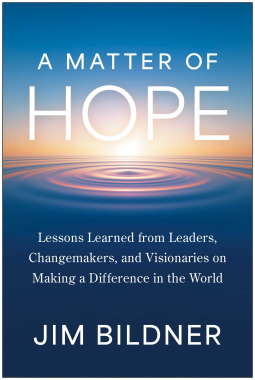
A Matter of Hope
Lessons Learned from Leaders, Changemakers, and Visionaries on Making a Difference in the World
This title was previously available on NetGalley and is now archived.
Send NetGalley books directly to your Kindle or Kindle app
1
To read on a Kindle or Kindle app, please add kindle@netgalley.com as an approved email address to receive files in your Amazon account. Click here for step-by-step instructions.
2
Also find your Kindle email address within your Amazon account, and enter it here.
Pub Date Sep 8 2026 | Archive Date Aug 31 2026
BenBella Books | Matt Holt Books
Talking about this book? Use #AMatterofHope #NetGalley. More hashtag tips!
Description
USA Today Bestseller
There is one human characteristic that separates those who see a world full of problems from those who see a world full of potential: hope.
Hope is not in short supply; it is everywhere. Venture-philanthropy leader Jim Bildner shows what it takes to move beyond despair and into action.
Drawing on more than a decade as CEO of one of the largest global venture-philanthropy foundations and on the hard-won clarity that comes from profound personal loss, Jim Bildner provides real-life examples of what it takes to turn hope into action, sharing powerful stories of hope transforming lives and the ripple effect it has on whole communities.
Grounded in real cases from hundreds of social enterprises impacting over 600 million lives, Bildner weaves the mindset of optimism with intimate stories of individuals finding strength through vulnerability and lessons from social entrepreneurs changing the world.
A Matter of Hope provides the reader with a practical blueprint on how to solve problems that exist in the world by:
- Understanding the nature of the problem you are trying to solve
- Analyzing the ecosystem and existing infrastructure that surrounds the problem
- Being clear about what you hope to accomplish
- Developing a specific execution strategy: namely, having the right people, in the right places, at the right time
- Knowing who needs to ultimately adopt your solution to embed or institutionalize it, and have a plan—and partners—to do that
This book is perfect for social entrepreneurs, funders, impact investors, nonprofit and philanthropic leaders and their boards, business leaders driving change, incubators and impact accelerators, faculty, and anyone who wants to make a difference in the world, in their community, and in their lives.
Hope gives you the power to change someone else’s life and, with that very act, to change your own. Hope is there for the taking. You just have to be open enough to see it.
Available Editions
| EDITION | Other Format |
| ISBN | 9781637749760 |
| PRICE | $28.00 (USD) |
| PAGES | 208 |
Available on NetGalley
Available to Buy
Buy on BN.com Buy on Bookshop.orgBISAC Codes
Average rating from 1 member
Featured Reviews
 Demetris P, Reviewer
Hope With an Eraser Nearby
Jim Bildner’s “A Matter of Hope” makes its finest case for change when conviction remains humble enough to listen, discard the beautiful first answer, and begin again with the problem actually in front of it.
By Demetris Papadimitropoulos | August 18th, 2026
Death is the first problem Jim Bildner cannot turn into a project. In the prologue to “A Matter of Hope,” he recalls the 2005 overdose that killed his twenty-one-year-old son, Peter, and the contradiction left behind: a man increasingly devoted to changing the world had been unable to save his own child. The loss unsettles more than his confidence. Work no longer looks like a reliable measure of what deserves his time, and time itself no longer behaves like a resource that replenishes because tomorrow is on the calendar. Bildner had spent years believing that effort and attention could bend circumstances toward an intended result. Peter’s death leaves him with a harder question: when control gives out, what is still yours to do?
Even the word hope arrives carrying more luggage than most nouns should be asked to check. It turns up in campaign speeches, commencement addresses, hospital corridors, decorative wall art. Bildner’s better instinct is to make it earn its keep. At the Draper Richards Kaplan Foundation, he has spent years around social entrepreneurs confronting problems large enough to make resignation look reasonable. Here hope comes with work attached. Look closely. Find the actual obstruction. Change your mind when the evidence changes. Build something another person can use. Find out whether it lasts when you leave. This is a decidedly unsentimental use of an over-sentimentalized word: hope becomes less a mood than a willingness to keep learning after the first burst of conviction has worn off.
Muso Health provides the cleanest lesson in how little good intention knows by itself. Ari Johnson arrives in Mali wanting to improve health outcomes, but Nana Niaré, a retired nurse and community matriarch, teaches him an almost humiliatingly simple first move: sit down. Listen. Families around her reveal that child mortality cannot be reduced to one missing drug, one inadequate clinic, one transportation problem, or one fee. The binding problem is delay, produced by barriers that become lethal in sequence. Muso grows from that correction. Conviction does not triumph by becoming louder. It becomes trustworthy by allowing reality to edit it.
Each subsequent case changes the furniture but keeps that drama intact. Clementine Jacoby imagines Recidiviz as a way to make criminal-justice data more visible to outsiders, then learns from corrections officials that people inside the system can barely use their own fragmented information. Wawira Njiru plans to finance Food4Education through commercial catering, then drops the elegant “Robin Hood” model when it threatens to distract from feeding children. Evan Marwell finds schools with devices but connections too poor to make those devices useful. Jared Walker discovers that hospital financial-assistance policies exist while many eligible patients cannot navigate them. Again and again, somebody has to get close enough to a problem to become embarrassed by the first description of it.
The founder Bildner most trusts is not the one who mistakes stubbornness for integrity. He likes audacity, but not the brittle kind that treats revision as betrayal. The person worth following sees enough to begin, stays near enough to learn, and can throw away a beautiful first answer without throwing away the mission. Wawira’s discarded catering plan tells us more about leadership than another hymn to perseverance would. In a culture fond of confusing certainty with competence, Bildner offers conviction with an eraser nearby.
Read aloud, much of Bildner’s prose reveals its natural habitat. His sentences tend to be short or medium in length; rhetorical questions and conversational turns keep the voice close to speech. Managerial nouns – ecosystems, scale, constraints, adoption – sit beside service, compassion, purpose, care. He can take an institutional knot apart without making the reader feel deputized into a consulting team. There is very little syntactic concealment here; Bildner normally tells you where a sentence is headed and trusts momentum more than surprise. Better still, the prose wakes up when a system can be held in the hand: Nana’s couch, a box of unused medicine, a school lunch, a mother stopping the car for a homeless man, Nancy’s hand through another round of treatment.
In weaker passages, he does not quite trust those objects to finish the thought. A scene lands; he explains why it landed; then hope arrives to notarize the transaction. Sometimes he escorts the story all the way to the door, checks that it has its keys, and reminds it what the evening meant. The habit gives “A Matter of Hope” a sermonic recurrence that some readers will welcome. It also means that a good scene can acquire one moral too many. Nana rarely needs the extra help.
Problems enter these chapters most vividly as mismatches. Medicine exists; patients cannot afford or reach it. Schools own computers; students cannot connect. Hospitals have financial-assistance policies; eligible people cannot find their way through the paperwork. Families already perform enormous amounts of care; medical systems often treat them as incidental. Bildner likes the moment when an intimidating social problem becomes more exact without becoming trivial. The suspense is not whether his featured organizations eventually succeed. We generally know they do. It is the quieter pleasure of watching the wrong question give way to a better one. This repeated act of reframing supplies more narrative momentum than the eventual scale figures, impressive as those figures often are.
After eight profiles, Chapter 9 gives names and sequence to habits the stories have already taught us: define the real problem, map what surrounds it, decide what success would look like, order the work, and identify who must eventually adopt the solution. That last demand is the shrewdest. An intervention that works only while an unusually charismatic founder is pushing it, or while funders remain unusually attentive, has not yet become part of the place it hopes to change. These are useful disciplines. They are not insurance.
Peter’s death and Nancy Bildner’s illness keep that machinery from becoming the final authority. Peter comes before the entrepreneurs and establishes that there are losses no ingenuity can reverse. Nancy comes after the playbook. Diagnosed with stage 4 cancer, she lives through repeated grave prognoses, more than eighty chemotherapy cycles, hospitalizations, appointments, and the daily indignity of plans made provisional. No sequence of diagnosis, execution, partnership, and adoption can guarantee the ending she and Bildner want. A business book has reached something business language cannot manage.
At this point Nancy alters the terms without offering a new system. She continues to travel when she can, see friends, play, move, accept treatment, and inhabit family life without pretending illness is fair. There is agency here, but not mastery. Peter shows Bildner what cannot be recovered. The entrepreneurs show what can sometimes be altered. Nancy occupies the harsher middle ground in which a condition may remain immovable while a life inside it is still being lived.
DRK’s portfolio also makes Chapter 9 easier to formulate than it might look from outside the winners’ circle. Mistakes abound, but most are mistakes on the way to vindication: the model changes, the institution comes around, the bottleneck is found, the organization scales. We never spend comparable time with someone who listens well, understands the local terrain, hires intelligently, secures resources, persists for honorable reasons – and still fails. That absence matters because the playbook is drawn retrospectively from organizations that survived long enough to exemplify it. Bildner can show what successful interventions came to require. He cannot quite show how often those requirements prove insufficient, or how one distinguishes admirable persistence from the moment when persistence has become attachment to a sunk cost. A failed case would have introduced friction into the method without draining the book of hope.
If the obstacle is malfunction, his instincts are persuasive. Bad information can be cleaned up. Hidden eligibility can be surfaced. A delay can be shortened. An existing program can be made usable. Harder are situations in which the parties understand one another perfectly well and still want incompatible outcomes, or where an institution benefits from the arrangement another group needs dismantled. Those are not clogged pipes. Sometimes the fight is over who owns the water. Clementine Jacoby’s “big tent” remains an appealing model of coalition, but a tent helps only when the quarrel is not over the ground beneath it.
More crowded still is hope itself. By the final chapters the word has been asked to cover courage, persistence, imagination, compassion, openness to correction, endurance, service, organizational stamina, and, now and then, competence. The capaciousness gives the book continuity at the cost of some precision. Kiah Williams’s outrage at medicine being discarded while patients go without is not quite the same capacity as Jacoby’s coalition-building or Edith Elliott’s ethic of caregiving. Nancy’s endurance is something else again. The stories retain those differences even when their governing noun grows baggy.
In Jacqueline Novogratz’s “Manifesto for a Moral Revolution,” moral purpose also has to survive contact with institutions; Rebecca Solnit’s “Hope in the Dark” likewise refuses to make uncertain outcomes an excuse for passivity. Bildner belongs somewhere between their temperaments. He shares Novogratz’s appetite for execution and Solnit’s refusal of despair, but he is much less willing than Solnit to leave uncertainty alone. He wants to know what can be done Monday morning. His hope wants a clipboard. That is both the charm and the limit of “A Matter of Hope”: it is excellent at finding the next usable move, less patient with situations in which no move yet deserves confidence.
The part of Bildner’s worldview that feels especially current is his stubborn faith in repair. His founders rarely stand outside an institution and declare it hopeless. They go inside. They map its habits, borrow its infrastructure, replace a bad tool, enlist an unlikely partner, make an obscure benefit usable. Distrust here is diagnostic rather than ornamental. These people notice the leak and then, unfashionably enough, look for a wrench.
Readers allergic to inspirational nonfiction may still feel their defenses rise. Bildner is earnest, generous toward his subjects, and not especially interested in irony as a permanent address. Many of the people he profiles come from a philanthropic world in which he has been participant, adviser, and funder; the affection is visible, and so is the reduced critical distance. But the admiration is not vacant. The most persuasive founders in these pages are precisely the ones willing to become less enamored of their own ideas. Bildner’s affection sometimes softens scrutiny, but it also gives him access to the small corrections and private inheritances that a colder account might miss. Warmth and rigor coexist more easily here than the genre’s reputation might suggest.
Once the private losses begin pressing against the organizational lessons, “A Matter of Hope” becomes more than an attractive portfolio of good works. Bildner starts with helplessness, spends the middle among people who carve a tractable piece from an enormous problem, and ends by admitting that tractability itself has limits. What can a person do when some part of the world simply will not obey? Sometimes the answer is build. Sometimes revise. Sometimes remain.
Perhaps this is why Nana, Jared Walker’s mother, and Bildner himself as a belatedly attentive father can linger longer than some of the largest outcome numbers. Nana puts a hand on the couch and asks Ari to listen. Jared’s mother stops the car because somebody by the road is hungry. After Peter’s death, Bildner recognizes how many of his daughter Lizzie’s games and ordinary days he had treated as expendable and becomes the father who shows up. None of these moments requires a theory of scale. The book keeps enlarging its units of measurement; its best scenes keep shrinking them back to one person within reach of another.
On my scale, “A Matter of Hope” lands at 81/100, or 4/5 stars. Its architecture and emotional weight exceed the originality of its prose, and its practical counsel is stronger than the universal claims occasionally built on top of it. Bildner has not produced a complete account of how social change succeeds. He has done something narrower and useful: shown how good intentions can become more accurate, how conviction can tolerate correction, and how an intervention can be built with enough humility to belong eventually to someone besides its founder.
Under all the repetition of hope lies a harder proposition. Control is temporary. Knowledge arrives incomplete. Good work can fail, and love cannot guarantee rescue. Yet helplessness does not occupy the whole field. There may still be a neighbor to hear, a plan worth discarding, a form to complete, a meal to serve, a coalition to widen, another treatment to endure. Bildner is wisest when he does not enlarge these acts into salvation.
Late in the book, Nancy gathers the argument back to its human size. After the founders, metrics, systems, grants, and talk of scale, there is a life that cannot be secured in advance and two people continuing to inhabit it together. The title sounds at first like a promise about the future. By the end, it offers less and means more: not an assurance that the next point will be won, only the recognition that it is still there to be played.