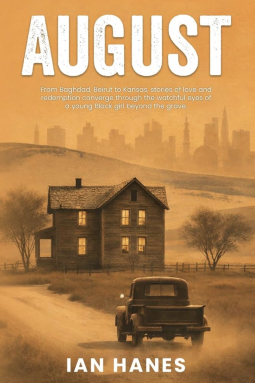
August
We Carry What We Bury
Sign In or Register Now to see if this title is available for request.
Buy on Amazon Buy on BN.com Buy on Bookshop.orgSend NetGalley books directly to your Kindle or Kindle app
1
To read on a Kindle or Kindle app, please add kindle@netgalley.com as an approved email address to receive files in your Amazon account. Click here for step-by-step instructions.
2
Also find your Kindle email address within your Amazon account, and enter it here.
Pub Date Jun 2 2026 | Archive Date Feb 15 2027
Description
A Kansas farm. A man who never left. A past that refuses to stay quiet. August Harper thought staying on the farm would keep everything still. Kansas had other plans.
August is a quiet, powerful story about memory, inheritance, and the fragile ties that shape a life. Narrated in part by Rose Carter — speaking from the other side with sharp wit rather than solemnity — the novel follows August Harper, a man who traded a future for a farm and discovers that silence has a breaking point.
Readers have called the novel:
“A beautifully observed, quietly devastating debut.”
“Rose narrates with a tone closer to an eye‑roll than elegy — a brilliant choice.”
“Hanes refuses tidy arcs or scheduled forgiveness. The novel earns its honesty.”
Themes & Resonance
Intergenerational grief and renewal
The cost of silence
Found family
Cross‑cultural connection
The weight of unresolved loss
For readers who love: Claire Keegan, Kent Haruf, Anne Enright, Alice Sebold, and quiet, character‑driven literary fiction.
August Harper has spent his life on a Kansas farm, convinced that stillness is a kind of safety. But when an abandoned infant arrives on his doorstep, the quiet life he built begins to shift — and the past he buried refuses to stay silent.
Watching from the other side is Rose Carter, whose voice carries through the novel with sharp humour and unflinching clarity. She knows August too well to be precious about him, and she narrates his grief with the honesty of someone who loved him without illusion.
Across the world, Layla — an Iraqi‑Lebanese woman shaped by war, displacement, and the 2020 Beirut port explosion — builds a life out of fracture. Her story threads through August’s in ways neither of them expect, asking what it means to carry loss that cannot be resolved.
Quiet, lyrical, and emotionally exact, August: We Carry What We Bury is a novel about the ties we inherit, the stories we protect, and the moments that force us to speak agai
A Note From the Publisher
This novel grew from years of thinking about memory, grief, and the small, private moments that shape who we become. It’s a quiet book, but one that asks big questions about loss, identity, and the ways we carry our past into every new chapter of our lives.
August is a lyrical, atmospheric exploration of identity and the weight of memory. For readers who seek quiet intensity, emotional depth, and prose that lingers, this is a novel about what it means to return — and what it means to finally face the truth of who we are.
I’m deeply grateful to every reader who spends time with this story. Your feedback and reviews genuinely help independent authors like me reach new audiences. Thank you for being part of August’s early journey.
Author Q&A: Ian Hanes on August
Q: What inspired you to write August?
A: The novel grew from a long period of thinking about memory — how it shapes us, how it distorts us, and how it quietly governs the choices we make. I wanted to explore the emotional weight of returning home, and the way grief can sit beneath the surface of an ordinary life.
Q: What do you hope readers take away from the book?
A: I hope readers feel seen in the quieter parts of themselves. August is a story about the moments we rarely speak aloud: regret, longing, unresolved love, and the small acts of courage that help us move forward.
Q: Who is August as a character?
A: He’s someone who has spent years avoiding the truth of his own past. Returning home forces him to confront the people and memories he’s tried to outrun. His journey is one of acceptance — not dramatic transformation, but a slow, honest reckoning.
Q: Why did you choose this setting?
A: I’m drawn to landscapes that hold emotional resonance — places where silence feels meaningful. The setting mirrors August’s internal world: familiar yet unsettled, beautiful yet heavy with memory.
Q: What kind of readers do you imagine connecting most with this story?
A: Readers who appreciate quiet, reflective literary fiction; those who enjoy character‑driven narratives; and anyone who has ever returned to a place that once felt like home and discovered it changed — or discovered they had.
Q: What are you working on next?
A: A new literary novel set across Versailles, Warsaw, and Jerusalem, exploring time, identity, and the ways history shapes personal lives.
Advance Praise
“Utterly enthralling — beautifully written and quietly powerful.”
“A moving, atmospheric novel that lingers long after reading.”
“A beautifully crafted story of memory and loss. I would absolutely recommend this to my audience.” — NetGalley Reviewer
“Elegant, evocative, and emotionally resonant.”
Available Editions
| EDITION | Paperback |
| ISBN | 9798950750250 |
| PRICE | £13.99 (GBP) |
| PAGES | 268 |
Available on NetGalley
Available to Buy
Buy on Amazon Buy on BN.com Buy on Bookshop.orgBISAC Codes
Average rating from 3 members
Featured Reviews
 lily c, Reviewer
# Book Review: *August: We Carry What We Bury* by Ian Hanes
Rose Carter doesn't get out of the way in this one. She narrates from the other side of it, and Hanes leans into that risk — a dead woman explaining the living to us — fully aware readers will hear Alice Sebold's *The Lovely Bones* underneath it before page thirty. What keeps it from tipping into pastiche is tone. Less elegiac hush, more a woman still capable of an eye-roll. She reports on August the way you report on someone you knew too well to be precious about.
August Harper himself is a familiar shape in rural American fiction — the grief-rationed man who trades a future for a farm, closer to Kent Haruf's Colorado ranchers than to anything invented fresh here. Hanes doesn't try to reinvent that archetype; he trusts the reader already recognizes it, and spends his pages instead on what disrupts the pattern: an abandoned infant showing up in a life that had organized itself around not wanting anything new. That's the stronger choice. The interest isn't in August's silence — silence is the default setting for this kind of character — it's in what has to give for him to speak again.
The harder swing is Layla, an Iraqi-Lebanese woman whose story runs through war, displacement, and the 2020 Beirut port explosion, which killed more than 200 people and leveled entire neighborhoods. Braiding a documented mass-casualty event into a novel built around private, invented grief isn't a neutral craft choice — it's a real risk. Handled carelessly, a real catastrophe becomes set dressing for someone else's emotional arc. Whether Hanes earns the connection, makes Layla load-bearing rather than illustrative of a theme the American plotline already needed, is the more useful question to sit with while reading than whether the prose is lyrical.
And that's the real structural bet of the book: three narrative registers — afterlife narration, quiet-man farm plot, geopolitically specific displacement story — each with its own genre gravity, running in parallel. That's ambitious math. The seams show most in the tonal jump between Rose's wit and the weight of Layla's material; not because either thread is weak on its own, but because the book is asking a reader to hold two very different registers of grief in the same hand without asking them to rhyme.
What the novel earns isn't atmosphere — it's refusal. No tidy arc, no forgiveness arriving on schedule. It rewards readers willing to let loss stay unresolved rather than explained, and it's most convincing exactly where it resists its own instinct toward warmth.
 Account D, Reviewer
Rose Carter doesn't get out of the way in this one. She narrates from the other side of it, and Hanes leans into that risk — a dead woman explaining the living to us — fully aware readers will hear Alice Sebold's The Lovely Bones underneath it before page thirty. What keeps it from tipping into pastiche is tone. Less elegiac hush, more a woman still capable of an eye-roll. She reports on August the way you report on someone you knew too well to be precious about.
August Harper himself is a familiar shape in rural American fiction — the grief-rationed man who trades a future for a farm, closer to Kent Haruf's Colorado ranchers than to anything invented fresh here. Hanes doesn't try to reinvent that archetype; he trusts the reader already recognizes it, and spends his pages instead on what disrupts the pattern: an abandoned infant showing up in a life that had organized itself around not wanting anything new. That's the stronger choice. The interest isn't in August's silence — silence is the default setting for this kind of character — it's in what has to give for him to speak again.
The harder swing is Layla, an Iraqi-Lebanese woman whose story runs through war, displacement, and the 2020 Beirut port explosion, which killed more than 200 people and leveled entire neighborhoods. Braiding a documented mass-casualty event into a novel built around private, invented grief isn't a neutral craft choice — it's a real risk. Handled carelessly, a real catastrophe becomes set dressing for someone else's emotional arc. Whether Hanes earns the connection, makes Layla load-bearing rather than illustrative of a theme the American plotline already needed, is the more useful question to sit with while reading than whether the prose is lyrical.
And that's the real structural bet of the book: three narrative registers — afterlife narration, quiet-man farm plot, geopolitically specific displacement story — each with its own genre gravity, running in parallel. That's ambitious math. The seams show most in the tonal jump between Rose's wit and the weight of Layla's material; not because either thread is weak on its own, but because the book is asking a reader to hold two very different registers of grief in the same hand without asking them to rhyme.
What the novel earns isn't atmosphere — it's refusal. No tidy arc, no forgiveness arriving on schedule. It rewards readers willing to let loss stay unresolved rather than explained, and it's most convincing exactly where it resists its own instinct toward warmth.
louisa t, Reviewer
Oh August.
He really did steal my heart a bit.
When the other stories came in, I just wanted to go back to Kansas
They won me over however, and here at the end of the book I find myself a bit emotional.
Beautifully written, with characters that will stay with you a while.
Lovely.
Readers who liked this book also liked:




Laraine Stephens
General Fiction (Adult), Historical Fiction, Mystery & Thrillers