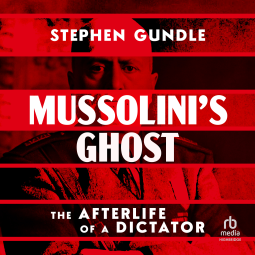
Mussolini's Ghost
The Afterlife of a Dictator
with Nigel Patterson (Narrator)
This title was previously available on NetGalley and is now archived.
Send NetGalley books directly to your Kindle or Kindle app
1
To read on a Kindle or Kindle app, please add kindle@netgalley.com as an approved email address to receive files in your Amazon account. Click here for step-by-step instructions.
2
Also find your Kindle email address within your Amazon account, and enter it here.
Pub Date Aug 27 2026 | Archive Date Aug 27 2026

Talking about this book? Use #MussolinisGhost #NetGalley. More hashtag tips!
Description
The Italian Fascist dictator Mussolini was killed in 1945, his body exhibited upside down in Milan before an angry crowd. The repudiation by the people of the dictator who had led them to disaster was complete. But his story did not end there. The Duce continued to live on thanks to a legacy that was multi-faceted and complex.
In Mussolini's Ghost Stephen Gundle explores the many aspects of Mussolini's strange afterlife, be it through the fate of his statues and the places that Mussolini was most associated with, his impact on political life, his treatment in public history, and his place in popular culture. Gundle argues that the root causes of Il Duce's disturbing persistence lie in the way Italians negotiated the transition from war to peace and from Fascism to democracy. Instead of acknowledging the enthusiastic backing many had given to a criminal dictatorship, many Italians behaved as though Fascism had never really existed. The dictator was instead recast as a flawed but well-meaning family man. Thanks to this and other strange reconfigurations, the grip Mussolini established over the popular mind was never properly dismantled. Gundle uses psychoanalysis and collective psychology to explore a bold new interpretation of the causes of Mussolini's posthumous persistence, and compares his and Italy's fate to that of Germany.
Advance Praise
"Mussolini's Ghost is a tour de force in the history of cultural memory and collective psychology. Through innovative exploration of written and visual sources, memorabilia, artifacts and physical places, Stephen Gundle reveals the ways in which Mussolini's cult resonated in the post-war decades, while guiding the reader through the complex intricacy of aftermaths more generally." —Claudia Baldoli, Italian Fascism, 1914-1945: Themes and Interpretations
Available Editions
| EDITION | Other Format, Unabridged |
| ISBN | 9781696623148 |
| PRICE | $24.99 (USD) |
| DURATION | 11 Hours, 22 Minutes |
Available on NetGalley
Available to Buy
Buy on Audible Buy on Kobo Buy on Libro.fmBISAC Codes
Average rating from 10 members
Readers who liked this book also liked:





Ben Devlin
Literary Fiction, Mystery & Thrillers, True Crime



Publishers Lunch
General Fiction (Adult), Nonfiction (Adult), Teens & YA



Malcolm Gladwell, Bruce Headlam
Biographies & Memoirs, Entertainment & Pop Culture, Nonfiction (Adult)