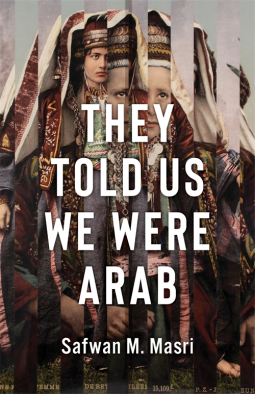
They Told Us We Were Arab
Sign In or Register Now to see if this title is available for request.
Buy on BN.com Buy on Bookshop.org*This page contains affiliate links, so we may earn a small commission when you make a purchase through links on our site at no additional cost to you.
Send NetGalley books directly to your Kindle or Kindle app
1
To read on a Kindle or Kindle app, please add kindle@netgalley.com as an approved email address to receive files in your Amazon account. Click here for step-by-step instructions.
2
Also find your Kindle email address within your Amazon account, and enter it here.
Pub Date Feb 9 2027 | Archive Date May 19 2027
Talking about this book? Use #TheyToldUsWeWereArab #NetGalley. More hashtag tips!
Description
In They Told Us We Were Arab, Safwan M. Masri offers a critical and personal examination of what it has meant—and what it has cost—to be labeled “Arab.” Drawing on history, political analysis, cultural critique, and his own experience as a Palestinian Jordanian American, he traces how this expansive identity came to exist: who defined it and to what ends.
Masri systematically dismantles the pillars taken as evidence of a unified Arab identity—language, culture, history, and politics—across a region spanning five million square miles that is home to more than 450 million people. He shows that “Arab” has never functioned as a coherent racial, religious, linguistic, or political category. Instead, it has operated as a flexible and often imposed label, rendered legible through colonial legacies, nationalist projects, authoritarian regimes, and Western frameworks of representation. Though frequently invoked as a source of unity, the category has flattened internal diversity and displaced more nuanced ways of understanding belonging, citizenship, and political responsibility.
The consequences of this abstraction are most significant in Palestine. The century-long project to erase Palestinian identity and render Palestinians interchangeable with “Arabs” has obscured political realities, recast dispossession, and misrepresented a settler-colonial project as a regional dispute.
Moving between analysis and reflection, this book unravels how Arabness came to feel natural, inevitable, and necessary—leaving identity freer, finer-grained, and closer to lived experience.
Masri systematically dismantles the pillars taken as evidence of a unified Arab identity—language, culture, history, and politics—across a region spanning five million square miles that is home to more than 450 million people. He shows that “Arab” has never functioned as a coherent racial, religious, linguistic, or political category. Instead, it has operated as a flexible and often imposed label, rendered legible through colonial legacies, nationalist projects, authoritarian regimes, and Western frameworks of representation. Though frequently invoked as a source of unity, the category has flattened internal diversity and displaced more nuanced ways of understanding belonging, citizenship, and political responsibility.
The consequences of this abstraction are most significant in Palestine. The century-long project to erase Palestinian identity and render Palestinians interchangeable with “Arabs” has obscured political realities, recast dispossession, and misrepresented a settler-colonial project as a regional dispute.
Moving between analysis and reflection, this book unravels how Arabness came to feel natural, inevitable, and necessary—leaving identity freer, finer-grained, and closer to lived experience.
Available Editions
| EDITION | Other Format |
| ISBN | 9780231225342 |
| PRICE | $27.00 (USD) |
| PAGES | 320 |
Available on NetGalley
NetGalley Reader
(PDF)
NetGalley Shelf App
(PDF)
Send to Kindle (PDF)
Download (PDF)
Available to Buy
Buy on BN.com Buy on Bookshop.org*This page contains affiliate links, so we may earn a small commission when you make a purchase through links on our site at no additional cost to you.
BISAC Codes
POL059000 POLITICAL SCIENCE / World / Middle Eastern
HIS026000 HISTORY / Middle East / General
Average rating from 6 members
Readers who liked this book also liked: