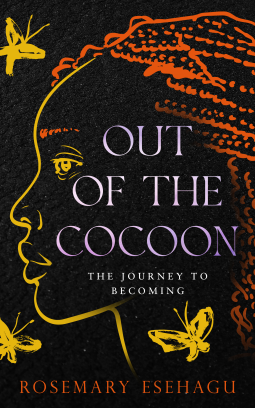
Out of the Cocoon: The Journey to Becoming
Sign In or Register Now to see if this title is available for request.
Buy on BN.com Buy on Bookshop.orgSend NetGalley books directly to your Kindle or Kindle app
1
To read on a Kindle or Kindle app, please add kindle@netgalley.com as an approved email address to receive files in your Amazon account. Click here for step-by-step instructions.
2
Also find your Kindle email address within your Amazon account, and enter it here.
Pub Date Mar 8 2025 | Archive Date Dec 21 2026
Manhattan Book Group | Independent Book Publishers Association (IBPA), Members' Titles
Talking about this book? Use #OutoftheCocoonTheJourneytoBecoming #NetGalley. More hashtag tips!
Description
How would you live your life if you understood that your scar, trauma, or suffering can make you stronger and greater?
Rosemary Esehagu, who has studied psychology and medicine, has seen the damaging effects of having people's abuse or trauma speak for them. In her memoir, Out of the Cocoon: The Journey to Becoming, she shares her story of posttraumatic growth and offers a radical perspective on abuse. Despite encountering abuse as a child and racism and trauma when she immigrated to the US as a teenager, she has found her place and is living her purpose. She uses prose and poetry to express that we can overpower and repurpose others' harmful actions.
A Note From the Publisher
Hardcover: 9781965340912
Additional Book Formats with (ISBN-13)
Hardcover: 9781965340912
Advance Praise
"The author reveals her unique personal experience and her own process of healing. The book helps us to better understand the process of healing and the journey to self-love. This is a must-read for anyone searching to be freed from their victim status to experience wholeness and for those who are offering any type of support to victims of trauma."
—Vanessa Bridges, Ph.D., author of Changing the Way You Change
"A profound journey of resilience, "Out of the Cocoon" is a soaring legacy of healing, strength, and the triumph of Light. . . . Her message throughout every piece is that light always wins, no matter how much darkness tries to snuff it out. There is always a soaring transformation to be found in the things that try and destroy us. . . . This collection of poems is most certainly a legacy that will inspire all who read it."
—Claudia Almendoza Alzra, Reedsy
"Esehagu relates her metaphorical journey from egg to butterfly as she overcame childhood abuse and immigrated to the U.S. from Nigeria. . . . [T]here are some luminous moments of observation . . . such moments hint at a wonderfully radical unearthing of self."
—Kirkus Reviews
"Readers receive a juxtaposition of prose followed by reinforcing poetry sections that pair personal experience with reflections on the healing process. Esehagu's message is clear: anyone can reconstruct themselves, as she did."
—Diane Donovan, Midwest Book Review
Available Editions
| EDITION | Paperback |
| ISBN | 9781962987127 |
| PRICE | $14.50 (USD) |
| PAGES | 144 |
Links
Available on NetGalley
Available to Buy
Buy on BN.com Buy on Bookshop.orgAverage rating from 3 members
Featured Reviews
 Claudia F, Reviewer
Out of the Cocoon by Rosemary Esehagu, is a very important and heartfelt work, mixing prose and poetry, about what trauma is, how to overcome it and becoming a new version of oneself. Unfortunately, the poetry style wasn't much to my liking, but that doesn't take away the importance of the message and the personal experience of the authour: about womanhood, racial discrimination, violence and resilience. A very powerful kind of autobiography about the ability to overcome and transform oneself.
 Ruthie W, Reviewer
In the poem, “The Partiality of Luck,” Rosemary Esehagu writes, “Life is a four-letter noun that is called a maze.” That line captures the emotional terrain of Out of the Cocoon: The Journey to Becoming, a vulnerable, deeply personal memoir about trauma, identity, and the difficult, nonlinear work of healing.
Esehagu writes about childhood sexual abuse, immigration, race, racism, and sexism with an openness that makes the book feel less like a polished account of survival than an invitation into its complicated aftermath. For Black women in particular, that journey is often made harder by the intersecting forces of racism and misogyny, as well as the persistent pressure to be strong, silent, or grateful rather than fully seen and believed.
What stayed with me as much as Esehagu’s story of overcoming trauma was her vulnerability in telling it. She does not offer an easy narrative of redemption or suggest that pain disappears simply because someone survives it. Instead, she makes room for shame, isolation, anger, fractured self-worth, and the difficult work of learning to trust one’s own voice again. Her candor is as striking as the story itself: vulnerability becomes not a weakness, but the source of the book’s emotional power.
The memoir is filled with poetry that underscores and deepens its central themes. These poems do not simply accompany the prose; they create space for what straightforward narration cannot always hold—grief, memory, rage, confusion, and hope. They sharpen the memoir’s emotional truths and reinforce the sense that survival is not a clean, linear journey, but a maze one must keep finding a way through.
Esehagu also emphasizes the destructive power of trauma when it is ignored—both personally and as a society. What goes unspoken can seep into identity, relationships, and one’s sense of safety. On a wider level, she asks readers to confront how communities, institutions, and cultural norms enable harm when they minimize abuse, doubt survivors, or treat trauma as an individual burden rather than a collective responsibility.
The cocoon metaphor is familiar, but Esehagu uses it thoughtfully. Transformation here is not instant or pristine; it is private, painful, and uncertain. *Out of the Cocoon* understands healing not as a destination, but as a continuing process of confronting what happened, honoring the person one was, and making space for the person still emerging.
As Esehagu writes, “Resilience is not born out of your expectations.”
 Josiane R, Reviewer
Out of the Cocoon: the journey to becoming by Rosemary Esehagu
A memoir in prose and poetry about self-love, trauma, and overcoming trauma.
Two critical events shaped Rosemary Esehagu’s life. The first happened in Nigeria, her native country, where she grew up. Esehagu was sexually abused when she was a child.
The second event happened when she arrived in the United States at sixteen-year-old. She experienced emotional abuse that threatened her identity and security.
“The abuses I endured nearly turned me into a miserable soul, unable to find peace, love and trust,” she writes, adding that those abuses failed to imprison her because she recognized that she could reconstruct herself.
In her memoir, Rosemary Esehagu shares her journey (in the prose section) to becoming the mother she is today with a rare honesty that can help readers going through the same path.
Her reconstruction was not linear. It was difficult. Chaotic. She hated any man’s sexual interest in her. She was abnormally independent. Many times, she pretended to be quiet, absent.
She swallowed her abuses, reminiscent of her childhood experiences because she didn’t want to voice her dissent or anger for fear of appearing defiant, aggressive, or accusatory.
“But abuse is not pretty,” she notes. “No one wants to hear it. No one wants to be conscious of the existence of the varieties of evil that are locked away in each of us, for fear that knowledge might unlock their chains.”
But how can one write about abuse in a way that is digestible ? By sharing her story and her healing experiences with sincerity, Rosemary Esehagu managed to even turn her book into an educational resource.
To heal, she followed four core steps. Firstly, she had an anchor. Her trauma therapist helped her heal her childhood wounds. But her main anchor was and is still God, she writes, describing how “praying was therapeutic”.
Then came her family and friends who helped with their patience and love, through her breakdowns and ugliness.
Thirdly, Esehagu built a new vision. At some point, she became sick of herself, tired of the “reactionary Rosemary” who was constantly disturbed by her past. She dreamed of a life where she could be carefree, unshackled from her past that had kept her prisoner.
And finally, she stopped wishing to invalidate her past self, to rewrite her story with: “if only”, “I could have”, “I should have”... For her, it was the “hardest step “.
But Rosemary Esehagu became “more than my trauma.” “Because I love who I am now, I love who I was, and I recognize that all that I have to endure to become her.” Some of her best tools? Prayers and meditation.
As a proof of her healing, the poetry part of the book is a celebration. Dedicated to Amadou Diallo killed in 1999 by nineteen bullets from the forty-one gunshots of four white police officers in Bronx (New York), the 41 poems symbolize “a positive legacy “ since his family created Amadou Diallo Foundation that helps students pursuing their dreams of achieving a college education for example.
They turned tragedy into opportunities for young people. “This is posttraumatic growth,” Esehagu emphasizes in her memoir.
A resourceful autobiography for those who want to go beyond their trauma and live a happy life.
Readers who liked this book also liked:




Reese Minshew
Health, Mind & Body, Nonfiction (Adult), Professional & Technical


Marit Weisenberg
General Fiction (Adult), Mystery & Thrillers, Women's Fiction