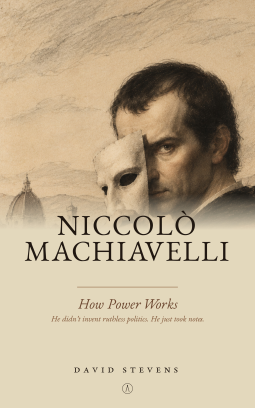
Machiavelli
How Power Works
This title was previously available on NetGalley and is now archived.
Send NetGalley books directly to your Kindle or Kindle app
1
To read on a Kindle or Kindle app, please add kindle@netgalley.com as an approved email address to receive files in your Amazon account. Click here for step-by-step instructions.
2
Also find your Kindle email address within your Amazon account, and enter it here.
Pub Date Oct 18 2026 | Archive Date Nov 10 2026
ARC provided by Victory Editing NetGalley Co-op | Decision Publishing
Talking about this book? Use #Machiavelli #NetGalley. More hashtag tips!
Description
He didn't invent ruthless politics. He just took notes.
On the twenty-sixth of December 1502, a Florentine clerk in the Romagna wrote home that the man who governed the province for Cesare Borgia had been found in the public square that day, cut in two. Why, he wrote, nobody quite knew, except that it had pleased the duke.
The clerk was Niccolò Machiavelli. Before him, books of advice told rulers what they ought to be. He wrote about what rulers actually do — from evidence, about men of his own day — and said when the ugly thing worked, and why. Five hundred years later his name is still an insult.
For fourteen years he stood beside the men who decided things, and was never allowed to decide anything. They sent him to a countess bargaining for her own state, to a court that called his republic Signor Nothing, to a conclave that made a pope in a night, to an emperor whose promised army never came. Then he lost the job, was hoisted six times on the rope, and went home to a farm to write, from what he carried in his head, what became the most notorious book in Europe.
Around the work was a life: a friend who had his new mantle cut to fit himself because the customer was away; a wife's one surviving letter; a bill for veal he could not settle; and a comedy that made him famous while The Prince sat unprinted.
Also in these pages: whether he ever said the ends justify the means, whether The Prince was satire, what his job actually was, and what happened the six times they hoisted him on the rope.
Every quotation in this book is sourced. The notes at the back say where each one comes from, so any of it can be checked against the record.
One of five narrative lives built the same way: the documents first, then the life that comes out of them.
Marketing Plan
Paperback and case laminate hardcover through IngramSpark, returnable, available to the trade at a full 55% discount. Ebook in all major stores.
Author site. davidstevensbooks.com carries a research section for each subject: a timeline, the full source list, and direct answers to the questions readers actually search for.
Readers' list. Readers are offered The Trial File, a short free book on what the documents in Galileo's trial file actually say, for joining the list.
Reviews. Advance copies through this listing and through Booksprout ahead of publication.
Companion title. Galileo's Inquisitor, a novel of the 1633 trial told from the prosecutor's side, publishes the same day and is listed separately here.
Available Editions
| EDITION | Ebook |
| ISBN | 9798953350228 |
| PRICE | $9.99 (USD) |
| PAGES | 132 |
Available on NetGalley
Available to Buy
Buy on Amazon Buy on BN.com Buy on Bookshop.org Buy on KoboBISAC Codes
Average rating from 5 members
Featured Reviews
 Educator 2212784
4 stars overall.
My college professor called Machiavelli “the Dr. Pepper of political philosophy, meaning, the reputation does not match the substance. Machiavelli was someone trying to provide commentary to keep his country together. That stated, this book provides excellent context for The Prince. Every student or academician citing The Prince should also cite this book. On page 10/108, there is a clunky sentence, “The man above them stayed ten years, and Machiavelli worked to him for all of them.”
 Keith M, Reviewer
I've went down this historical rabbit hole lately of figures like Machiavelli, Galileo, Confucius, Aristotle, Plato, Nero, Marcus Aurelias.
I think Machiavelli is a predominantly misunderstood guy and this is a great book for either an introduction or refresher.
Highly recommend giving it a read.
 Demetris P, Reviewer
The Man Who Remembered Everything and the Republic That Forgot Him
David Stevens’s “Niccolò Machiavelli: How Power Works” and the Strange Afterlife of a Florentine Secretary Who Turned Political Experience into Political Theory
By Demetris Papadimitropoulos | October 20th, 2026
During Niccolò Machiavelli’s fourteen years in the Florentine chancery, the republic replaced its nine chief magistrates every two months. The clerks stayed. “The price was a government with no memory,” David Stevens writes. “So it bought one.” Machiavelli belonged to that purchase. He recorded what rulers did but rarely directed them. Before he became an adjective, he was an employee. The office outlasted magistrates, though not necessarily the men who kept it running.
Elsewhere, Machiavelli is cast as a tutor of tyrants, the alleged author of the ends-justify-means maxim. Stevens returns to the salaried Florentine behind the reputation. He reads diplomatic dispatches beside later accounts in “The Prince” and “Discourses on Livy.” Sometimes judgments survive; elsewhere doubtful motives harden or facts disappear. These are changes in how a participant explained events after losing his place in them. The papers show what changed more readily than why.
Machiavelli was twenty-nine when he entered the second chancery in 1498. As a mandatario, he carried instructions but could not bind Florence like an ambassador. In France, his government expected persuasive words without furnishing money or soldiers to make refusal costly. The French could decline. Stevens’s “Signor Nothing” catches the humiliation. Caterina Sforza had already distinguished Florence’s satisfactory words from its disappointing actions. Machiavelli could report that difference, not repair it.
Even Stevens’s prose resembles chancery work: it establishes an arrangement, shows its cost, and moves on. “So it bought one” turns constitutional trouble into a practical purchase. Horses need tending, soldiers paying, letters answering. Political grandeur returns to the work that sustains it. Such dry detail unsettles grand titles, though brisk conclusions can make uncertain inferences sound settled. His economical sentences sometimes close questions prematurely.
The episode at Cesena begins with Ramiro de Lorqua, Cesare Borgia’s harsh governor. Machiavelli reported his imprisonment on December 23, 1502; three days later Ramiro’s bisected body lay in the square. “The cause of his death is not precisely known,” the secretary wrote, apart from Borgia’s pleasure in demonstrating power. Everyone saw the punishment; Machiavelli could not know the duke’s private deliberations. He knew what happened, not with equal certainty why.
Rather more seems knowable in “The Prince.” Ramiro’s cruelty establishes order; his execution lets Borgia disown the resentment. The spectacle becomes a calculated sequence. Stevens contrasts a cautious dispatch with a treatise organized around intention. Perhaps Machiavelli learned more, inferred a cause, or chose a useful interpretation. We cannot tell. Reflection may reveal a cause or erase doubt. The body at Cesena is unchanged. The confidence of its explanation is not.
In the same dispatch, Machiavelli thanks Florence for twenty-five gold ducats and sixteen yards of black damask, and mentions three mares at Poppi. Nearby letters also mention an altered mantle and a request involving Plutarch. A man has been cut in two, yet the accounts continue. The absurdity is not a joke about the execution. The horror has entered the file; the file has other business. We cannot know what Machiavelli felt, and the absence of a fabricated reaction makes the juxtaposition more disturbing.
Political dispatches have employers. Their writer must communicate uncertainty while showing diligence and perhaps defending himself. Stevens distinguishes his sources yet sometimes overprivileges the earliest. Proximity is not impartiality. Machiavelli answered to officials who judged his work. Conversely, the later thinker could understand more than his younger self. Neither the tentative document nor the confident treatise should be treated as an impartial witness.
Another complication concerns Borgia. John M. Najemy, writing in The Review of Politics, suggests Chapter Seven of “The Prince” may warn against borrowed power rather than simply praise an exemplary ruler. Borgia depended on his father, France, and insecure forces. Apparent praise might thus contain criticism. Stevens acknowledges fortune but cannot settle that rhetorical intent through comparison. What did Machiavelli learn, and what did he want his readers to notice?
Pistoia offers a personal test. Florence sent Machiavelli to manage factional violence through conciliation. Later he blamed such indecision for prolonging disorder. Stevens restores the critic to his assignment: “He had been the one they sent.” He carried out a policy he could not choose. His judgment may be sound, but it does not stand outside the policy he helped carry out. Stevens makes the gap between responsibility and authority painfully clear.
At home, another record survives. In 1503, Marietta described their baby’s hair as black velvet, sent Machiavelli clothes, and asked him to return. A child, shirts, a towel, an absence: little survives. Officials generated dispatches; those living with their consequences left fewer traces. We hear Marietta briefly before the narrative returns to affairs of state. Stevens cannot invent the absent voices. This history knows more about how powerful men explained their conduct than about those who lived beneath it.
Documents preserved commitments, not the troops needed to fulfill them. The Florentine militia required recruitment, pay, arms, and cooperation; many soldiers came from subject territories, complicating the image of free citizens defending Florence. It helped recover Pisa in 1509 before Prato in 1512. Christopher Lynch’s “Machiavelli on War” likewise sees mixed results. Machiavelli could argue for native troops, but maintaining them demanded resources he did not control.
In his report on Prato, Machiavelli wrote that soldiers fled “after not much resistance.” The qualification measures failure. Yet in “Discourses on Livy,” he stresses Piero Soderini’s indecision and omits the flight. No false event need be added: selection changes the apparent cause. Military collapse becomes a lesson about a leader’s hesitation. It may explain more while sparing the militia’s organizer awkward evidence. Stevens need not allege concealment to make the omission matter.
Machiavelli may have protected his project, reconsidered what caused Prato, or selected material for a general argument. The surviving texts cannot tell us which. The militia had helped recover Pisa and failed at Prato. A dispatch and a treatise do different work, and disagreement need not imply deceit. Stevens sometimes lets omission stand in for motive. Here the most exact reading leaves that question open.
If every later judgment differed, Stevens’s method would prove too easy. Maximilian offers an exception. The emperor’s ambitions exceeded his money and reliable support, an assessment Machiavelli largely retained in later writing. The title was magnificent; the means less so. Once more, intentions require resources. Stevens does not manufacture a contradiction. A good comparison must recognize continuity too.
The biography’s pattern becomes familiar: mission, dispatch, later judgment, comparison. Stevens varies episodes more than form; a chapter can seem designed for its closing contrast. His careful notes acknowledge more dispute than his brisk narrative does. A compact biography cannot rehearse every scholarly disagreement, but Borgia’s contested role in “The Prince” changes a central example. That complication deserves more space in the main argument.
Returning to the chancery, permanence seems less comforting. Machiavelli carried out policies he later criticized and organized forces he later interpreted. Neither innocent among fools nor Florence’s hidden master, he worked between obeying decisions and understanding their cost. Diagnosis could not protect his job. Florence relied on his knowledge; the job was hers. Nothing required the institution to remain loyal to its clerk.
One prison document is a comic poem. Suspected after the Medici returned, Machiavelli spent twenty-two days imprisoned and endured six drops of the strappado. He wrote of irons and lice to someone who might obtain his release. Stevens lets the strained humor suffice. After an amnesty, Machiavelli sought employment from the family whose restoration displaced him. His potential employers owed him no sympathy. Understanding power had not ended his dependence upon it.
Personal embarrassment had an exact price. In April 1513, a veal dinner cost fourteen soldi per person. “I had nothing on me but ten,” Machiavelli admitted, leaving four owed to a friend who wanted repayment. His strained amusement makes it both funnier and less comfortable. Stevens places it beside pleas for work. A man who negotiated with rulers and organized soldiers could be pursued over dinner. Political intelligence did not pay the bill.
One family exchange resists allegory. Machiavelli told his son Guido to let a crazed young mule work off its trouble; Guido answered that it could not be moved because the grass had not grown back. Children, a little chain, and Marietta’s laundry enter the letters. Machiavelli wanted to come home. The mule stayed put. Making it a political allegory would erase his family’s separate concerns. A political life contains laundry and uncooperative animals.
Under dismissal, writing became another occupation. In a letter to Francesco Vettori, Machiavelli changes from everyday clothes into formal dress before entering his study to converse with ancient authors. The ritual restores dignity, not employment. “The Prince” came from a man who had lost the work through which he knew politics. He asked friends to remember him. His ideas could travel beyond Florence; he still needed Florence to find him useful.
Losing the office took away the institutional use of Machiavelli’s knowledge, not the knowledge itself. When the republic returned in 1527, another secretary was chosen. Stevens writes: “The office that does not change did not change. It simply had somebody else in it.” The repetition strips stability of comfort. For Florence, “somebody else” was routine. The files continued; the man who had helped preserve them was no longer wanted.
Once Machiavelli died in June 1527, his books circulated beyond his control. “Discourses on Livy” appeared in 1531 and “The Prince” in 1532. Innocent Gentillet repackaged his arguments as dangerous maxims. The ends-justify-means slogan is not his, though his writings disturb. A writer who shaped rulers into examples became one for readers to reshape. Neither party was necessarily dishonest. I rate Stevens’s book 85/100, or 4.50/5 Goodreads-compatible stars, for its intelligence without automatic acquittal of its subject.
Stevens gives Machiavelli letters to send, accounts to settle, soldiers to recruit, and a family waiting. His comparisons can be too tidy, and “The Prince” sometimes demands more rhetorical scrutiny. Yet the papers exceed any verdict. Dispatches tell employers what a secretary could establish. Treatises reshape experience into argument; readers select again. Others keep Florence’s records as his books circulate. The papers remain, awaiting another reader to decide what they prove.
Readers who liked this book also liked:

Silvia Moreno-Garcia
Historical Fiction, Literary Fiction, Sci Fi & Fantasy

Rachel Joyce
Historical Fiction, Literary Fiction, Women's Fiction

We Are Bookish
General Fiction (Adult), Romance, Women's Fiction



We Are Bookish
Literary Fiction, Multicultural Interest, Women's Fiction

We Are Bookish
Biographies & Memoirs, Nonfiction (Adult), Parenting, Families, Relationships

We Are Bookish
Business, Leadership, Finance, Nonfiction (Adult), Self-Help

We Are Bookish
Mystery & Thrillers, OwnVoices, Teens & YA


We Are Bookish
General Fiction (Adult), Romance, Women's Fiction

We Are Bookish
Arts & Photography, Health, Mind & Body, OwnVoices

We Are Bookish
Multicultural Interest, OwnVoices, Teens & YA

We Are Bookish
General Fiction (Adult), Literary Fiction, Women's Fiction