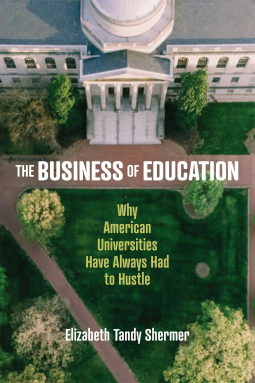
The Business of Education
Why American Universities Have Always Had to Hustle
Sign In or Register Now to see if this title is available for request.
Buy on BN.com Buy on Bookshop.orgSend NetGalley books directly to your Kindle or Kindle app
1
To read on a Kindle or Kindle app, please add kindle@netgalley.com as an approved email address to receive files in your Amazon account. Click here for step-by-step instructions.
2
Also find your Kindle email address within your Amazon account, and enter it here.
Pub Date Jan 5 2027 | Archive Date Jan 5 2027
Talking about this book? Use #TheBusinessofEducation #NetGalley. More hashtag tips!
Description
How US colleges and universities aggressively hustle to limit expenses while also competing for public and private revenue sources
How new is the higher education hustle? Americans have complained for years that colleges and universities have put profits over people. In The Business of Education, Elizabeth Tandy Shermer shows that campuses have always had to hustle to limit expenses while aggressively competing for donations, business contracts, federal grants, state allocations, and students willing to pay tuition. All those different sources of revenue have made campus finances something of a black box, no matter a school’s status as for-profit, non-profit, private, or public.
Rather than looking at well-studied, elite universities, Shermer instead traces the history of US higher education finance by investigating five campuses from across the country that gradually became leading public research universities. The University of North Carolina at Chapel Hill, the State University of New York at Buffalo, Michigan State University, Arizona State University, and the University of California San Diego are part of state systems that annually teach thousands more students than Ivy League schools. Shermer argues that these campuses, taken together, demonstrate that even the country’s premier public research universities had to aggressively fundraise and cut costs to be able to rapidly expand. Even during the heyday of government financing, they relied on business support, which focused on the science and engineering departments that Congress also prioritized. Over time, students, faculty, and neighboring communities expected universities to be more democratic places to live, work, and study, yet those demands clashed with university administrators, taxpayers, politicians, and donors who were more attuned to what colleges and universities could do for business.
The Business of Education’s examination of the higher education hustle reveals how US colleges’ and universities’ historic reliance on chaotic, uncertain funding reflects changing and sometimes contradictory political, economic, social, and cultural norms that have shifted expectations for what it means to be equal, accessible, and democratic.
Advance Praise
"We all know that universities are expensive to attend. But how do they pay their own bills? Elizabeth Tandy Shermer has produced our first sophisticated history of the often ingenious—and, always, insufficient—ways that American higher education funded itself. Relying on an unstable mix of private and public sources, universities became vulnerable to the whims of corporate capital and predatory politicians. Anyone who wants to understand our contemporary higher-education crisis will have to read Shermer's careful account of its historical roots."—Jonathan Zimmerman, University of Pennsylvania
"The Business of Education is a sweeping, provocative reframing of the history of modern American higher education financing. Elizabeth Tandy Shermer pushes back against familiar narratives of the privatized and corporatized ‘neoliberal university’ to argue that, for most institutions outside of the well-funded elite, a golden age of robust and predicable finances never happened."—Margaret O’Mara, University of Washington
"American higher education has always been a peculiar business: a can’t-make-it-up mix of entrepreneurial opportunism, public service, real estate speculation, utopian visions, and ambulance chasing. Elizabeth Tandy Shermer’s latest title nails this complexity and clarifies it with scholarly acumen and no little wit. Here at last is the long-arc account of postsecondary finance we need to think soberly about the nation’s current predicament over college costs."—Mitchell Stevens, Stanford University
Available Editions
| ISBN | 9781512830415 |
| PRICE | $45.00 (USD) |
| PAGES | 352 |