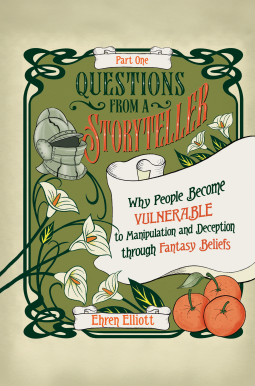
Questions from a Storyteller: Why People Become Vulnerable to Manipulation & Deception Through Fantasy Beliefs
Part One
Sign In or Register Now to see if this title is available for request.
Buy on Amazon Buy on BN.com Buy on Bookshop.orgSend NetGalley books directly to your Kindle or Kindle app
1
To read on a Kindle or Kindle app, please add kindle@netgalley.com as an approved email address to receive files in your Amazon account. Click here for step-by-step instructions.
2
Also find your Kindle email address within your Amazon account, and enter it here.
Pub Date Oct 22 2026 | Archive Date Dec 2 2026
Talking about this book? Use #VulnerabilityFingerprints #NetGalley. More hashtag tips!
Description
NO AI WAS USED IN THIS BOOK.
This is an atypical workbook designed to help us begin staying safer from emotional manipulation/coercion through compassionate education on ourselves, called "Questions from a Storyteller". It is a collection of fantasy allegories and guided reflections used to help readers recognize emotional vulnerabilities that can lead to exploitation, as emotional manipulation surrounds us everywhere day-to-day.
Part One being released now — which addresses learning our own mental vulnerabilities first and I use a fantasy world and fiction character to make mistakes for the reader, who they can safely experience themselves through in order to dispel shame. Imagine of wearing a suit of armor that has openings & cracks you’re unaware of, or owning a house which has open windows and unsecured doors you don’t know about. Within our mind, these are potential points for emotional exploitation that we are rarely educated about.
~*~
Two quotes from survivors who read this book state, “We need this way of thinking in today's world more than ever. The exercises were gentle and so thoughtfully built. As a survivor myself, I can't even describe how helpful, insightful, and truly authentic all the stories felt to me.”
And another said, "Questions From A Storyteller is not a typical self-help book. It is part memoir, part psychological workbook, and part whimsical fable, and somehow, that impossible combination works beautifully. Ehren Elliott has taken one of the hardest topics imaginable, how and why we become vulnerable to manipulation, grooming, and exploitation, and wrapped it in a world of forest animals, magical "Wonderments," and a girl named Someone who is just trying to figure out who she is.
The structure is unlike anything I've encountered. Each week, you read a short allegorical story about Someone and her friends. Then, the author gently pulls back the curtain and reveals what the story was actually teaching you about shame, fantasy, addiction, and the beliefs that make us vulnerable. By the time you finish a chapter, you feel like you've learned something profound without ever being lectured to."
~*~
Many adults have been left behind. They are taught vulnerability belongs to specific, focused-on groups, so they never realize what their vulnerabilities to exploitation may be. Romantic control/exploitation/abuse is focused the most for education, and the subtle manipulation and control we experience every day at the hands of co-workers, associates and our own culture is dismissed — even while we feel the hurt and pain of it constantly. This workbook is not just for survivors. It is even moreso for the adults who feel invisible or think their daily pain, feelings of helplessness in their life and depression don’t matter because it is “just what happens as an adult”. Yet your story matters and the ability for you to be coerced or exploited matters, too.
Advance Praise
Praise #1:
We need this way of thinking in today's world more than ever. The exercises were gentle and so thoughtfully built. As a survivor myself, I can't even describe how helpful, insightful, and truly authentic all the stories felt to me.
Overall, reading this book felt like a warm, gentle hug—a safe space where we can explore potentially traumatic situations without feeling overwhelmed.
This book is an amazing example of using storytelling as a way to educate and for personal growth. By following the main protagonist and her group of friends, the reader learns the importance of questioning and critically evaluating the world around them. The ultimate goal isn't necessarily finding answers, but rather learning how to navigate a reality that is multidimensional and rich in nuance.
Through the exercises at the end of each chapter, the author creates a truly experiential learning process, while fully respecting the pace at which the reader wishes to go deeper."
Praise #2:
"Self-help really doesn't seem like the right genre for Questions from a Storyteller. Ehren doesn't present herself as an expert, and, much to its credit, the book totally eschews self-help and therapy language in favor of wild, whimsical allegory. I thoroughly enjoyed it.
The essayistic portion of the book is genuinely illuminating: Ehren talks about how our personal vulnerabilities can be exploited, about how certain beliefs about ourselves and others are harmful, and about the dangers of a fantasy-centered life—straightforwardly, without political or social agenda. I think this section runs a little long, but just about anyone can get something valuable out of it.
But the allegories are where the book really shines. They're whimsical but grounded, silly but insightful, and always legible in their lesson. I'm certain I would have been bored to tears (or just turned off) if this subject matter had been presented as psychobabble. I vastly prefer the near-socratic method Ehren deploys to communicate what might otherwise be uncomfortable or unbroachable lessons."
Praise #3:
https://wroteabook.org/book-review-questions-from-a-storyteller-by-ehren-elliott/
Available Editions
| ISBN | 9798995182818 |
| PRICE | |
| PAGES | 290 |