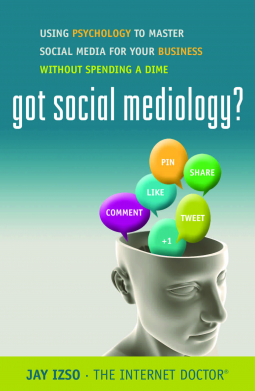
Got Social Mediology?
Using Psychology to Master Social Media for Your Business without Spending a Dime
This title was previously available on NetGalley and is now archived.
Send NetGalley books directly to your Kindle or Kindle app
1
To read on a Kindle or Kindle app, please add kindle@netgalley.com as an approved email address to receive files in your Amazon account. Click here for step-by-step instructions.
2
Also find your Kindle email address within your Amazon account, and enter it here.
Pub Date Feb 21 2015 | Archive Date Mar 3 2015
Smith Publicity | InterAction Press
Description
Posts, pokes, pins, pluses, and tweets. Oh my!
If you are like most businesspeople, you may be feeling overwhelmed by the technology, language, and culture of social media. What should you be saying on these platforms? How often should you be interacting? And do you really need to be on every social media platform out there?
With a witty style and no-nonsense attitude, Got Social Mediology? dispels the myths, gives the real scoop, and provides business- people everywhere with all they need to cus- tomize a social media marketing plan that’s right for them.
The book’s approach is simple but revolution- ary: by understanding the psychology of the social media user and focusing on creating au- thentic relationships rather than engaging in paid-for advertising, you will be able to grow your business on social media, far faster than ever before and without emptying your mar- keting budget in the process. That’s good news for business owners everywhere.
Get ready to discover how social media for business can be free, effective, and, yes, even fun!
A Note From the Publisher
Author is available for interviews, blog tours, autographed book giveaways, contests, and book club discussions.
Marketing Plan
Author Bio: JAY IZSO, the Internet Doctor, is a psychological business consultant, social mediologist, speaker, and writer who helps entrepreneurs and small businesses reduce their marketing budget and achieve higher ROI by understanding the psychology of their consumer on social media and beyond. He has a Master's of Science in Experimental Psychology from Washington State University and has taught psychology for more than twenty years, including at Washington State University and North Carolina State University. When he's not busy consulting, engaging on social media, writing, teaching, or speaking, Jay enjoys life as a wine geek, musician, sports fan, and movie buff. He lives in Raleigh, North Carolina, with his wife, Linda Craft, and their two dogs, Katie and Bandit.
Available Editions
| EDITION | Hardcover |
| ISBN | 9780991513604 |
| PRICE | $19.95 (USD) |
Average rating from 10 members
Featured Reviews
 Conrade Y, Reviewer
Master social media without spending a dime for your business? Sounds a little too far-fetched isn't it? Perhaps it is, but chances are, many people would be piqued to find out more why Jay Izso, sometimes called "Internet Doctor" believes it is possible. With psychology and basic business sense, it is entirely possible through what Izso defines as "social mediology." It is not technology that is the main driving force in this new media for business. It is the psychology behind it.
Izso starts by listing down some social media "personalities" which essentially are the different behavioral traits. The "heartthrob" is one who lives, eats, walks, and sleeps all things social media. The "traveler" only does social media in short spurts through the day. The "fly on the wall" are mainly observers. The "benchwarmers" are waiting for things to happen before jumping in while the "rookie" knows how to create a profile but does not go any much deeper into social media. Others like the "curmudgeon" are totally against social media and avoids them like a plague. Izso aims to make converts of all these, to help the proponents push the envelope further and the naysayers to turn around and venture bravely into this brave new world. Three things sum up the authors intent. First, that social media is less about technological tools but more about human cultures. Second, social media is a unique form of communications which increase the interactive capacity. Third, understanding psychological principles will help one make the best use of social media.
Arguing that social media is always "social first and media second," Izso is telling us that the person is more important than the technologies behind social media. Why do people use social media? The key reason is because they feel connected. Using it stimulates dopamine in our brains, the chemical that makes us happy. Connectedness. Happiness. Free. That is tempting.
Izso debunks several myths surrounding the two extremities, like those who detest and avoid it; and those who embrace it to the extreme of uncritical trust. Readers will learn about the different tools and purposes behind LinkedIn, Pinterest, Facebook, Instagram, Twitter, and other social media platforms. Before venturing into the various platforms and their pros and cons, Izso spends time talking about what "social mediology" is.
It is knowing the user will get turned off by advertisements on social media just like search results It is knowing the power of "liking" or "repin"
It is being present frequently so others will notice you It is learning to associate business with personal posts, and link "likes" with the products offered
...
The really interesting parts come when Izso gives us the inner look into the workings, and the pros and cons of using LinkedIn, Facebook, Twitter, Google+, Pinterest, Youtube, and other social media platforms. By beginning with LinkedIn, Izso knows the business audience well as LinkedIn has often been labeled the most "true social media business platform." After all, many employers and prospective employees use them for jobs, for fact finding about businesses, for networking about business associates, and so on. What was resume in the past is now increasingly LinkedIn. Moreover, it does not require frequent updates or interactions, but provides a convenient way to be visible to the business world. Forget name cards. LinkedIn is the new world that does more things than name cards. The important thing is about credibility, not the quantity of information or accolades we put on our LinkedIn profiles. Readers will learn techniques from as simple as a photo shot to something more selective, like groups to join.
He deals with Facebook next, and notes the statistics of FB users where more than half are over 25 years of age, 58% women and 62% having an income of over $100,000. This shows us that many FB users are affluent, and how FB is able to entice businesses to pay more for promoting their posts. Izso shows us some ways to promote our posts for free. The key is to understand the culture of FB, how EdgeRank works, and most importantly, why people use FB. Distinguish making friends (personal) from promoting products or services (business), and to learn how to promote businesses without interfering with the personal experience users want. The trick is to know when, what and how much to post. Don't forget that "follow up" is crucial.
With Twitter, the demographics change again, with 62% women users vs 38% men; and 51% of users having a college education. It is a "pop and information" culture that basically combines "celebrity status and valuable information." Izso feels that Twitter is not absolutely necessary for businesses but can be potentially useful as long as businesses understand its culture.
Filled with lots of reasoned observations and perceptive understanding of the way the technology works, the psychology of the user environments, and many very interesting pointers about how to utilize the potential of social media and avoid the pitfalls. I enjoy reading the underlying technologies and techniques explained without much technical jargon. The description of the pros and cons of the common social media tools give us a very good overview of what the technology can and cannot do. Information is key to using it well and Izso has done it with clarity and poise. There is no boring moment, especially for anyone who is familiar with social media tools. Even long-time users will learn a tip or two about the media as well as the kinds of people who tend to use the media. The separate segments allow readers to zoom into the social media platform of interest very quickly.
This book is an important read for businesses as it deals with issues more at a human level rather than a machine level.
Rating: 5 stars of 5.
conrade This book is provided to me courtesy of InterAction Press and NetGalley in exchange for an honest review. All opinions offered above are mine unless otherwise stated or implied.
Readers who liked this book also liked:



Views expressed in promotions/advertisements do not necessarily reflect those of NetGalley or its affiliates.
© 2026 NetGalley LLC
• All Rights Reserved


Views expressed in promotions/advertisements do not necessarily reflect those of NetGalley or its affiliates.