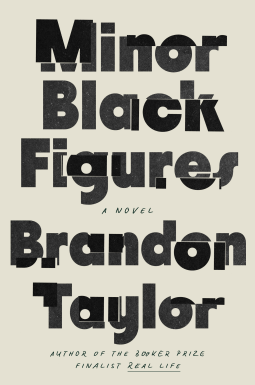
Minor Black Figures
A Novel
This title was previously available on NetGalley and is now archived.
Send NetGalley books directly to your Kindle or Kindle app
1
To read on a Kindle or Kindle app, please add kindle@netgalley.com as an approved email address to receive files in your Amazon account. Click here for step-by-step instructions.
2
Also find your Kindle email address within your Amazon account, and enter it here.
Pub Date Oct 14 2025 | Archive Date Oct 14 2025
Riverhead | Riverhead Books
Talking about this book? Use #MinorBlackFigures #NetGalley. More hashtag tips!
Description
From “literary superstar” (The Boston Globe) and Booker Prize finalist Brandon Taylor, his “most accomplished novel” (The New York Times): the story of a gay Black painter navigating the worlds of art, desire, and creativity
New York simmers with heat and unrest as Wyeth, a painter, finds himself at an impasse in his own work.
After attending a dubious show put on by a collective of careerist artists, he retreats to a bar in the West Village where he meets Keating, a former seminarian. Over the long summer, as the two get to know each another, they talk and argue about God, sex, and art.
Meanwhile, at his job working for an art restorer, Wyeth begins to investigate the life and career of a forgotten, minor black artist. His search yields potential answers to questions that Wyeth is only now beginning to ask about what it means to be a black artist making black art amid the mess and beauty of life itself.
As he did so brilliantly in the Booker Prize finalist Real Life and the bestselling The Late Americans, Brandon Taylor brings alive a captivating set of characters, this time at work and at play in the competitive art world. Minor Black Figures is a vividly etched portrait, both sweeping and tender, of friendship, creativity, belief, and the deep connections among them.
Available Editions
| EDITION | Other Format |
| ISBN | 9780593332368 |
| PRICE | $29.00 (USD) |
| PAGES | 320 |
Available on NetGalley
Available to Buy
Buy on Amazon Buy on BN.com Buy on Bookshop.orgAverage rating from 96 members
Featured Reviews
 Kyle C, Reviewer
When I read this novel, I was reminded of Rita Felski’s 2015 book “The Limits of Critique”. In short, her book examines how “critique” has become the dominant praxis in the humanities. Scholars have moved away from appreciating great works of art and literature and just commenting on the formal aspects of genre and themes. There is less affect, less description. Instead, trained in an array of subdisciplines (Marxist theory, Freudian psychotherapy, feminist reading, queer theory, postcolonialism), they engage in the higher act of critique, applying different methods and lenses in order to problematize the works in front of them. In this model of scholarship, the critic does not simply read texts but unmasks and demystifies them, exposing the structural, systemic and even subconscious origins of a piece of art or literature. Critique is a suspicious and cynical posture towards art and literature, always looking for the operative systems of power underpinning it—hegemony, patriarchy, heteronormativity, colonialism, the superego. Art becomes, like all cultural products, another object of academic scrutiny. But this exaltation of critique also means the evisceration of art, taking away any idea of beauty (isn’t this what critique is meant to show—that any beauty is just some invention of the white male bourgeoisie or, subversively, some resistance to it?)
So it is in this novel: Wyeth is a black painter who paints black figures, but he is troubled by his work. Everyone seems to think that his portraits mean something: that they are a political commentary, that they are a response to the BLM protests. He adapts a scene from Ingmar Bergman’s “Winter Light”, recasting the disconsolate priest as a black man. In the background lies the body of a suicide. What Wyeth meant to convey in his painting was a black figure experiencing spiritual doubt and disillusionment; what online viewers saw was an allusion to George Floyd and a history of state violence. Wyeth likes to paint black men in renaissance style and he is obsessed with French New Wave film. But other painters see all this as anachronism and whimsy, an artist failing to depict blackness in its contemporary realities. Whatever he does, Wyeth cannot escape a political presentism and racial reading of his work. When Wyeth looks at others’ portraits of black people, he in turn sees a vista of problematics: the exoticization of blackness, the essentialization of black identity into an inherent object, the treatment of the black person “a creature of sentimental curiosity” and at the same time “hypersaturating or desaturating the black figure to the point of abstraction”. Wyeth wants to depict a black person in 19th century Swedish knitwear or in the style of Sargent—but he can’t think of a way to represent blackness outside of contemporary politics and Ivy League preoccupations.
Unsurprisingly, Wyeth is unable to paint anymore. He has so thoroughly internalized the discipline of critique that he can no longer imagine a way to represent a black person without implicating them in broader representational tropes (if there is nothing outside the text, as Derrida says, then there can never be blackness outside of the traditions of slavery and centuries of racism). Wyeth worries about how his art will always be misinterpreted as some off-key statement of black activism; he also worries that if he depicts black figures, he will be perversely profiteering off his race rather than engaging in legitimate art (“identidarian art grift”); he wants to produce and sell art but he worries that the requisite pushiness and careerism, the networking at parties, the self-promotion on social media, will render his art mercantile and inauthentic; he worries that the proliferation of digitized copies online will dilute the value of the original piece; and he worries that if he depicts black people, they will no longer be real individuals, just faces subsumed into black identity. He wonders, then, if the only way to depict a black man would be to paint a white figure. He discovers in an exhibition, the bold claim that “true negro figuration would be depicting the white man as the object of histories of violence”—and he is enamored with this. Maybe blackness is not about black skin but about violence and subjection.
Wyeth is versed in all the academics trends and he talks theory with other artists reluctantly but with authority. But in practice, he is a traditionalist. He paints people because he likes the subtle features of their face or the distinctive course of their veins. He wanders the street taking photographs of moments, hoping to somehow transmute the moment into a painting that is “real”. He loves canonical artists from the renaissance to the early 20th century—from Caravaggio to Sargent. But theory has put him in perdition. He cannot create without torturing himself with critique, wondering whose eyeballs and whose hegemonic gaze will interpret his work. Can’t he just, he wonders, depict black people in the same way white artists depict white people—without it becoming a thesis on identity?
In this novel, Brandon Taylor has given a real novel of thoughts, showing an artist engaging with theory, with the craftsmanship and technique of art, with literature and cinema, and struggling with how to paint and to represent something “real” (whatever that might mean). In the end, Wyeth does depict a kind of black identity: a black sheep, a lost soul, an ex-Jesuit, Wyeth’s on-and-off-again boyfriend, Keating. Somehow, “it’s a black painting,” Wyeth thinks when he sees it at an exhibition. But for all Wyeth’s relentless self-examination over the ethics of representation, his boyfriend Keating is surprisingly hyper-scrutinized and under-theorized. Wyeth notices everything about his lover—the veins of his forearm, the coiffure in his hair, the classical proportions of his face; Wyeth intensely examines each of Keatings’ words, looking for offense; he wonders about all of Keatings’ actions, down to why he washed his hands after shaking them with homeless people; Wyeth understands on some level the spiritual crisis Keating has experienced. But he never really seeks to understand or probe the life-story of an ex-priest who has become a bricklayer and well-dressed New York hipster. He puts him on a pedestal and holds him there for a portrait—and somehow his agonized-over “black painting” feels unreal—he has objectified this white ex-priest as some shorthand for his own spiritual agonies.
I think there are a lot of lazy ways to pin this novel down—it’s about a black boy from the south who moved to New York to make art; it’s about a gay man struggling to find meaningful intimacy over short-term flings; it’s about the vicious competitiveness and pointless vanity of the art-market; it’s a slutty priest fantasy. But it’s also a deeply probing work that looks at leftwing culture politics with brave heterodoxy (not that Wyeth isn’t himself a pro-abortion, pro-gay leftwing artist himself—he just doesn’t accept the platitudes about black art and representation that are in vogue). What irks Wyeth is that reading, and celebrating, race and gender in art does not deconstruct or liberate race and gender but further essentializes them.
It's a complex novel that is cerebral and metaphysical but also humorous and sexy, too. My review, unfortunately, doesn’t give a sense of the heartbreak in the story, the messiness of Wyeth’s relationships, and the beautiful cattiness of queer solidarity. Although it sometimes has the dragging feel of a “flaneur” novel, there are some fantastic scenes and parallel plots that keep it running along. It's an ambitious novel and I look forward to reading the reviews when they come out.
 Sara H, Reviewer
I have been eagerly awaiting this new novel by Brandon Taylor in part because I love reading his literary criticism. I haven’t learned much about being a generous, yet critical reader from Taylor and I often find myself agreeing with his broader takes on the state of literature. This book is about Wyeth, a Black painter from the South by way of the midwest now living in NYC. He works part time at a gallery and part time for an art restorer, and, in his spare time, he is trying and failing to paint something that feels real to him. Taking place over a single summer, the book includes Wyeth’s budding relationship with former Jesuit and a mystery surrounding the discovery of a series of lithographs. But it is mostly about Wyeth. His internal anxieties about his art and the way his need for control inhibits authenticity.
When I started Minor Black Figures I was thrilled because I felt like I was seeing his thinking about books come to life in this book. This is a social novel that cares about how people exist in a complex ecosystem of other humans. It explores clashing ideologies, deepfelt friendships, and philosophies of art. It’s also a love story. In many ways, the book feels old fashioned and yet it is also extremely of its time, wrestling with technology, apathy, and life after the reality shattering events of 2020: Covid and the murder of George Floyd. Taylor manages to bring his own brilliant critic’s eye about art and ideology into this novel while still creating an emotional anchor for the reader and a flawed, but relatable character in Wyeth. I absolutely loved this book. It won’t be for everyone, but it was most certainly for me, and I am happy to say I have a new favorite Brandon Taylor novel.
Readers who liked this book also liked:




Melinda Taub
General Fiction (Adult), New Adult, Sci Fi & Fantasy



We Are Bookish
Multicultural Interest, OwnVoices, Teens & YA


Silvia Moreno-Garcia
Historical Fiction, Literary Fiction, Sci Fi & Fantasy

Khadijah Queen
Biographies & Memoirs, Essays & Collections, Nonfiction (Adult)