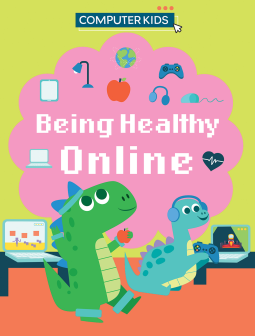
Being Healthy Online
This title was previously available on NetGalley and is now archived.
Send NetGalley books directly to your Kindle or Kindle app
1
To read on a Kindle or Kindle app, please add kindle@netgalley.com as an approved email address to receive files in your Amazon account. Click here for step-by-step instructions.
2
Also find your Kindle email address within your Amazon account, and enter it here.
Pub Date Aug 15 2025 | Archive Date Sep 15 2025
Rosen Publishing Group | Windmill Books
Talking about this book? Use #BeingHealthyOnline #NetGalley. More hashtag tips!
Description
Grades K - 2+
It’s important to take care of your body and mind each day, and online is no different. This book introduces readers to important concepts related to being healthy online, from dealing with cyberbullies to taking short breaks when needed. Readers will learn the skills they need to stay safe and healthy as they use the internet regularly. Activities give readers the opportunity to use what they’ve learned and test their skills. With much of their lives spent online, kids need these essential skills to keep them happy and healthy.
Available Editions
| EDITION | Hardcover |
| ISBN | 9781538399743 |
| PRICE | $28.93 (USD) |
| PAGES | 32 |
Available on NetGalley
Available to Buy
Buy on Amazon Buy on BN.com Buy on Bookshop.orgAverage rating from 11 members
Featured Reviews
 Kara S, Librarian
This book uses engaging characters like dinosaurs to serve as positive role models for kids on healthy habits re: internet use! It breaks down exactly what it is going to share with kids immediately, getting them prepared and making it clear what they are about to read. This is an extremely important topic, explored in an adorable fashion. It includes practical habits and objectives, and will certainly be a must buy for my public library collection. From physical health to mental health, this is much to be considered when allowing a child online for the very first time, and this read really does do a thorough job of covering them all in a digestible fashion. I would almost recommend reading it together in chunks over a spread out period of days or weeks and discussing as a family before allowing a child their first device. This team delivered a great tool that we’re lucky to have!
 Carolyn C, Librarian
I really appreciated the helpful tips, cheerful illustrations, and appropriate wording for the intended audience. There are wonderful universal tips that kids and adults can use, such as making sure we are careful with devices (don't eat or drink near a screen, use good posture), and good advice about being responsible online.
I highly recommend this book for schools and libraries.
Shannon K, Reviewer
This is such an important book and a great tool to teach young kids about internet safety. I will start this review off with a quick note: I think that this book is great as an introduction, but other resources will likely be needed as kids get older and face new things online. Now for my actual opinions on this book specifically. For multiple reasons, this book is perfectly age-appropriate and will definitely be a great resource for so many. The author made sure to cover a wide range of topics from physical health tips to online trolls. I thought that it was notable that the author included tips on posture and taking breaks because people don't think about these things, despite them being very important. Lastly, since I have nothing bad to say about this book, I loved how the author and the illustrator worked together to create likable and fun dinosaur characters, who acted as catalysts to get the teachings of this book across. Bravo!!!
 Jamie R, Librarian
“Being Healthy Online” is a must have for health teachers. This is the perfect story to introduce staying safe online while making it plenty humorous. I highly recommend it for school libraries, classroom collections, and homeschool families.
Thank you to NetGallery and Rosen Publishing Group for an advanced copy of this ebook in exchange for my honest review.
 Reviewer 1838901
Thank you for reminding me that I should probably have better posture while writing this review. This book is full of very helpful information. Though I think that it might be a little bit much for the younger age range to sit through, depending on the child. I do think the activities included in the book, such as stretching and trying to match the devices to the dinosaur, will help with this, though. I appreciate the details in the section titled "It's Not All True" this feels like an updated version of what used to be taught in schools, but it now includes that filters can make things seem different than they are, which I appreciate. Overall, I think this book could be very helpful for elementary school environments in the current age of technology. Even if a younger child couldn't sit through every page, it would be a good conversation starter and something to go back to.
John L, Reviewer
A very suitable early reader to discuss a lot of aspects of the online life, from correct posture at the keyboard or with the tablet to troll life and fake news. Bright colours, cartoon dinosaur characters, and sheer common sense all make up its impact. Plus, of course, it also suggests having a real world experience if trolling gets you down, or if you've spent too long chatting to a friend online then damned well go and have a bike ride or popcorn with them irl. Yes, a lot of this is obvious, but the more it's reinforced the better for everyone. A strong four stars – it's just annoying there are six books in this set, including "Staying Safe Online", when all these valuable how-tos could all have been between the same two covers.
Educator 985113
Thank you Netgalley for allowing me to read this book in exchange for a honest review.
Great book full of easy to follow computer safety and health information. I
 Annelisa J. P, Reviewer
As someone who’s worked extensively with and has always loved children, I naturally have thoughts and concerns about the increased amount of time that they spend in front of screens, at increasingly younger ages. In this short and timely guide for children, author Clive Gifford demonstrates how to practice healthy habits while engaging in online activities. Mini, console-loving dinosaurs converse with each other and the reader, demonstrating real-world situations that children are likely to find themselves in and offering tips for them to have fun safely. The colors and overall presentation of the book are bright and welcoming, and the information, including the reflection questions, are presented simply and effectively.
Gifford’s tone is that of one who is very familiar with the online spaces that children inhabit. He understands the sense of excitement and fulfilment that they get from their time there. As such, his approach is not to completely deter them from spending time online altogether, but to appeal to them with kid-friendly logic about how to balance their time appropriately. The author respects children by speaking directly to them with the understanding that they will be on their own with their devices. At the same time however, there’s also the implicit assumption that an adult will be nearby. The author makes frequent references to children speaking with their adults, such as asking them questions about something they view online which may seem untrue.
In addition to the practical advice about their online behavior, Gifford takes care to talk to children about the physical care for the devices. This includes advice about handling them firmly so that they aren’t in danger of dropping, making sure that they don’t overcharge or overheat, and not eating or drinking while using them to prevent food gumming up the works, literally. These messages about the importance of caring for one’s belongings are important ones that children can carry with them as they participate in many activities, both online and off, and which parents and caregivers can reinforce.
I thoroughly enjoyed Gifford’s discussions with the reader about establishing the difference between fact and opinion, asking questions to determine whether something is too good to be true. This is a necessary skill for children to have in the age of AI and deepfakes (some of which they’ve likely encountered already) and the tips here provide them with a skillset that they can build on for the future. One of my favorite aspects of the book is the way that Gifford draws clear distinctions between online worlds and the real world. He firmly states that the real world is a fun, important place and that care of the physical body is important, hence the importance of taking stretch and snack breaks and setting timers. There’s a deep sense of empathy that runs through the text, coupled with the importance of emotional health and thinking about how online behavior can impact others. Gifford emphasizes the importance of establishing and maintaining human relationships with friends and family, and to be considerate of the people they talk to on the other side of the screen. These are great lessons for children (as well as older readers) and help reinforce the connection between responsible digital activity and social-emotional skills.
This book is the latest iteration of a long line of technology etiquette manuals for devices such as telephones (shout out to Bell Laboratories!) record players and personal computers, tailoring the guide to correlate with children’s needs in a new, constantly evolving digital age. Same traditions; new media. I see that it’s one of a series of books about online skills for children. I would like to read them all and see how they complement each other. The series would make a good acquisition choice for a library that seeks books about digital citizenship information for young readers. Although directed towards children, there’s a lot of potential for parents and caregivers to read the book with their children, prompting good and meaningful discussions that will be beneficial as they grow.
Thank you to NetGalley and the publisher, Windmill Books (Rosen Publishing Group) for this DRC in exchange for a fair and honest review. The thoughts and opinions expressed here are my own.
Readers who liked this book also liked:

JUNO
Arts & Photography, Comics, Graphic Novels, Manga, Travel
Kelly Thompson
Comics, Graphic Novels, Manga, Entertainment & Pop Culture, Teens & YA
Julie Tremaine; Carly Caramanna
Cooking, Food & Wine, Entertainment & Pop Culture, Travel

DaySpring
Entertainment & Pop Culture, Humor & Satire, Religion & Spirituality