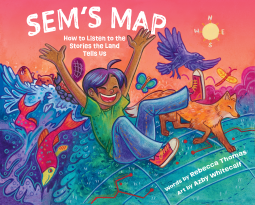
Sem's Map (pb)
This title was previously available on NetGalley and is now archived.
Send NetGalley books directly to your Kindle or Kindle app
1
To read on a Kindle or Kindle app, please add kindle@netgalley.com as an approved email address to receive files in your Amazon account. Click here for step-by-step instructions.
2
Also find your Kindle email address within your Amazon account, and enter it here.
Pub Date Sep 9 2025 | Archive Date Oct 14 2025
Nimbus Publishing | Nimbus Publishing Limited
Talking about this book? Use #SemsMappb #NetGalley. More hashtag tips!
Description
From the author of I'm Finding My Talk comes a candid picture book about the importance of Indigenous place names, and acknowledging traditional lands.
Sem is confused. The map Mr. Trainer has just put on the screen is all wrong. It's the same shape as Turtle Island but it's nothing but boxes and lines, and it's filled with names he doesn't know. There's no reference to the stories of the land his Kiju tells him every night while she braids his hair. But Sem's teacher and classmates claim there's nothing wrong. It's the same map they've always used.
See tries to see the land the way Mr. Trainer showed him, but it just doesn't feel right. Where is the story of how the moose gets his dinner? Or where the fish run in the spring? Or when to tap the trees for syrup?
With the help of Kiju, Sem will show his teacher and his classmates how the stories of the land, the Indigenous place names, are far older than any map.
A gentle calling-in, this assured story from Governor General's Award finalist Rebecca Thomas is paired with colourful, lively illustrations from Azby Whitecalf, as well as colonial and decolonial maps of Turtle Island (North America) for reference. Sem's Map is an invaluable resource for caregivers, educators, and young readers about the importance of acknowledging the traditional lands we live on, and unlearning colonial ways of the past.
Available Editions
| EDITION | Paperback |
| ISBN | 9781774714966 |
| PRICE | CA$14.95 (CAD) |
| PAGES | 32 |
Links
Available on NetGalley
Available to Buy
Buy on Amazon Buy on BN.com Buy on Bookshop.orgAverage rating from 9 members
Featured Reviews
 Reviewer 1232720
Thoughts:
I received an advance review copy for free, and I am leaving this review voluntarily. I really enjoyed this book myself as it tells a real story about the land before settlers arrived. As a Brit myself I don’t have enough in-depth knowledge about the history and land boundaries of North America but this explains it in a great way to start children’s exploration of the land they live on. The illustrations themselves were beautiful and added to the overall impact of the story. I also liked the map of North America at the beginning and the map of Turtle Island at the end to base further learning on.
Favourite Quote:
Kiju always told him about the land. She would tell stories about the river and the forest. Where the moose ate his dinner and when it was time to tap the trees for syrup.
Mr. Trainor’s map didn’t tell any of these stories. They were all lines and boxes.”
Librarian 1848089
What a unique way to look at the land we live on. This book has beautiful pictures and did a great job informing the reader of the way indigenous people look at the map of North America. Very cute.
 Lauren S, Librarian
In geography class, Sem's teacher uses a map of North America on which the names are not the ones Sem has been taught by his grandmother, Kiju. When he shares with his class that the names are not the ones he knows, his classmates laugh and his teacher seems eager to move on. At home that night, Kiju affirms Sem's ancestral knowledge and the next day, Sem speaks with his teacher again, this time asking if his grandmother could visit their class. The story comes to a close as Kiju arrives to talk to Sem's class.
While the story ends rather abruptly, it succeeds in celebrating Indigenous naming traditions and ways of knowing, and Whitecalf's vibrant, textured illustrations boldly leap from the pages. An author's note speaks to Thomas's own experience with place names and her hope for a return to listening to the land. Two maps of North America bookend the story, the first of which is labeled with settler borders & place names and the second with Indigenous place names.
Carolyn C, Librarian
This important book tells a simple story of a child who doesn't understand why the geography lesson isn't teaching what he knows to be true in his heart. The reader then learns how indigienous and First Nation stories are passed down, why the names we give people and places are so important, and what the land was meant to be called and how it was meant to be treated.
In the beginning of the book, Sem wasn't listened to. Once his teacher and classmates agreed to listen, there was so much more learning that can be had. The author also had a great note about her experiences with the atlas and geography she learned in school vs. the land and names that were more recently reclaimed.
I highly recommend this book for all ages.
Librarian 1896886
I enjoyed the relationship between Sem and Kiju, as well as Mr Trainor's ability to change his mind and listen to Sem. The concept of original place names is important for educators to cover at UW Botanic Gardens, where I work.
Readers who liked this book also liked:

Gertrude Chandler Warner
Children's Fiction, Comics, Graphic Novels, Manga
Chris Oxlade, Anita Ganeri, Mike Love
Children's Nonfiction, History, Science
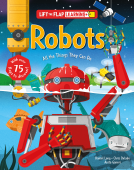
Chris Oxlade, Anita Ganeri, Daniel Long
Children's Nonfiction, Computers & Technology, Science
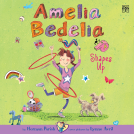
Herman Parish
Children's Fiction, Teens & YA
Dan Gutman
Children's Fiction, Children's Nonfiction, Teens & YA