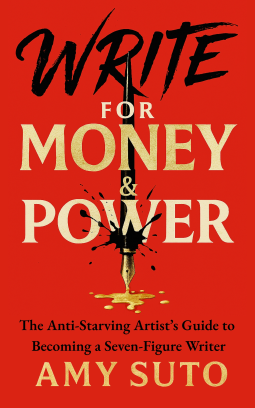
Write for Money and Power
The Anti-Starving Artist’s Guide to Becoming a Seven-Figure Writer
This title was previously available on NetGalley and is now archived.
Send NetGalley books directly to your Kindle or Kindle app
1
To read on a Kindle or Kindle app, please add kindle@netgalley.com as an approved email address to receive files in your Amazon account. Click here for step-by-step instructions.
2
Also find your Kindle email address within your Amazon account, and enter it here.
Pub Date Jan 12 2026 | Archive Date Apr 15 2026
Description
AMAZON BESTSELLING AUTHOR, TOP SUBSTACK NEWSLETTER CREATOR, AND 7-FIGURE WRITER AMY SUTO SPILLS HER SECRETS
Still buying the starving artist myth? Burn it — and get paid.
The gatekeepers told you poverty was noble so that you’d shut up and stay cheap. Ready to write your way out of the lie designed to keep you small, obedient, and broke?
If you’ve ever felt trapped in a writing career that pays in “exposure” or pocket change, this is your permission slip to demand more. Much more.
Amy Suto went from broke in the Hollywood trenches to becoming booked out as a seven-figure writer, bestselling author, and creator of a top 30 Substack newsletter. In Write for Money and Power, she shows you exactly how she did it — and how you can too, even if you’ve never made a dollar from your writing before.
Whether you’re a freelancer, a ghostwriter, a novelist, or any kind of writer with bills to pay and a vision to realize, this isn’t another “believe in yourself” pep talk. It’s a real, grown-up plan to make money and grow your personal power with your writing.
If you’d rather make history than excuses — keep reading.
In Write for Money and Power, You’ll Learn How To…
- Crush the lie that artists should be broke with history’s real examples (Michelangelo invoiced like a boss, Shakespeare co-owned the damn theater.)
- Follow Amy's 12-month roadmap to build your writing empire. This is the exact plan she'd use to go from $0 to building a seven-figure writing empire from scratch.
- Rewire your brain for seven figures. Learn the pricing scripts, positioning plays, and simple mental models that allow you to generate money and power from your words and your laptop.
- Build a ghostwriting business that screams luxury. Trade cheap words for six- and seven-figure projects — and what film schools and gatekeepers are scared for you to find out.
- Grow a paid newsletter empire. Own your audience, write on your terms, and unlock the freedom of predictable, reader-funded income.
- Self-publish like a tycoon. Who needs permission to publish? It’s time to own your work. Consider: Taylor Swift bought back her masters. Brandon Sanderson pocketed $41 million on his self-published book launch on Kickstarter. Now? It’s your turn.
- Scale without burning out. Learn the systems, daily rituals, and non-negotiable boundaries that turn chaos into cash flow.
- Write from anywhere — on the couch, a coast, or a café in Rome.
Why is this book different?
Because this isn’t “wait your turn” advice — it’s how to skip the line.
Amy shares the exact systems she used to turn her writing into a seven-figure, work-from-anywhere biz.
Still skeptical?
“But I’m a total beginner.” Great. This book exists to make sure you don’t stay one. All you need is the willingness to bet on yourself.
“But no one will pay that much for writing.” Amy’s clients do — and so do so many other clients and readers. This book is here to build your confidence and smash your limiting beliefs so you can step into your power and charge more than you ever thought was possible.
“How do I know this is what I need?” It’s 99 cents. If a dollar feels like too much of a risk to change your writing life, you need this book more than you think.
Add. To. Cart.
If you want your words to fund your life and your dreams — not starve them — Write for Money and Power is your next essential read.
Own your story. Build your empire. Make your writing your job.
Because power isn’t a dirty word: it’s your ticket to freedom.
Advance Praise
Like a kid watching an R-rated movie for the first time, I was wide-eyed and mouth agape while reading "Write for Money and Power," hanging on Amy's every word. It’s not just a practical guide. It’s the pep talk I didn’t know I needed. I can’t un-dream Amy’s fullproof plan, or stop the avalanche of creative energy hitting me now. Writers looking to get paid what they deserve—read this book now!
—Lauren Burke Meyer, an award-winning writer and founder of the Lauren's Law blog
I requested an arc of Write for Money and Power yesterday morning. It hit my inbox within an hour.
I finished the book last night around midnight. Holy moly.
If you’re a writer who’s ready to take control of your life, this is the book you need. I didn't think Amy Suto could write a book that's more helpful and insightful than Six-Figure Freelance Writer. I was very wrong. Turns out, Write for Money and Power obliterated the bounds of what I thought was possible from a writing career.
Amy's incredibly raw, honest, and "wake up" attitude to controlling your IP, piloting your own ship, and taking control of your life is what every creative needs. Thoughtful frameworks like growth weeks vs. maintenance weeks as a tempo for the writer lifestyle and concepts like building out your business with a clear promise, audience, and stance provide tangible, immediate steps and systems to implement. Seven figures as a writers isn't just possible, it's shockingly attainable with the framework Amy shares. And beyond practicality or tips-and-tricks, Amy hits you over the head with the most powerful one-liners that shift your mindset from starving artist to Creative CEO in a way that rewires how you think about yourself, your words, and your worth.
Not a single sentence of this book is wasted. It's a masterclass in writing in itself, and a direct shot of writerly adrenaline to get your butt into action, get those fingers on the keyboard, and grab ahold of that life you've always wanted.
I'll stop talking now. Just do yourself a favor and go read this book. Now. Stop procrastinating.
--Allison Lau, writer of the Bookish Biologist Substack
Available Editions
| ISBN | 9798992619041 |
| PRICE | |
Available on NetGalley
Available to Buy
Buy on Amazon Buy on BN.com Buy on Bookshop.orgAverage rating from 30 members
Featured Reviews
 Kelly P, Reviewer
I'm always on a quest to make additional income from my writing, so when I came across this title, I knew I had to read it! Suto’s book is informative and left me feeling inspired. I know it takes effort and skill to write well, but Suto’s guide puts it all together for you. Thanks to NetGalley for the ARC.
 Kailee C, Reviewer
If you’re a writer who’s ever felt trapped by the “starving artist” stereotype then Write for Money and Power just might be the book you’ve been waiting for. Amy Suto doesn’t offer gentle encouragement, but she gives you a game plan that you can actually use.
From the first page I was invested. Instead of being just a “chase your dreams” pep talk, Suto draws on her own experience, going from minimum-wage Hollywood jobs to a seven-figure writing income. She strips down exactly how she built a writing career that pays the bills and more, from stints in ghostwriting to newsletters to self-publishing.
What really sets this book apart is that it doesn’t leave you hanging. You get concrete, tactical advice, including pricing, pitching, building an audience, protecting your creative energy, and structuring your business so writing becomes not just passion or hobby, and instead becomes profit. Suddenly the idea of charging what you’re worth, and getting clients who pay it, doesn’t feel audacious - it feels right. I highly recommended this for any writer ready to step up, claim their value, and make writing their job.
Thank you so much to the author, NetGalley and Sutoscience LLC for the eARC of this book!
 Siggy P, Educator
Write for Money and Power is equal parts memoir and life/business advice. Amy Suto shares her early experiences trying to make it as a script writer in Hollywood in a system where the odds are stacked against creatives and very much in favour of management. She shares her story in a way that is honest, vivid and very relatable. As a teacher keen to do some more writing, much of Amy’s advice can also be applied to schools.
Most of us know theoretically we should not undersell ourselves or give away our power too easily. When careers are presented as ‘dreams’ rather than professions, it is very easy to fall into these self-sacrificing traps. What this book offers is the steady reminder of why we shouldn't do that, and how to change it.
Amy writes from lived experience rather than theory. She traces her path from insecure, sporadically paid Hollywood work to a writing career that pays well and pays reliably. Seeing writing as a business is key as is valuing yourself as a professional.
For me this is a message that landed in a timely way. It might speak to you too!
With thanks to Amy Suto and Netgalley for the arc copy.
 Ajla G, Reviewer
Thank you, Amy! As soon as I finished reading the book, I started my first newsletter on Beehiiv, and I wrote and scheduled my first issue.
This book is a two-in-one actionable roadmap and a therapy session for both working and aspiring writers.
I haven't yet read Amy's first book on freelance writing, but now I'm going to.
 Mike M, Media/Journalist
Finally, a book that speaks directly to writers and will help them to see what is really possible with their writing careers.
 Ioana M, Reviewer
"Write for art. Write for fun. Write for rage. But don't be ashamed to write for money and power".
And what a powerful book this has been. So empowering and inspirational and talking the real talk. Part manifestation, part strategy manual, it is filled with strength and realness. The perfect pep talk + tools to really do the work.
I am grateful to have received this in order to share my view on it and I recommend it to anyone who it's on this path and maybe feel a bit comfortable by these two words: money and power. Just read it.
Lyle P, Reviewer
Do you believe in the myth of the starving artist? Amy Suto sure doesn’t, and in her new book, Write for Money & Power, she delivers a 12-month guide on how to you can go about making real money from your writing. Inspiring and informative, this book may just be the kick in the pants you need to jumpstart a successful writing career. This is definitely a book I’ll be reading more than once. Thanks so much to the publisher for an ARC.
 Reviewer 1191677
This is a sharp, practical guide for writers who want more control over their careers. Suto’s focus on IP ownership, strategic positioning, and treating writing like a business feels both refreshing and necessary. The frameworks—like alternating growth and maintenance weeks and defining your promise, audience, and stance—offer concrete steps rather than vague motivation. The tone is candid and confidently pushes writers to think beyond the “starving artist” mindset and into a Creative CEO model. For anyone serious about building a sustainable writing career, this is worth reading
Reviewer 1931224
I will admit, I am NOT a writer, I am a wannabe blogger though. I was excited to read this book to see if there were some ideas on how I can turn my dreams into reality. I was blown away by this book. I love that it wasn't just a bunch of "how to write" advice but instead focused on mindset and strategies to help you turn your writing into a profitable business. It shares multiple income stream options and how you don't need to be a "starving artist" in order to make writing your full-time career. I haven't started implementing much yet but I have been able to start exploring some of the concepts in the book and have found them really helpful.
* I received this book at no cost in exchange for my honest review. All opinions are my own.
 Demetris P, Reviewer
“Write for Money and Power” and the End of the Starving-Artist Myth: A Review of Amy Suto’s Playbook for Writers Who Want Leverage, Not Martyrdom
By Demetris Papadimitropoulos | February 4th, 2025
In “Write for Money and Power,” Amy Suto arrives wearing two outfits at once: the silk robe of the artist and the tactical vest of the operator. She is here to romance you out of your shame about wanting money, then hand you a clipboard. She is here to seduce the starving artist myth into a dark alley and leave it there, blinking. She is here, most of all, to tell you that the modern writer’s problem is not talent. It’s architecture.
The book’s central argument is both blunt and strangely tender: money is not a moral compromise, it is “creative oxygen.” Power is not celebrity or domination, it’s freedom – the right to choose your work, your pace, your health, your life. If that sounds like a slogan, Suto anticipates the eye-roll and barrels through it anyway, because she writes like someone who has already lived through the alternative. Her pages are full of hard-won urgency, the kind you get after your body mutinies or your bank account does. She wants writers to stop treating their ambition as a guilty pleasure and start treating it as a business plan.
This is not a book about writing sentences so much as it is a book about writing as leverage. Suto’s true subject is the writer as a small, self-contained company – a “creator CEO” – building an engine that can generate income without requiring martyrdom. The prose comes with an espresso-shot tempo: short paragraphs, sharp pivots, a fondness for swaggering imperatives (“raise your rates,” “ship the draft,” “stop undercharging”), and metaphors that turn anxiety into a toy you can throw across the room. The vibe is equal parts confession and pep talk, with a San Francisco sheen: Substack subscriptions, remote workflows, high-end clients, the occasional rooftop bar, a sense that you are always one good system away from getting your life back.
Suto is also a reliable narrator of her own obsession: she likes frameworks the way some writers like sonnets. You can feel her pleasure in naming the parts. “Three pillars.” “Roadmaps.” “Laser protocols.” “Safety nets.” “Lean dream teams.” “Freedom seasons.” She writes in the gospel cadence of contemporary self-help – brisk, motivational, a little profane – yet she’s at her best when she lets the seams show: the moments when the book admits how fragile the whole enterprise can feel, especially for the kind of person who makes things out of language and then has to invoice for it.
The book is divided like a business blueprint with a novelist’s sense of momentum. Early chapters perform an exorcism: the inherited scripts about art, suffering, gatekeepers, and virtue. Suto positions traditional institutions – publishing, Hollywood, legacy media – less as villains than as collapsing infrastructures. She gestures at labor unrest and the shrinking middle of creative careers, at how the old ladder has missing rungs. In this landscape, her thesis isn’t merely aspirational; it’s an adaptive strategy. When she writes about “Wi-Fi and weaponized words,” she is naming a real shift in the culture: the way distribution has decoupled from permission. The writer with an email list and a payment link is no longer a quaint internet curiosity. They’re an economic unit.
Part Two of the book becomes a practical catechism: three income pillars (paid newsletter, self-published books, and luxury freelancing/ghostwriting) designed to reinforce one another. The logic is modern and slightly ruthless. You build recurring revenue (subscriptions) while you build assets (books) while you fund everything with high-ticket cashflow (services). This is, in essence, the creator economy’s answer to the old patronage system, updated for the era of platforms. If “The 4-Hour Workweek” sold a dream of escape through automation, Suto offers something more grounded: not escape, but control. She is less interested in vanishing to a beach than in waking up in your own life without dread.
Her most compelling practical chapter, “Your Roadmap From Zero to Seven-Figure Writer in 12 Months,” reads like a cinematic montage, all sprint and sweat and calendar blocks. It’s audacious on purpose, a kind of productive dare: if you aim at a million and land at half, you’ve still built a life. The month-by-month structure is a familiar self-help device, but Suto gives it bite by pairing it with a psychological argument about belief: “realistic” is not a neutral category, it’s a ceiling your nervous system enforces. The roadmap’s true function is less forecasting than permission-making. It asks the reader to behave like a professional before they feel like one – to publish before they’re “ready,” to pitch with imperfect confidence, to treat consistency as a moat.
The book’s best pages are the ones that understand how much of a writing career is actually mood management. Suto has a novelist’s instinct for the villain that lives inside the house. Perfectionism is “procrastination wearing Prada.” Catastrophic thinking is “misplaced imagination.” The enemy is rarely craft alone; it is the spiraling story the writer tells themselves about what they deserve. There are echoes here of “The War of Art” and “The Practice,” though Suto’s tone is less monkish and more boardroom-with-a-ring-light. Her spirituality is systems.
And then, in Part Three, she becomes something like a pragmatic maternal figure for the overworked freelancer: build the safety net, protect the body, hire help, stop trying to be the entire supply chain. In “Creating Your Safety Net,” she is notably clear-eyed about the fragility of being a one-person enterprise. The advice is “boring” by design: emergency funds, legal templates, insurance, sleep. But she writes about those fundamentals with the intensity most people reserve for plot twists, because she knows what it costs when they’re absent. It’s one of the book’s most convincing sections precisely because it is not glamorous. It is the anti-highlight reel.
“Build Your Lean Dream Team” continues this anti-fantasy: scaling doesn’t have to mean building an agency that eats your life. Suto favors specialists over bureaucracy, partnerships over payroll, small teams over sprawling structures. She cites research on small teams and makes it feel like commonsense: fewer moving parts, less overhead, more speed. Here the book quietly aligns with a broader cultural mood: the post-ZIRP hangover, the era in which “growth at all costs” looks like a hangover rather than a virtue. Suto’s ideal business is a well-tuned machine, not a kingdom.
The chapter that will likely provoke the most conversation is “Humans vs. AI: Win With Taste,” in which Suto discloses that she wrote this very book with AI assistance in 83 hours. This is both a marketing grenade and an argument in miniature. She frames AI not as replacement but as intern: summarizer, outliner, idea machine, proofreading assistant, a way to buy back thinking time. The rhetorical move is savvy. Instead of pretending purity, she admits the taboo and then attempts to control the moral framing. In the current climate – where generative tools are reshaping white-collar labor, where writers and artists are debating consent and compensation, where trust in “authentic” creation has become a consumer anxiety – her transparency is either refreshing or irritating, depending on your priors.
What Suto gets right is that AI accelerates the already-existing market pressure toward “serviceable” content. If the internet is about to drown in competent prose, the differentiator won’t be grammar. It will be judgment. Taste. Worldview. The particular scar tissue of a lived life. This is, arguably, the book’s most genuinely literary claim: that writing is not typing, it is thinking, and thinking is shaped by experience. AI can mimic structure; it can’t mint soul. Suto’s metaphor of the limited-edition press – the hand-bound object that survives mass production because it contains care – is one of her best images, and it reveals her true aesthetic: not maximal output, but signature perspective.
Still, the AI chapter also reveals one of the book’s tensions: Suto wants to argue for voice, but she often writes in the shared dialect of modern entrepreneurial self-help, a genre whose voice can become, ironically, serviceable. Her sentences move fast, her metaphors land cleanly, her advice is frequently useful – yet the book occasionally feels like it’s sprinting past its own complexities. The ethical questions around AI training data, compensation, and consent are acknowledged more as atmosphere than as a field of conflict. The labor politics of creative industries – the way power still concentrates even on “democratized” platforms – appear in the background, then recede. A more ambivalent, more searching version of this book might have lingered longer in those shadows.
There is also the question of audience. Suto writes as if her reader is ready to be converted into a high-functioning operator: someone who can pitch relentlessly, post consistently, build funnels, run audits, price confidently, and maintain a fitness regimen. For many writers, that is an exhilarating reframing; for others, it may feel like a new kind of pressure masquerading as liberation. The book argues, persuasively, that systems create oxygen. But systems also require a particular temperament. The most helpful pages are the ones that admit wobble, that treat iteration as the point, that allow for seasons. When Suto leans too hard into the “countdown clock” mentality, the book risks reproducing the very burnout culture it condemns, only in a cuter outfit.
And yet: for all its occasional over-caffeination, “Write for Money and Power” is hard to dismiss because it speaks to a real contemporary ache. We live in a moment when “making it” as a writer often means assembling income from scraps: freelance gigs, side hustles, content work, platform algorithms. The old dream – one big deal, one gatekeeper anointing – has become, for most, statistically remote. Meanwhile the new dream – direct-to-audience, community-backed, subscription-supported – is both plausible and precarious, dependent on attention economies that can shift overnight. Suto’s book is, at bottom, a survival manual for this era, dressed up as a manifesto so it can also be a spell.
Her strongest kinship is with a shelf of pragmatic inspiration: “Essentialism” in its insistence on focus; “Atomic Habits” in its love of small, compounding actions; “Deep Work” in its reverence for protected attention; “Show Your Work!” in its belief that visibility is part of the job; “Company of One” in its suspicion of bloated growth; “The $100M Offers” school of value-based packaging; even “Year of Yes” in its insistence that a new life begins with a series of uncomfortable decisions. Suto’s difference is that she speaks directly to writers – not founders who happen to write, but writers who have been taught to apologize for wanting stability. She doesn’t just tell you to monetize; she tells you to stop flinching when you do.
If I’m putting on my reviewer hat – the one that demands both appreciation and resistance – I’d say Suto’s book succeeds as a catalytic object. It is less a work of original theory than a high-voltage synthesis, delivered with enough charisma to make familiar ideas feel newly executable. It is also, unmistakably, a product of its time: an artifact of the creator economy’s coming-of-age, of post-pandemic remote normalization, of legacy media’s erosion, of AI’s sudden arrival at the writer’s desk like an uninvited assistant. Its limitations are those of the genre it inhabits: it can oversimplify, it can glamorize, it can talk like certainty is a personality trait. But its virtues are equally genre-native: it can propel, it can clarify, it can make action feel possible.
Suto’s most persuasive promise is not the seven figures. It’s the redefinition of what a writing life can be when it is built to sustain a body. The safety net chapter, the emphasis on sleep and nervous system care, the insistence that outsourcing is a life strategy – these are the book’s quiet moral center. If the earlier chapters are gasoline, these are the firebreaks.
By the end, you feel what Suto wants you to feel: that the gate is open, that the old shame is optional, that the “blinking cursor and a fully-charged laptop” is not just a cliché but a genuine tool of agency. You may not buy every claim. You may bristle at the swagger. You may want more nuance where the book chooses speed. But you will almost certainly finish with a sharper sense of the battlefield – and a clearer map of your own leverage.
I’d rate “Write for Money and Power” an 84 out of 100: an energetic, savvy, often genuinely useful manifesto that sometimes outruns its own complexity, but whose core insistence – that writers deserve money, systems, and freedom without self-betrayal – lands with the satisfying weight of something a little like truth.
 Laura G, Reviewer
I genuinely enjoyed the insight and honesty Amy brings to 𝐖𝐫𝐢𝐭𝐞 𝐅𝐨𝐫 𝐌𝐨𝐧𝐞𝐲 𝐚𝐧𝐝 𝐏𝐨𝐰𝐞𝐫. Even though I don’t currently have personal aspirations of becoming a professional writer, I found so much meaningful application to other creative pursuits I care about.
What makes this book stand out is Amy’s anti-gatekeeping approach. She doesn’t hoard knowledge or speak in vague inspiration - she shares specifics. Not just the 𝙬𝙝𝙖𝙩, but the 𝙝𝙤𝙬. From practical advice on branding, avoiding common pitfalls, and an illuminating look behind the curtain of traditional publishing, she gives readers real tools. Her insight on outsourcing, navigating contracts, and confidently asking for your worth financially is both empowering and refreshingly direct.
Her personal stories and journey serve as inspiration, but never as “and you should want the same thing”. There’s no exultation of her path as the only path. Instead, she continually redirects the focus back to the reader, urging you to define what your ideal life and work situation looks like. It makes the book feel expansive rather than prescriptive.
I also appreciated her take on AI, a topic that can 𝘲𝘶𝘪𝘤𝘬𝘭𝘺 become divisive. She approaches it as a tool - one to be learned and harnessed responsibly - not as a replacement for creativity. Her perspective feels realistic and forward-thinking, acknowledging that we are moving deeper into an AI-driven world while still honoring the irreplaceable human element in meaningful work.
One of her closing ideas resonated deeply with me: that writing for money and power is (ultimately) about building a life rich with wonder before time runs out, and there’s no shame in that desire. That line encapsulates the heart of this book.
Everything she outlines is active - it requires focus, consistency, and motivation. This isn’t a passive dream. It’s a deliberate choice to show up. If you’re willing to put in that work, Amy paints a compelling picture of how writing can become more than a craft, it can be a vehicle for building a life you truly love.
Reviewer 2004041
This felt a little like Tim Ferris's 4HWW, but for writers. Suto has clearly done well off the back of the premium ghostwriting and Substack movements, having coffee in numerous lovely literary locations along the way :D Then to release a romantasy novel is a shrewd move, again given the market, giving a trio of revenue steams in the domain.
The biggest strength of this book for me is in fighting limiting beliefs. Elevating your vision. Having just released a debut fiction trilogy of my own, I'm very much in the trenches here with imposter demons rearing their head on many occasions. Suto offers genuine encouragement and inspiration here and that is a call to action for the reader/writer.
It was interesting hearing about her Hollywood background and how that wasn't all it's cracked up to be. The book is also pragmatic in highlighting the keys of consistency and looking after your health (physical and mental) on the journey too.
Maybe because I'm British, I couldn't completely shake a scepticism about a few elements and "Will this actually work for me?" but I think that would missing the point. You have to make your own roadmap, set your own north start and carve your own path towards it.
I made lots of highlights and will go back to re-read certain sections for sure.
Note - I received a free ARC copy of the ebook from NetGalley - Thanks Amy!
Readers who liked this book also liked:






Nancy B. Ronquillo
Biographies & Memoirs, Health, Mind & Body, Parenting, Families, Relationships