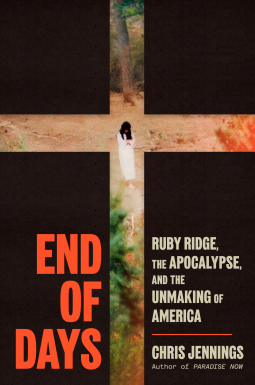
End of Days
Ruby Ridge, the Apocalypse, and the Unmaking of America
This title was previously available on NetGalley and is now archived.
Send NetGalley books directly to your Kindle or Kindle app
1
To read on a Kindle or Kindle app, please add kindle@netgalley.com as an approved email address to receive files in your Amazon account. Click here for step-by-step instructions.
2
Also find your Kindle email address within your Amazon account, and enter it here.
Pub Date Feb 10 2026 | Archive Date Mar 10 2026
Description
The gripping story of the Ruby Ridge siege, showing how the historic standoff between federal agents and a white-separatist family set the stage for the conspiracy-laced politics of the Trump era.
“Vivid, frightening, and fascinating…This book blew me away and opened my eyes.”—Walter Isaacson, author of The Code Breaker and Elon Musk
On August 21, 1992, shots rang out while federal agents were surveilling a cabin in Boundary County, Idaho as part of an operation to arrest Randy Weaver—a reclusive, mountain-dwelling survivalist—for failure to appear in court on a gun charge. When Weaver finally surrendered to the authorities eleven days later, his wife, son, and dog lay dead, as did a US Marshal. Ever since, America has been trying to make sense of what happened on Ruby Ridge. Today, the question could not be more urgent, as the shock waves from Ruby Ridge have amplified and compounded, cracking the very foundations of our democracy.
In End of Days, Chris Jennings explains the significance of this historic siege by setting the story of the Weaver family within the long history of apocalyptic Christianity in the United States, illuminating the ways in which that faith has gradually transformed the nation. The strain of doomsday Christianity that gripped the Weavers, he shows, was grounded in a particular reading of biblical prophecy that can be traced back to the 1870s and up through the twentieth-century rise of Christian fundamentalism to the right-wing conspiracism that now defines American society and politics. The events at Ruby Ridge acted as an accelerant for this spreading worldview, and are essential to understanding the crisis that our nation confronts today.
Available Editions
| EDITION | Other Format |
| ISBN | 9780316381949 |
| PRICE | $30.00 (USD) |
| PAGES | 384 |
Available on NetGalley
Available to Buy
Buy on Amazon Buy on BN.com Buy on Bookshop.orgAverage rating from 30 members
Featured Reviews
 Brendan D, Reviewer
A lot of people are going to be upset with this book. Come to think of it, everyone should find something to be upset with in Chris Jennings' End of Days. The writing and storytelling are the only things that didn't fill me with dread.
The book is ostensibly about Ruby Ridge. For the uninitiated, "Ruby Ridge" is shorthand for the 1992 standoff between a survivalist family in Idaho and the federal government. Before the Oklahoma City bombing was Waco and before Waco was Ruby Ridge. However, the most compelling aspect of this book for me was Jennings' very clearly explaining that Ruby Ridge was far from the beginning of this particular strain of paranoia, fundamentalism, and persecution complex.
Where did it start? The Bible of course! No, not all of it. Just one particular part of it. The truly unhinged Book of Revelation. Jennings takes the time to meticulously walk the reader through the many interpretations of Revelation which ultimately lead to the aforementioned survivalist family on one side of the standoff, the Weavers. I think that this portion of the book may be uncomfortable for some, much like how I, as a Catholic, squirm reading about the Inquisition or Crusades. It is important to note that Jennings doesn't mock anyone's beliefs or call them stupid. He will, however, quietly (and often hilariously) point out when specific people are being quite hypocritical and unchristian-like.
Lest you get concerned that this is a one-sided narrative, I can wholeheartedly disabuse you of that notion. While the Weavers are not heroes in this story, the federal government looks no better and, it can coherently be argued, actually look worse. While the feds are not the evil minions of the antichrist that the Weavers perceive them to be, they ultimately end up doing a heck of a lot of things that line up quite well with the idea of an oppressive force bent on destroying the family. However, Jennings' clear-eyed look at their operations leads you to the old adage, "Never attribute to malice that which is adequately explained by stupidity." While the first part of the book will not endear many to the Weavers, the final portion humanizes them and will make you sympathize with their losses even while abhorring their more extreme views.
This is all wonderful and thought-provoking stuff. However, the true gem of this book is Jennings' writing. It flows so easily and his word choices lean into the religiosity of the story. Jennings does everything with a purpose. A little alliteration here and there is also fun. It is an example of an author who wants to take his writing to a higher level without showing off and taking away from the themes of the book. It is excellent from beginning to the apocalyptic end.
(This book was provided as a advance reader copy by NetGalley and Little, Brown and Company.)
Readers who liked this book also liked:


Ransom Riggs
Sci Fi & Fantasy, Teens & YA


Mary Pope Osborne
Children's Fiction, Comics, Graphic Novels, Manga

Marcie Colleen
Children's Fiction, Comics, Graphic Novels, Manga, Teens & YA