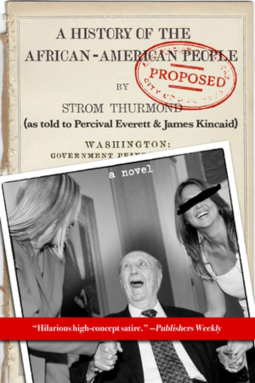
A History of the African-American People (Proposed) by Strom Thurmond, as Told to Percival Everett & James Kincaid (A Novel)
This title was previously available on NetGalley and is now archived.
Send NetGalley books directly to your Kindle or Kindle app
1
To read on a Kindle or Kindle app, please add kindle@netgalley.com as an approved email address to receive files in your Amazon account. Click here for step-by-step instructions.
2
Also find your Kindle email address within your Amazon account, and enter it here.
Pub Date Feb 3 2026 | Archive Date Jan 31 2026
Akashic Books | Akashic Books, Ltd.
Talking about this book? Use #AHistoryoftheAfricanAmericanPeopleProposedbyStromThurmondasToldtoPercivalEverettJamesKincaidANovel #NetGalley. More hashtag tips!
Description
“[A]n outrageously funny satire of race relations and racism, US history, contemporary sexual mores and behavior, academia, and the publishing industry . . . It could become a cult-classic . . . Highly recommended.”—Library Journal
“The story’s epistolary format allows novelist Everett and literary theorist Kincaid to write in a chorus of richly individuated voices, by turns—and often simultaneously—sardonic, hysterical, obsequious, and threatening, aware of their own hypocrisies but unwilling to renounce them. The result is a truly funny send-up of the corrupt politics of academe, the publishing industry, and politics, as well as a subtle but biting critique of racial ideology.” —Publishers Weekly
In A History of the African-American People [Proposed], Pulitzer Prize–winning novelist Percival Everett (James) and James Kincaid present a fictitious chronicle of former South Carolina senator Strom Thurmond’s desire to pen a history of African Americans—his and his aides’ belief being that he had done as much, or more, than any American to shape that history. An epistolary novel, A History follows the letters of loose-cannon congressional office workers, insane interns at a large New York publishing house, and disturbed publishing executives, along with homicidal rival editors and kindly family friends. Strom Thurmond appears charming and open, mad and sure of his place in American history.
Available Editions
| EDITION | Other Format |
| ISBN | 9781636142845 |
| PRICE | $18.95 (USD) |
| PAGES | 320 |
Available on NetGalley
Available to Buy
Buy on Amazon Buy on BN.com Buy on Bookshop.orgAverage rating from 11 members
Featured Reviews
 Media/Journalist 144784
The title - 6 stars
The book - 4 stars
This is the reissue of a book originally published in 2004, an epistolary novel between the writers in the title and then a fictional book editor and his assistant and an assistant to/intern for the famously racist Senator from South Carolina Strom Thurmond. Then add one assistant’s sister, an aspiring writer named Septic and brief appearances by the Senator himself. And start with the premise that Thurmond’s intern believes that Thurmond believes that Thurmond has done as much as anyone to shape African American history which, well, I guess if you look at it a CERTAIN way is not….WRONG?!?! And is Everett the black one?
This is as witty as one would expect. It brings to mind a parody I saw in “George” magazine where there was a meeting of Republicans running for President and Strom Thurmond says to Colin Powell, “I thought I told you to stay with the car.” Only writ large. Plus the writers send up publishing and the relationships that members of Congress have with their staffers. You probably know now whether you are going to think this is clever or not, and I thought the writers did a fine job…I’m glad it’s getting another push in light of the success of JAMES.
 Miles L, Educator
In this book, a reissue of the original from 2004, Percival Everett and James Kincaid skewer everything from racism in America to academia and more personal quirks than I knew existed.
While the authors are well known now they were considerably less so in 2004 which may be why I hadn't read it before now. I admit I expected Thurmond to be more specifically lambasted but he largely serves as a representative for the worst racist impulses of the country, as well as a mouthpiece to point out some uncomfortable truths, albeit cloaked in his ugly mindset. I think of it more as an over-the-top reflection of the dysfunction this country has long been suffering, even before the moron-in-chief took office again.
These are told in emails, texts, and other such forms of documentation, so it takes a little effort (not too much) to keep the plot (such as it is) straight since many of the pieces of documentation will have you laughing and forgetting the bigger (surreal) picture.
I would recommend this to readers who might like to ponder our country's ills, from personal to political, while also laughing. I also think you can read it simply as entertainment, even though the message will still play a part in the humor.
Reviewed from a copy made available by the publisher via NetGalley.
 susan b, Reviewer
This is what I imagine happened: Percival Everett and James Kincaid were having a rough day. Perhaps student essays were particularly bad or they were having issues with their publishers. One of them pulled out a bottle of bourbon. Good bourbon as a testament to their friendship. After a drink or three as they were continuing to lament about circumstances, they began to imagine the worst idea ever possible for a book. Strom Thurmond writing about the African-Americans made them both chuckle heartily. Then one of them said, "but wait! what about.....?" The reply, "oh yes! and imagine......!" Thus, this book was born. No you do not get any actual history and yes you should probably know who Thurmond was and his actual impact on Blacks, Blacks in the South, the history of racism, etc. The epistolary format works very well for the antics throughout this book. Sadly, it is as poignant today as it was when it was originally published over 20 years ago.
Sam M, Reviewer
I wasn't quite sure what I was expecting when I started this book, but it certainly was not what I thought I was in for. This was certainly a wild ride from start to finish.
This epistolary novel starts with the absurd premise of publishing a book on African-American history from the perspective of a known anti Civil Rights and segregationist politician from the south, and the equally puzzling correspondences that follow this proposal. It features an absolutely insane and morally questionable cast (with a couple of voices of reason) attempting to handle what should be a serious topic.
Between the absurd personalities, toxic relationships, and insane correspondances (that sometimes could be considered harrassment) is a commentary on attempts of revisionist history for the sake of softening the reality of racism in the American South. While this is a point that I wish the story had spent a little more time with, its nonetheless a compelling point. This re-release is well timed, given current events.
If you are a lover of satire and history and don't mind dark comedy exhibited through some deplorable characters, this may certainly be a book for you. It was a hilarious ride and was difficult to put down.
I voluntarily read and reviewed an advanced copy of this book
Reviewer 328937
This satirical novel, first published in 2004 and re-released in 2026, is hilarious and completely bonkers. In the epistolary story - related mostly in letters, notes, and memos - Senator Strom Thurmond (1902 - 2003) is writing a history of the African-American people with the help of ghostwriters Percival Everett and James Kincaid.
This is the background, in case you need a refresher: Strom Thurmond served as a U.S. Senator from South Carolina for nearly half a century, from 1954 to 2003. Thurmond was a notorious racist and segregationist who promoted Jim Crow laws under the guise of supporting states rights.
*****
The book opens in 2002 when Senator Strom Thurmond is approaching his 100th birthday. The Senator's advisor Barton Wilkes writes to Simon & Schuster Publishers in New York, proposing a book called 'A History of the African-American People' by Strom Thurmond. Wilkes asserts, "As the history of the African-American people has been, to a great extent, coextensive with the Senator's own, he will be able to draw on his own life experience (and not just in politics) for much of his material."
The book proposal is followed by a good deal of correspondence among aide Barton Wilkes; a lower echelon Simon & Schuster editor called Martin Snell; and Snell's novice assistant R. Juniper McCloud. Coming to believe Thurmond's book will be a bestseller that gets him a promotion, Snell approves the project. Two professors from the University of Southern California are engaged to ghostwrite: Percival Everett - a Black writer; and James Kincaid - a White scholar and author.
Everett and Kincaid repeatedly ask Wilkes about Thurmond's plan for the history book, but all Wilkes sends are excerpts from an anthology of documents compiled by Herbert Aptheker. Examples of the passages are:
➤➤ From 'An Address of Delegates of the State Convention of the Colored People of South Carolina to the White Inhabitants of South Carolina' in 1865: "We fully recognize the truth of the maxim, 'The gods help those that help themselves'." Wilkes asserts, "That is, they simply wanted the opportunity to develop their domestic and commercial lives by helping themselves."
➤➤ From a speech by Booker T. Washington in 1884: "The best course to pursue in regard to the civil rights bill of the South is to let it alone.....Good schoolteachers and money to pay them will be more potent in settling the race question than many civil rights bills and investigating committees."
➤➤ From an address to the U.S. Congress from 'The National Association of Colored Men' in 1896: "We mark the opening of the militant period of our race in this country....Our calm deliberate advice is for every member of the race henceforth to employ every weapon of every kind of warfare...in the demand for every right."
It becomes clear that Thurmond and Wilkes' agenda is to clean up the Senator's reputation, and Thurmond himself tells Everett and Kincaid, "I'm getting old...And when I die I'd like to have a seat at the big party....I'm talking about heaven....I'm trying to make amends, trying to have my parking ticket validated...I realize I've done some underhanded things and that I've hurt a lot of colored people. But hell, I hope I've hurt as many liberals and Jews...Times have changed. Now we've got Muslims and Arabs to hate. You know a lot of them are pretty dark. What's that tell you?" In addition, when Everett and Kincaid visit Senator Thurmond in Washington, the politician exhibits a foggy memory. Kincaid comments to Everett, "Is he a piece of work or what? Can't recall if the servants were black." And Everett responds, "I should have asked if the slaves were black."
Wilkes' letters to Everett and Kincaid also demonstrate his own insensitivity. As an example, Wilkes writes:
"Dear Percival and Jim,
.....Tell me more about yourselves. Which one is Black?....Only one of you is Black, right? Neither name is much of a giveaway, is it? But then, they seldom are. Jackson, perhaps, or Johnson, but then you can get into serious troubles by making such assumptions, believe you me. Now, if one of you were named Shumoonunu Ackabawka, then I wouldn't have to ask. But neither of you is, so I must."
Though a good part of the book skewers Strom Thurmond and Barton Wilkes, authors Everett and Kincaid take the opportunity to amuse themselves with endless 'jokes' about the publishing industry; loony editors; horny men; niche books; and more. For instance, editorial assistant R. Juniper McCloud - who's a sort of dogsbody for the African-American history book - attracts unwanted sexual attention from his boss Martin Snell AND from Thurmond's assistant Barton Wilkes.
Amongst myriad other things, Snell sends Juniper a note inviting him to a St. Patrick's Day party. Snell writes, "We'll each wear (or adorn ourselves with) green in places...There will be prizes for those who can most successfully search out each other's green pastures, so to speak." Snell signs the missive, "Love and I mean it, Martin."
As for kinky Wilkes, he repeatedly sends Juniper suggestive letters, and in one note, Wilkes describes a childhood game of doctor. Wilkes recalls, "I was always the patient, carefully undressed and probed by a large hospital staff of neighborhood and visiting girls, and boys too. From the time I was 8 until well into my teens I played this part. The attending physicians ranged in age from 4 to 16 at least...I remember being very careful to present myself in a variety of comely ways, seeking out nice undergarments and, every now and then perfumes."
In addition to sending wildly inappropriate letters, Wilkes arranges to meet Juniper in Atlantic City, to advance the African-American history project. There Wilkes insists they play board games, go on carnival rides, cook in their room, and play Twister.
Other individuals who appear in the book include:
➤➤ Juniper's sister Reba McCloud - a sweet soul who's trying to help her brother;
➤➤ An author called Septic, who's hawking a book called 'Class Ass' - a tell-all about her life as a pimp and prostitute. Septic describes acting in and directing porn (adult and child); committing robbery and assault; selling and taking drugs; and more.
➤➤ A Simon & Schuster senior editor named Ralph Vendetti - a Mafia type in charge of cookbooks, self-help books, true crime, unauthorized biographies, and diet books. One diet book is the 'Butter Bliss Diet', based on eating ice cream, milk, yogurt, butter, cheese, bread, sweets, and fried foods - and avoiding vegetables.
At one point, a rival editor sends Vendetti a letter calling Vendetti's mother a slut and saying vile things like, "You aren't worth a pile of cowshit as an editor....That's why they give you all those books aimed at fairies and stupid women....and the ones on pimps and whores....I may just run you down with my car. I'd have to go back over you thirty times to get all the glop out of your fat body." The letter has dire repercussions.
There's much more hilarity in the story, which I enjoyed. I can imagine authors Everett and Kincaid laughing themselves silly while penning the narrative.
I highly recommend the book (though MAGA fans might not be the intended audience).
I had access to the digital book and the audiobook, narrated by James Fouhey, who does a fabulous job with the voices. You'll want to follow along in the text though, to keep up with the story.
Thanks to Netgalley, Percival Everett, James Kincaid, and Akashic Books for an ARC of the novel.
Readers who liked this book also liked:





Kenneth Womack; Scott Freiman
Entertainment & Pop Culture, Nonfiction (Adult)

Will Kaufman
Entertainment & Pop Culture, Nonfiction (Adult), Politics & Current Affairs

Malcolm Gladwell, Bruce Headlam
Biographies & Memoirs, Entertainment & Pop Culture, Nonfiction (Adult)