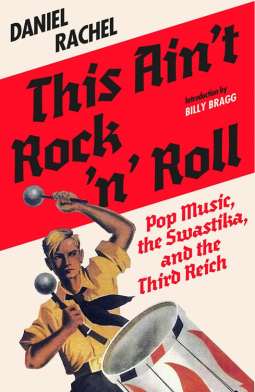
This Ain't Rock 'n' Roll
Pop Music, the Swastika, and the Third Reich
This title was previously available on NetGalley and is now archived.
Send NetGalley books directly to your Kindle or Kindle app
1
To read on a Kindle or Kindle app, please add kindle@netgalley.com as an approved email address to receive files in your Amazon account. Click here for step-by-step instructions.
2
Also find your Kindle email address within your Amazon account, and enter it here.
Pub Date Feb 10 2026 | Archive Date Jan 31 2026
Akashic Books | Akashic Books, Ltd.
Talking about this book? Use #ThisAintRocknRoll #NetGalley. More hashtag tips!
Description
OVER THE LAST SEVEN DECADES, some of rock ’n’ roll’s most celebrated figureheads have flirted with the imagery and theater of the Third Reich. From Keith Moon and Vivian Stanshall kitting themselves out in Nazi uniforms to Siouxsie Sioux and Sid Vicious brandishing swastikas in the pomp of punk, generations of performers have associated themselves in troubling ways with the aesthetics, mass hysteria, and even ideology of Nazism. Whether shock factor, stupidity, or crass attempts at subversion, rock ‘n’ roll has indulged these associations in a way not accepted in any other art form. But how accountable should fans, the media, and the music industry be for what has often seemed a sleazy fascination with the eroticized perversions of a fascist regime?
In This Ain’t Rock ‘n’ Roll, award-winning music historian Daniel Rachel navigates these turbulent waters with extraordinary delicacy and care, asking us to look anew at the artists who have defined us, inspired us, and given us joy—and consider why so many have been drawn to the imagery of a movement responsible for some of the twentieth century’s worst atrocities. Rachel asks essential questions of actions often overlooked or underplayed, while neither casting sweeping judgment nor offering easy answers. In doing so, he asks us to reassess the history of rock ‘n’ roll, and he sheds new light on the grim echoes of the Third Reich in popular culture and the legacy of twentieth (and twenty-first) century history as it defines us today.nd sheds new light on the grim echoes of the Third Reich in popular culture—and the legacy of twentieth (and twenty-first)-century history as it defines us today.
Available Editions
| EDITION | Other Format |
| ISBN | 9781636142852 |
| PRICE | $29.95 (USD) |
| PAGES | 336 |
Available on NetGalley
Available to Buy
Buy on Amazon Buy on BN.com Buy on Bookshop.orgAverage rating from 11 members
Featured Reviews
 Eric E, Book Trade Professional
Daniel Rachel’s powerful study on the history of musicians incorporating Nazi imagery into their work is an essential read. Hopefully, future generations of artists will no longer flirt with fascist imagery and fashion. This Ain’t Rock ‘n’ Roll should be read by not only music makers and fans, but by everyone so that we are reminded about not repeating history’s dark past.
 Niamh H, Educator
When I tell people I study communication, they always assume I mean advertising, public relations, or something in that vein. However, I have always been much more interested in how humans communicate meaningful things about themselves. This book takes a similar approach, examining in great detail how musicians have used symbols of fascism over time and what that has communicated to their audiences—whether it communicated the intended message or not.
I found this book fascinating and chilling. We all probably have some exposure to musicians' interactions with fascist language and imagery—John Lennon's infamous Christ/Hitler quote comes to mind—but I was shocked to see how far many musicians have taken it, as well as the sheer number of musicians who have used fascist symbols and/or language. I definitely feel that I learned a lot from this book and I am excited to recommend it to students and colleagues.
The one thing that brought this to a 4-star rating (really 4.5) for me was that I felt there was a lack of nuance when mentioning artists' stances on Israel and Palestine. I do not believe that the author intended to present one side over another, as he noted in his epilogue that people often mistakenly conflate anti-Semitism and anti-Zionism. There have been plenty of full-length books written on conflict in the region, and I believe the author probably felt that it was too much to get into while keeping the book succinct and focused on the Third Reich. However, the only times I noticed the modern conflict being mentioned were in contexts where artists were critical of Israel. Again, this was the only reservation I had, and it was disappointing to me because I felt the rest of the book had been incredibly fair and understanding towards the artists discussed. I would still recommend this book!
 Novie N, Bookseller
This book is well-researched with a lot of content, and it's interesting enough that the 336 pages felt like a quick read. There's a lot to learn - so many examples of musicians flirting with or overtly displaying Third Reich imagery, denying its power or endorsing (vaguely or explicitly) its meanings.
Starting with John Lennon and the Rolling Stones, spanning to more recent examples, like Kanye West's statements and his reception. I expected discussion about The Sex Pistols and Vivienne Westwood, but I was shocked to read about antisemitic behavior or comments from beloved musicians like Bowie (despite this information being publicly available for decades.) We read how over the years, people make similar problematic rejections of antisemitism and racism: "I can't be racist because I date a person of color / play with a Jewish bandmate." And the lazy and immature justification that "the swastika is punk/rock/metal because it makes people angry."
The author doesn't shame us fans - they're a music fan too, wrestling with this uncomfortable truth and demanding we address it. I appreciated the other examples of people calling out antisemitism and racism over the years, including zine-makers, ska bands, Caroline Coon, and contemporary bands like Trupa Trupa.
This book was a 5 for me until the final chapters: The author argues that American musicians could never get away with symbols that represent hatred toward other minorities (as they do with antisemitism) - this is plainly untrue and suddenly jolts away from the solidarity that the book was building. The author seemingly equates a musician's support for Palestinians with antisemitism (despite earlier mentioning Jewish musicians like Phranc who manage to support Palestinians and critique IDF) - I'm not sure how to rate the book now, to be honest. Do I rate it for the first 90% of its content only? I was ready to buy all the author's books for our shop, but now I can't recommend them without this serious warning and caveat.
The book will convince readers to interrogate symbolism, to make sure you endorse what you're sharing and wearing, and to prioritize compassion over cheap thrills. This book releases 2/3/26.
 Reviewer 317847
Had the chance of reading this earlier this year and cannot recommend it enough to fellow music lovers and folks on the left who think they got the whole punk thing figured out.
 Brian S, Educator
“What do you do when your mom is a skinhead? You write a song about her,” Thurston Moore’s introduction to Sonic Youth’s “The Bedroom”
Big thanks to Akashic Books and NetGalley for the advanced copy of Daniel Rachel’s urgent and critical new book This Ain’t Rock ‘n’ Roll: Pop Music, the Swastika, and the Third Reich. Towards the end of the book, I thought about Thurston Moore’s intro to “The Bedroom,” a song from the early 90s that probably preceded “Youth Against Fascism,” but still emphasized the bands commitment to upholding their values yet also being provocative in their lyrics. I don’t think anyone would accuse SY of holding Nazi sympathies, yet Thurston’s ambivalent delivery leads listeners to wonder whether he’s angry, sad, or maybe even questioning the mother’s skinhead membership. If anything, it’s a kind of absurd premise, but still emphasizes the shock value that permeates the punk ethos from the early days of SY. This song intro nor any of SY’s music made it into this book, but it would have been interesting to read Rachel’s thoughts and questions about SY’s skinhead reference or another reference to Jews in their song “My Arena.” It would have been interesting to see how bands in the 80s, grappling with Reagan, racism, and other inequalities in the US have responded to issues like the resurgence of white supremacy (I’m looking at you Ice-T and Body Count).
If anything, I wonder how much context matters in these kinds of references and whether bands or musicians that referred to Nazi imagery from the UK had a different impact or intent than bands or musicians from the US. I think most people understand that the band Blondie, referenced in the book for some potential Nazi references, are not sympathizers with Nazis, but should we also question other bands from the 1970s like Joy Division or The Fall? Nevertheless, British music is more of the focus of Rachel’s book, and I learned so much from reading this book, both from the bands and the music, as well as the history and details that were relevant to many of the songs, albums, and artwork referenced throughout the book. While I knew about plenty of the bands and the Nazi references that these bands made, I never really considered the deeper implications, especially in how it may have impacted survivors and families who were impacted by the Holocaust. The book covers a lot of obvious candidates from the heyday of British punk like the Sex Pistols (especially Sid Vicious) and Siouxie Sioux, to Factory Records bands like Joy Division and New Order, whose names derive from Nazi references, to some American bands like The Stooges, whose lead guitarist Ron Asheton frequently dressed in SS uniforms and was deeply interested in German war history, and The Ramones, whose logo may have borrowed from the Nazi era eagle. Although The Ramones’ song “Today your love, Tomorrow the world,” referenced Ava Braun’s and Hitler’s love, The Ramones also referred to themselves as “Nazis” in the song, even though Joey Ramone was Jewish. Rachel notes in the end of the book that he is just presenting the facts as they are and making historical references to WWII and Holocaust history to identify possible references and allusions that the bands make. However, I’m not sure that anyone listening to this song took The Ramones to be Nazis, since they never really seemed serious about the subjects in any of their songs. They also sang about sniffing glue, wanting to get shock treatment, and claiming to be victims of a teenage lobotomy. In fact, Rachel later references The Ramones’ song “Bonzo goes to Bitburg” released shortly after Reagan’s shameful visit to an SS cemetery where he advocated for forgetting the past atrocities. If anything, this example shows how The Ramones used this imagery and references not lightly, but rather in a critical if not sarcastic manner to lessen the power and allure of the Nazis. It was interesting to consider other case studies and musicians like Sid Vicious (if you could even call him a musician or artist) who used Nazi imagery to shock and incite the older generation. I don’t agree with that approach, and I think Rachel makes a good case in noting that art should be provocative, but the “atrocities of the Third Reich are not to be used lightly as creative inspiration.” I think that the latter sections really helped me understand this argument much more, especially when we think about more modern examples of shock rock and how some artists demonstrate their ignorance in the use of Nazi imagery. He cites examples of Marilyn Manson and Ye to show how current attempts by musicians to shock are problematic and in many ways lazy. For Manson, the analogy between current politics and Nazis didn’t add up, especially in a country that allowed his music to thrive and be accessible, if not criticized, by many. I don’t really understand why Ye expressed his love for Hitler, but he clearly seems like someone who needs a lot of attention, but he has recently attempted to apologize for his Nazi era. In fact, it makes less sense when you read about Hitler’s thoughts about Black athletes like Jesse Owens who competed in the 1936 Olympics. I’m sure that Hitler would not have been a fan of Ye’s at all.
It’s interesting to see Rachel’s theory that the increasing education and introduction of Holocaust studies into curricula in Europe and America in the 1980s and 1990s as well as popular representations of Holocaust stories ranging from The Diary of Anne Frank to Art Spiegelman’s Maus to Elie Wiesel’s Night to films like Schindler’s List all helped to raise consciousness about the Holocaust and the evils of the Third Reich, which is a possible reason why the use of Nazi imagery and themes today has taken on a different tone, and where we are quick to either question or condemn its use. If anything, it’s important to remember the consequences of this kind of damaged nationalism and dangerous pull of the crowd since in the US we have seen an uptick in using Nazi-type propaganda in government social media messages where the Department of Homeland Security has posted “We’ll have our home again” and the Department of Labor posted “One Homeland. One People. One Heritage,” slogans that have a nearly literal German translation from Nazi slogans. As Rachel seems to argue, raising awareness is the first step, but it is also important to question and challenge, and not merely accept the repurposing of these phrases, images, and slogans.
In addition to these examples, I was really surprised to learn about some of the earlier Nazi examples Rachel cites from classic rock. In particular, there are stories about John Lennon’s fascination with Nazis, and how members of bands ranging from the Rolling Stones, the Who and Led Zeppelin would dress up in Nazi uniforms, sometimes for performances. I was aware of Bowie’s flirtations with fascism, as well as the explicit racism of Eric Clapton, who made continued racist comments in concert in the 1970s, even after scoring a hit from a Bob Marley cover song (once again appropriating Black art). This book was filled with various examples of artists who used fascism and especially Nazi imagery and ideas in their music. The book traces these examples from classic rock through punk and post-punk up until more modern examples and provides instances of other representations of Nazism in popular culture. Some of the most unbelievable examples are in the nazisploitation films like Isla, She Wolf of the SS, where Rachel provides the chilling real life Ilse Koch as the basis for this story. Other films like Salon Kitty and The Night Porter, which was especially celebrated and copied by artists ranging from Siouxsie Sioux to Madonna, were referenced, but also questioned as to the purpose of these films. Was it to shock? To excite? Or were there questions about the nature of power and violence? Rachel raises important questions as to the nature of these films and their impact on punk rock, popular music, and fashion, questioning whether they introduced a kind of Nazi-chic that remains relevant today as people rightly scrutinize the fashy fashion choices of ICE thug Gregory Bovino.
I was drawn to this book since it is a book about music, and the striking cover, featuring what looks like a Hitler youth banging a drum, really grabbed my attention as well. It’s a familiar picture, looking like something from either Joy Division album artwork or a recent Turning Point for Elementary School recruitment poster. While the book sometimes goes down a historical Hitler hole, deeply researching connections between history and the music Rachel discusses, it’s still a deeply important and timely book. Rachel’s research and connections made me question the music I consumed, and while I will still listen to the Ramones, Joy Division, The Stooges, Slayer, and Motorhead, I think it’s important to consider how the images they use are possibly pushing aside the horrors and atrocities of the Third Reich. I’m glad that in the last section of the book, Rachel references the infamous Dead Kennedy’s song about Nazi punks, and how they used that song to promote anti-racism, selling arm bands with crossed-out swastikas. For me, in a lot of ways, punk and metal was more about questioning this kind of overbearing authority and finding ways to assert your own voice, be your own person, amidst a society that will sometimes brutally push individuals towards conformity. Furthermore, the actions of education, awareness, and remembrance are even more important as US government officials like Elon Musk are given passes and grace for Nazi salutes, only to make Nazi-themed jokes on his social media account. I just kept thinking about the absurdity of this situation, where some of the most powerful people in the world were seemingly endorsing these policies, and remembered to the events in VA in 2017, where Trump celebrated, in his words, some “very fine people, on both sides,” and his continued refusal to disavow racism and bigotry from followers like the Proud Boys and David Duke. Rachel’s book is an important read, not only for music fans, but for anyone who consumes media today. It’s important to be aware of the kinds of messages that are swirling around, and how powerful groups can use images, propaganda, and catchy slogans to win over hearts and minds, attempting to sway our beliefs. Furthermore, Rachel’s research in this book is an important reminder about how powerful and successful the Nazis were in manipulation- in using images, slogans, and misinformation to sway so many people or to cover up their atrocities in the guise of nationalism, patriotism, duty, and honor. This book is important to remember those lessons from history because as Jello Biafra sang in the Dead Kennedy’s famous song “You’ll be the first to go, unless you think.” Highly recommended!
 Glen B, Reviewer
A well written, informative book concerning Rock N Roll and Nazi Germany symbolism. The book was factual, concerning Music, Music artists and even about Nazi Germany and the camps. Some of the artists discussed were very surprising.
Reviewer 862825
Throughout the history of rock and roll, many of the most popular musicians have had a disturbing interest in the imagery, uniforms or ideas of the Nazi Third Reich. Daniel Rachel surveys this history from the early days of the genre to current artists in This Ain't Rock 'n' Roll: Pop Music, the Swastika, and the Third Reich .
A central theme of rock and roll and its many derivatives is the inherit idea of rebellion or youth culture. As a popular music form, rock and roll exploded to popularity post World War II with the generation born a little before, during or after the war. Since then, many of the song or artistic themes have been recycled ad nauseam, but the appeal and the genre remain popular.
Likewise, the imagery and ideas of the fascist Nazi Third Reich have remained in the popular consciousness for various reasons, but frequently as the nadir of power and mass murder. Here Rachel draws from what was already reported public knowledge into a troubling compilation showing Third Reich imagery and ideas as a troubling under current in rock music.
Many of the artists biographed here speak of a fascinating with Adolf Hitler or the Third Reich more generally. The draw seems to have initially speak of the similarities of a rock concert with some of the filmed Nuremberg rallies, or the charismatic way Hitler was able to capture and control attention. Others focus on the striking appearance of the uniforms, or just a general flirtation with the power of the swastika symbol. As the time scale extends musical artists also incorporate the influence of other bands or Nazi kitsch and the sexplotation movies or books. Reproducing the visuals or ideas.
A key point of this work, is that many of the artists should know better, like Bono of U2 performing a salute on stage in Germany. Often the excuse is a lack of knowledge or trying a for an a la carte element choice (just the uniforms!) without considerations for the implications. Even if they should know better, after a brief burble of news coverage, much of the criticism dies down and there are few if any lingering criticisms (one notable exceptions Kayne West / Ye). Early punks like Sid Vicious used the swastika as an act of both rebellion and belligerence. Joy Division started off named just Warsaw, and changed the name to a concentration camp brothel before the death of Ian Curtis led to a reformation under the name New Order. Accountability matters, intention is important, but the usage of well known oppressive imagery should not be given a pass due to ignorance.
Recommended to readers or researchers of popular music, public perceptions, or ideas in popular culture.
Terri L, Media/Journalist
In this unique study of Rock 'n' Roll, Daniel Rachel asks us to look at how music is a safe haven for the terrible things that have happened in history, specifically, the Third Reich. Some bands and artists seem to glorify this terrible group. How do we allow this to happen and how can we reevaluate this and maybe change the way we look at music.
Sharon L, Reviewer
I love rock music but somewhere along the line I must have missed all the Nazi symbolism. Of course, I was more interested in the sound of the music rather than the theatrics, so the performances were not part of my experience. This book filled in what I had been missing. It starts with a description of who and how the symbolism was used, and if the artist knew or didn't know what it meant. Some artists didn't enter the Nazi rabbit hole, while others said they just liked the symbols but didn't believe the message. Although the author shares an immense amount of information, this book was fascinating. If you get bogged down in the detail, take a break. It would be a fantastic addition to anyone studying history, rock culture, music history, and the influence of media on messaging. Thank you toNetgalley and the publisher for the arc..
Readers who liked this book also liked:

Kenneth Womack; Scott Freiman
Entertainment & Pop Culture, Nonfiction (Adult)

Will Kaufman
Entertainment & Pop Culture, Nonfiction (Adult), Politics & Current Affairs


Julia Ebner
Health, Mind & Body, Nonfiction (Adult), Politics & Current Affairs