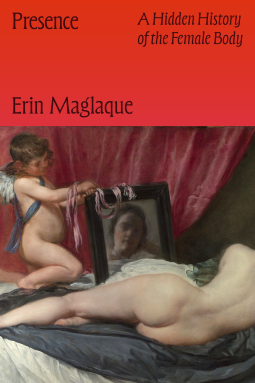
Presence
A Hidden History of the Female Body
This title was previously available on NetGalley and is now archived.
Send NetGalley books directly to your Kindle or Kindle app
1
To read on a Kindle or Kindle app, please add kindle@netgalley.com as an approved email address to receive files in your Amazon account. Click here for step-by-step instructions.
2
Also find your Kindle email address within your Amazon account, and enter it here.
Pub Date Jun 16 2026 | Archive Date Jun 2 2026
Astra Publishing House | Astra House
Talking about this book? Use #Presence #NetGalley. More hashtag tips!
Description
A vibrant history of women’s bodies, expertise, and work from a major new writer—stylish, revelatory, and liberating.
Today, we understand the mind and the body to be distinct; that the mind exercises control over the flesh. But as Erin Maglaque experienced the transformations of pregnancy, abortion, birth, and care-giving, she began to doubt the truth of that dichotomy. In an effort to better understand her experiences, she found herself reaching to the premodern past, a period when the strange rubbed up against the strikingly recognizable: when people accepted both levitation and the smallpox vaccine, witchcraft and universal gravitation; a time when understandings of the body and its capacity for thought were more expansive, and more unruly.
Structured as a biography of the author's own body, from girlhood and adolescence, to sex and abortion, to feeding and caring for an infant, to her experience caring for someone as they were dying, Erin places her personal history into a deep dialogue with the premodern past. She explores the relation between imagination and gender, between maternal and historical subjectivity; she positions female desire as a practice with a past, and offers gentler and more forgiving understandings of housekeeping, pregnancy, early miscarriage, abortion, birth, sleeplessness, and breastfeeding.
For readers of Amia Srinivasan’s The Right to Sex, Cat Bohannon’s Eve, and Olivia Laing’s Everybody, Presence is a unique experiment in historical thinking and embodied knowledge; a thoroughly researched, vibrant history of women’s bodies, expertise, and work from a major new writer.
A Note From the Publisher
FULL COLOR ILLUSTRATIONS THROUGHOUT: Erin uses gorgeous illustrations and paintings from the pre-modern era throughout the book to illuminate the female body and experience, making this book highly covetable and gift-y.
SERIOUS STYLIST: Erin manages to write about pre-modern history in the most compelling, engrossing way. There’s nothing dry about her approach—and nothing dry about the subject matter. She’s a serious stylist and her prose will garner much admiration.
Advance Praise
“An impressive book debut . . . As Maglaque examines pregnancy and miscarriage, abortion, labor and birth, caregiving, housework, and care of the dying, the voices of myriad women (herself included) amply fulfill her aim of making the past ‘present and immediate.’ A richly textured, revelatory history.” —Kirkus Reviews, starred review
“Engrossing and vital, Presence rediscovers the female body as a vessel of history. Interweaving past and present, the personal with incisive scholarship, these stories reveal the rich, unexpected, and sometimes brutal ways in which the complexities of female embodiment connect all women across all time.” —Michelle Orange, author of Pure Flame
“In Presence, Erin Magalaque expands and explodes the genre of personal history. In a voice at once deeply learned and often disarmingly intimate, these explorations unravel much of what women have been told about our bodies, desires, and capacities. They embody a mode of thought that does not only describe freedom but enacts it.” —Moira Weigel, author of Labor of Love
“An immersive, revelatory, and astonishing book about women, told through the distinct bodily experiences that punctuate our lives, and the history we’ve rarely been taught. Beautifully written and acutely insightful, Presence connects us to ourselves, our foremothers, and each other.” —Sophie Gilbert, author of Girl on Girl
Marketing Plan
MARKETING AND PUBLICITY PLANS • Pitch excerpt to major literary publications • Pitch author interviews and profiles • Pitch original essays and op-eds ahead of publication • National media campaign with coverage in major newspapers, magazines, online, podcasts, and broadcast media • Feminist and women’s media outreach • Feminist influencer and book club outreach • Academic outreach to women’s studies, history, and art history departments • Select in person and virtual author events including bookstores, universities, and festivals • Special outreach to women-owned and college town bookstores • Digital readers guide available for download
Available Editions
| EDITION | Other Format |
| ISBN | 9781662603341 |
| PRICE | $30.00 (USD) |
| PAGES | 304 |
Links
Available on NetGalley
Available to Buy
Buy on Amazon Buy on BN.com Buy on Bookshop.orgAverage rating from 33 members

Featured Reviews
 Zoe S, Reviewer
Erin Maglaque’s adoration for the female body is clear throughout Presence, both in her personal stories and her historical research. I found the first chapter, about food, and the last chapters, about desire and death, to be the most enlightening and heartfelt of the book. I could definitely see myself returning to this if I was working on a project surrounding the female body, as this is some of the most comprehensive and accessible research I’ve encountered on the subjects Maglaque touches on.
Thanks to NetGalley and Astra Publishing House for the arc!
Carolina E, Reviewer
This book was both fascinating and infuriating. An impressively accessible dive into the different versions of the historical female body and how they have changed over time. Not a lot has been written or researched on the subject, so the book felt like an ode to the seen and unseen work women and their bodies do in all stages of life. I learned a lot and loved the author's personal inputs.
Link to my review on Storygraph https://app.thestorygraph.com/reviews/ef90c676-43ae-4e32-ad65-06c6bb4fa57a
Will be posting about it on my tiktok as well: @carostidbits and writing about it on my blog: carostidbits.substack.com
Looking forward to the physical copy!
 Reviewer 1746050
Each chapter taught me more about things I didn't know about my own female body. Each historical fact, mixed with the author's own history, made this novel a gripping piece of revelation.
 Calli S, Reviewer
Starting this review with a quote from this book:
“There was a fundamental distrust of what happened inside the female body; external evidence not required.
Oh how this still rings true, even 500 years later.
There was so much history built into this book from the 1400s to present day. I appreciated the mix of personal anecdotes and historical evidence, but I felt the pacing of the book would’ve benefited from more depth on the personal side. At times it felt like we were jumping from historical quote to historical quote with no context as to why; a way of dumping a ton of data into one chapter.
Chapter 3 was the most intriguing, as Maglaque delves into the history of “unpregnancy” and how people assume society was always against it. That wasn’t always the case, even in the Catholic church who became much more strict on the subject in the late 1500s.
The chapters on sleep and desire were two of my favorites; they were fascinating and relatable and although these are biological forces, the way we approach them has changed so much throughout history.
The epilogue perfectly wrapped the book up, and brought the reason for the research full circle. It was about the risk of being present, the risk of searching for more, the risk of being curious. The word ‘presence’ permeated through the book and it not only referenced the presence of others throughout a woman’s history, but the presence of oneself while experiencing these phenomena.
Thank you to Astra House and NetGalley for the advanced reader copy!!
Chelsea K, Reviewer
Presence details the history of the female body by discussing topics of eating, pregnancy, abortion, birth, sleep, breastfeeding, desire, drudgery and dying. This book dives into historical facts around these topics but also discusses the authors personal experiences. People in the past especially men believed strange things about women regarding their bodies and this is a fascinating look at how certain beliefs have changed.
I enjoyed reading this and I had a good time learning the historical beliefs about women’s bodies. This is written well and even when I wasn’t the most interested in a topic I still found this compelling. I liked learning about the historical beliefs regarding pregnancy specifically what made a fetus human and the changing beliefs on fat/thin bodies. I think this book also shows how connections can be made to anything and at the time it will make sense. For example, in the past some people believed conditions a wet nurse had would be transferred to the child and at the time that easily made sense to people. I will be recommending this and I really appreciate what this author had to say on their experience of being a woman.
Tevia S, Reviewer
WOW! I am absolutely impressed with this book!
Because of the references to the 1600-1700s I was worried this book would fly over my head, but Erin Maglaque does a fantastic job of drawing parallels to the past with her own modern reflections on life as a AFAB Woman. From birth to breastfeeding to female desire , Maglaque paints a beautiful yet somber portrait of how the world has evolved through patriarchal ways.
I learned so much from this book & honestly can’t wait to buy a hard copy when it releases. I don’t know if i have read a book that so seamlessly marries two time periods!
Reviewer 1942261
Part-memoir, part-history, Maglaque’s
experience of pregnancy and mothering was the catalyst for delving into pre-modern Western Europe to uncover women’s understandings of, and writings about, their bodies - from birth to death and everything in-between.
I thoroughly enjoyed this necessary and urgent history, which provides a stunning corrective to both the theory of mind-body dualism and the invented ‘tradition’ currently being conjured to support efforts to legislate away women’s rights.
Drawing on women’s voices from diaries, letters and Court transcripts, as well as writings about women, Maglaque’s work is both theoretical and earthy, prompting introspection on how we have come to view ourselves and our role as women. I found it incredibly powerful to connect with and relate to the women Maglaque mentions as examples (and the many entirely absent from the historical record) and consider the differences and similarities in our lives, governed as they are by our bodies.
The book was interesting and accessible, well-structured, and cohesive. It would be a great fit for anyone who enjoys social history, or wants to understand women’s interiority in pre-modern Western Europe.
Reviewer 1925711
Very interesting history of women’s bodies presented in an accessible way. This is an important addition to feminist non-fiction. The author seamlessly weaves in her own experiences with her body. It is dense with history, so don’t try to read it all in one sitting. It is totally worth the read!
Thank you NetGalley for the ARC!
Silvia P, Reviewer
Some sections were slower for me, especially when the historical discussion became very dense, but overall I found the book rewarding and original. It made me think differently about everyday experiences like illness, care, and physical vulnerability, and how these have been shaped by culture and power.. Thanks for the ARC to the publisher and NetGalley.
 Jude C, Reviewer
An interesting work blending fact and personal experience to discuss woman’s bodies and how it is portrayed in the world around us.
Librarian 1982111
An informative and engaging read, which is a strong addition to feminist non-fiction. Maglaque's exploration of women's bodies is well navigated, and the memoir section is neatly woven in and nicely balanced with the history and societal information. It is well-written and does not get lost in the historical detail and case studies, which would be easy to do! Compelling and eye-opening, this is an impressive debut!
 Greer N, Reviewer
Presence gives the history of the female body through early modern accounts of women's daily lives and experiences and memoir. Erin Maglaque blends historical texts and lived experiences to explore topics such as beauty standards, sex, and pregnancy throughout the last 400-500 years. I'm not too familiar with early modern history, so it was fascinating to read about common beliefs such as having a birthmark would transfer to a baby and pregnant women should be given whatever they want to avoid disaster (which, let's face it, still should be the case). Some things were so absurd to think about, while others were strangely similar to life today.
Thank you to @netgalley and @astrapublishinghouse for the opportunity to read and review this book, out June 16th!
Reviewer 1540197
I really appreciate you providing a copy of Presence for me to review! I really liked this book, and I thought it did an excellent job of blending personal experience with deep historical research to create a truly liberating look at the female body.
Here are a few things that stood out to me:
Unique Structure: Framing the book as a biography of the author’s own body makes the entire book feel incredibly intimate and grounded. I really found this perspective interesting.
The Fresh Historical Perspective: I loved the exploration of the "premodern past"—it offers a much more expansive and forgiving way to think about our bodies than our modern views do.
Thoughtful Dialogue: The way the author connects her own experiences with motherhood, care-giving, and loss to the lives of women from centuries ago is really moving and I think it will connect deeply with readers.
I really appreciate the opportunity to read this book early and I will be recommending it to all my friends and followers! Thanks again!
Elizabeth R, Reviewer
Presence: A Hidden History of the Female Body by Erin Maglaque is an intellectually rigorous and deeply compelling work that makes a significant contribution to feminist historiography, the history of medicine, and embodied epistemology. Blending archival research with personal narrative, Maglaque offers a sustained challenge to the presumed universality of mind–body dualism, demonstrating how historically contingent—and politically loaded—our modern understandings of bodily authority truly are.
Structured as a “biography” of the author’s body, Presence moves through girlhood, sexual maturity, abortion, pregnancy, lactation, care work, and death, placing these experiences into dialogue with premodern European sources. What distinguishes this work is not merely its interdisciplinary ambition, but the sophistication with which Maglaque treats women’s bodily experiences as sites of knowledge production rather than anecdote. Drawing on court records, medical texts, religious writings, and women’s own accounts, she reconstructs a world in which the female body was understood as porous, intelligent, and responsive—capable of thought, memory, and moral reasoning.
Maglaque’s historical analysis is careful and precise, resisting the temptation to romanticise the premodern past. Instead, she foregrounds contradiction: a world that could simultaneously sustain expansive theories of embodiment and justify profound bodily control over women. Particularly strong are her chapters on “unpregnancy,” maternal imagination, sleep, and desire, which illuminate how moral panic, theological doctrine, and emerging medical authority converged to produce lasting frameworks of suspicion around women’s interiority.
The memoir elements are not decorative but methodologically integral. By situating her own embodied experiences alongside historical material, Maglaque enacts the very argument the book advances: that knowledge is produced through lived, gendered bodies, and that detachment has never been neutral. This approach aligns Presence with contemporary feminist philosophical work such as The Right to Sex by Amia Srinivasan and Everybody by Olivia Laing, while remaining firmly grounded in historical scholarship.
Lucid, humane, and theoretically assured, Presence is an outstanding scholarly work with wide relevance across gender studies, history, and medical humanities. It is both an academic achievement and a necessary corrective to narrow accounts of the female body—one that will reward careful, sustained reading.
Reviewer 745407
Great account of how history has treated women and women’s body for granted. How they are always present, and expected to be so. How their presence and work is most often unpaid. How most times it is men deciding what women can and cannot do or be. Great account that most people should read. The book was also well structure and engagingly written, very good overall.
Meghan M, Reviewer
I greatly enjoyed this thoughtful and provoking look at women's experiences of intimate and embodied moments throughout history. The author is able to juxtapose her own experiences with food, caring for relatives, clothing with the experiences she has found in the records. Each chapter is a self-contained exploration of one area of life. The author takes you through Western history, how place and time meant different experiences of living and dying as a woman. There are so many fascinating details here that I look forward to reading it again.
 yaakova s, Reviewer
really really interesting. there’s nothing else like it in regards to subject matter which serves to underscore the purpose for which it was written in the first place. i loved the last chapter, about death. it was exclusively about the history of women in christian europe, and i would’ve liked to see anything at all about women from other parts of the world.
 Janine S, Reviewer
I am always attracted to books that look at topics I wouldn’t normally read about so when this ARC popped up, I was immediately intrigued (my thanks to NetGalley and Astra Publishing House). It turned out to be an exceptional read.
The author, in her debut book, is on the faculty at the University of Sheffield, England, and offers a fascinating study of women using her own body “as the template.” Drawing on historical, artistic, midwifery journals, legal, scientific and “household guide” sources, we get a bird’s eye view of women’s experiences and self imagineds between 1500 to 1800. This was a period of “profound change” for women and during which men also took over things like births, normally handled by midwives. Another example , in the 16th C it was thought a woman needed to experience organism to conceive by the 18th C it was argued organism didn’t exist.
The book examines birth, abortion, miscarriage, breast feeding, house work and care for the dying. As on French memoirist, Madame de Roland, wrote in the 18th C, about breastfeeding: “In truth, looking at the matter closely, nursing a baby is a course in morals, and I think some women do well not to try it.” Also before the 18th C, sex was non-penetrative, by the end it was penetrative. We get our sexual proclivities from this century. Loved Chapter 8 entitled “A History of Durdgery.” This chapter actually explores women working on textiles and how to keep white linen clean.
There are wonderful paintings and illustrations in the book showing women in various poses and ways of life. This added nicely to historical tale being offered in this book. Highly recommend.
 Karla S, Media/Journalist
Early Modern historian Erin Maglaque has written a phenomenal debut that details the history of the female body, using the body – including her own – as both the subject and the method. She scoured archival materials, including letters, diaries, cookbooks, pamphlets, and more, to find women’s voices, bodies and experiences. While it was a challenge, the outcome is a stunning examination of women’s bodies through their endless searching, movement, restlessness and patterns.
See the full review in the Summer 2026 issue of Ms. magazine.
 Caitlyn F, Reviewer
Thank you to NetGalley and the Publisher for this eArc in exchange for an honest review.
Non fiction is definitely not my bread and butter but women’s history definitely is.
While at times the info-dump was really strong the author did a lot of research that made me want to look further into each source she credited to become more learned.
I would recommend this as a book to have and pick up and put down rather then read all the way through because of the sheer amount of references that don’t always follow a nice “story” line
 Georgia T, Reviewer
The book is going to be archived before I have the chance to finish it, but wanted to review what I have read before it does (I hope that's ok!) I've really been enjoying Presence. It's been a slow read for me, taking my time to understand things and constantly getting distracted, in a great way, as it's sparked so many ideas in my own fiction and non-fiction writing.
I love the way its written, these kind of mixes of historical and personal writing are always something I enjoy and Maglaque explores so much with so much nuance through that style.
It's accessible and interesting and filling a gap in research that is definitely needed! I found the history of pregnancy so compelling, which was unexpected to me, but the history surrounding community and folklore etc was so intriguing.
There's so much in this book that has not seen the light of day elsewhere and I will definitely be purchasing and recommending it to those around me!
Magalys O, Reviewer
Despite this being nonfiction, it was almost like a mystical read. The last time I felt like a book forced me to sit with my body and womanhood was when I read the Vagina Monologues when I was 18. I enjoyed it very much and despite it not being quite a 5 star read for me I plan on buying a copy, especially the US version which has a much more beautiful and elegant cover than the UK's.
Reviewer 1255912
The book Presence gathered a few threads and wove them into an enlightening read. Definitely a starting point for people who want to gain more knowledge on the history of Western (and westernized) women’s bodies.
Julia D, Reviewer
It was a fascinating look into the voices of women through the ages, however the author’s retelling of her own experiences seemed, in some cases, a bit forced.
Abby S, Reviewer
Presence is a fascinating look at the woman’s body.A combination of memoir and historical facts ,I enjoyed reading each scgment.#netgalley #presence
Reviewer 1130429
It’s a rarity that I actually read any nonfic that is not directly about politics or solely feminist theory, but this one did so well tying it all in enough to keep me invested in art history. I’m going to have to go buy a physical when I can get a paperback (the cover is gorgeous). I wish there was a little more on women worldwide not so eurocentric but it may have been too much of an undertaking?
Media/Journalist 1170014
This is a super fascinating book full of fun historical tidbits. My favourite type of history book is the kind that shares vivid details of people’s actual daily lives, and this one totally fits the bill. The author is an expert on Europe in the early modern period, and she shares how people during this time thought of women’s bodily functions like childbirth, breastfeeding, sex, and sleep. Like did you know that it was once common in France for upper- and even middle-class parents to ship their children off to a wet nurse in the countryside for the first few years of their life? Fascinating!
It’s so interesting to see how the way people perceived women’s bodies shaped the way they lived. The only part of this book that didn’t quite land for me is the way the author integrates her own life into each chapter. Maybe it would resonate more with me if I were a mother, as a lot of her story is about reconnecting with her body and sexuality after childbirth, but during these sections I found myself longing to get back to the cool historical facts. Still, this book is absolutely worth a read, and you will feel smarter and more informed having read it.
Thank you to the publisher for giving me access to an eARC of this book!
 Rachael J, Reviewer
In Presence: A Hidden History of the Female Body, historian Erin Maglaque executes a daring, deeply intellectually curious, and exquisitely written synthesis of archival excavation and personal memoir. Reaching into the premodern past—specifically the early modern period spanning roughly 1500 to 1800—Maglaque seeks to dismantling our contemporary, Cartesian bias that treats the mind as sovereign and the flesh as merely a vessel to be governed, optimized, or endured.
Structured as a biography of her own embodied experiences—spanning girlhood, desire, abortion, pregnancy, labor, infant care, and the ministering of the dying—Maglaque places her contemporary visceral life in direct, lyrical dialogue with the women of history. Drawing from an expansive array of archival fragments—physicians’ casebooks, legal testimonies, domestic receipt books, and private correspondence—she unearths a pre-Enlightenment world where female embodiment was understood as far more porous, fluid, and uncontained than our modern medical consensus allows.
Maglaque’s prose is undeniably elegant, marked by a rich, bookish cadence that balances academic precision with striking emotional intimacy. Her observations are often startlingly poetic; when recalling a difficult forceps delivery, she famously writes of feeling as though she were "being penetrated by the Enlightenment"—a brilliant, searing indictment of how the rise of male-dominated obstetrics reshaped women's bodily autonomy.
The book shines brightest when exposing how concepts we hold to be timelessly "natural"—from beauty ideals to rigid notions of maternal devotion—were actively constructed in the early modern crucible. The thematic chapters on drudgery, desire, and sleeplessness feel at once historically rigorous and intimately immediate. If there is a slight critique warranting the four-star rating rather than five, it lies in the sheer ambition of its hybrid form: occasionally, the transition between auto-ethnographic reflection and dense archival analysis feels abrupt, leaving the reader wanting a slightly firmer narrative thread to anchor the jump across centuries.
Nevertheless, Presence is an essential, revelatory work of feminist historiography. Maglaque has given us a deeply soulful, intellectually rigorous text that reminds us that our bodies carry a past—and that in understanding that past, we might find a freer, gentler way of inhabiting ourselves today.
Thank you to NetGalley and the publisher for providing an advance reading copy in exchange for an honest review.
 Kayleigh W, Reviewer
Thank you to the author and NetGalley for this ARC in exchanging for an honest review.
Heart breaking and beautifully written!
Readers who liked this book also liked:






Sarah Perry
Biographies & Memoirs, Nonfiction (Adult), Parenting, Families, Relationships