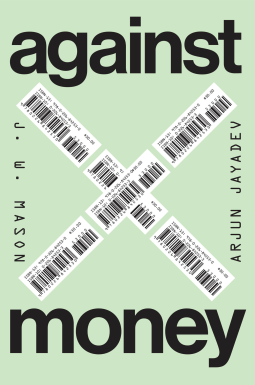
Against Money
This title was previously available on NetGalley and is now archived.
Send NetGalley books directly to your Kindle or Kindle app
1
To read on a Kindle or Kindle app, please add kindle@netgalley.com as an approved email address to receive files in your Amazon account. Click here for step-by-step instructions.
2
Also find your Kindle email address within your Amazon account, and enter it here.
Pub Date May 5 2026 | Archive Date Mar 30 2026
Talking about this book? Use #AgainstMoney #NetGalley. More hashtag tips!
Description
A powerful deconstruction of humanity’s most influential invention, from the acclaimed economists J. W. Mason and Arjun Jayadev.
Money is everywhere in our daily lives. It lurks in the swipe of a card at the grocery store, in looming student-loan debts, in the prices of things we want, and in our subconscious navigation of the modern world. Money is an invisible convenience that saves us, as a society, the hassle of bartering for goods and services—a reflection, in our pockets and on our phones, of the hard facts of scarcity and desire. Or is it something more?
In this revelatory book, economists J. W. Mason and Arjun Jayadev explain how and why money is so deeply misunderstood by the world it dominates—as well as the dangerous social implications of this misunderstanding. Against Money tackles the most dearly held “truths” of economics, arguing that the world of money has never been an impartial representation of the world of things. Instead, its existence in different forms—debt, capital, liquidity, and interest—increasingly shapes events in the real world rather than just reflecting them. Sometimes money enables new forms of cooperation; more oftenit facilitates domination. Human existence is not just facilitated by money but also governed by it.
In the tradition of works by Thomas Piketty and David Graeber, Against Money is an erudite, disruptive exposé of the illusions and tyrannies of money. Mason and Jayadev present a radically different way of thinking about money—imagining a hopeful future in which it no longer dictates the possibilities of our collective existence.
Available Editions
| EDITION | Other Format |
| ISBN | 9780226842530 |
| PRICE | $30.00 (USD) |
| PAGES | 352 |
Available on NetGalley
Available to Buy
Buy on Amazon Buy on BN.com Buy on Bookshop.orgAverage rating from 7 members
Featured Reviews
 Dora Archie O, Reviewer
I read this book because I was curious about money- as an invention, like how did we sit and decide that we'd have this thing called money and every country can print their versions of it, you can have this amount of money and it can get you a house, a packet of milk, or you can owe this much and if you can't pay it all you can say you are bankrupt...all these questions around money that have had me asking so many questions.
Of course the other interest is that the globalization of it, and how it's affected relationships between countries for example when I hear the dollar versus the Kenyan shilling on the market, or that Kenya has all this debt it owes IMF, the World Bank and who decides at what rate and currency we pay for it, and finally why did we ever sit down and come up with the concept of poverty line?
I loved how in the very first chapter of this book the authors highlight the paradoxes of money. And the subsequent chapters explore the illusions we have created around money and how our relationship with money Is affected- even on the broader aspect exploring debt, capital, interest and GDP...this is an interesting book, and I would love to read it again, a paperback version that I can take notes in, highlight and reflect more on.
Thanks Netgalley for the eARC. I would say that one, this book doesn't read like a technical book, rather the tone is more inviting to explore and ask questions on money, and I would highly recommend it to anyone curious about money.
Readers who liked this book also liked:

Marie Bostwick
Historical Fiction, Literary Fiction, Women's Fiction


Meg Anderson
General Fiction (Adult), Sci Fi & Fantasy, Women's Fiction