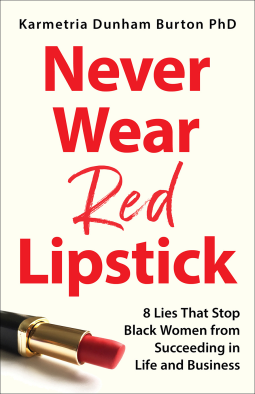
Never Wear Red Lipstick
8 Lies That Stop Black Women from Succeeding in Life and Business
This title was previously available on NetGalley and is now archived.
Send NetGalley books directly to your Kindle or Kindle app
1
To read on a Kindle or Kindle app, please add kindle@netgalley.com as an approved email address to receive files in your Amazon account. Click here for step-by-step instructions.
2
Also find your Kindle email address within your Amazon account, and enter it here.
Pub Date Mar 31 2026 | Archive Date Mar 8 2026
Talking about this book? Use #NeverWearRedLipstick #NetGalley. More hashtag tips!
Description
"More than a stuffy business guide, this book offers readers powerful wisdom about dropping archaic philosophies regarding being a Black woman in corporate structures and instead tapping into their bold authentic selves—red lipstick and all." —ESSENCE
"In this faith-based book, [Burton] shares 8 truths designed to help women lean into their power and go after their goals." —THE ROOT
A guide for Black women to unlock their potential in business and in life.
Despite being the fastest-growing group of entrepreneurs in the US, Black women face systemic barriers that threaten to derail their dreams, including lack of funding, racial and gender bias, and a lack of senior advocates in corporate spaces. Dr. Karmetria Dunham Burton, an executive with two decades of corporate experience, offers a new vision--one rooted in spiritual strength, self-care, confidence, and authenticity.
Never Wear Red Lipstick is more than a business book--it's a movement for liberation, leadership, and faith. Dr. Burton boldly dismantles the myths and limiting beliefs that have kept Black women from thriving in boardrooms and business ventures.
Blending heartfelt storytelling with field-tested strategies, Never Wear Red Lipstick introduces you to the Paint Your Lips Red principles: eight truths to help Black women embrace their power and lead with boldness. From overcoming betrayal in the workplace to prioritizing wellness, from claiming spiritual inheritance to redefining what it means to be a real boss, this book speaks to every woman who's been told she has to shrink to succeed. With the "Boss Blueprint" at its core, Dr. Burton lays out a practical, faith-driven path to growth, leadership, and legacy. Whether you're in a cubicle or launching a company, this book will help you stop surviving and start soaring.
Advance Praise
“As an Asian American woman in business, I found Never Wear Red Lipstick to be both powerful and deeply relatable as Dr. Karmetria Dunham Burton blends powerful insights with practical strategies that speak to the shared experiences of women of color in the workplace. Her honesty, wisdom, and faith contribute to personal storytelling that will help women of color shed those limiting beliefs and take action by reclaiming their full potential and power in the workplace.”
—Katie O. Mooney, talent and inclusion strategist
“The ‘Boss Blueprint Breakthroughs’ give great practical instructions on how to step into your role as a leader. This book is also a must-read for every white leader who wants to understand and appreciate the Black female experience”
—Francesca DeBiase, board member and retired global chief procurement officer
“Dr. Burton, an experienced executive and coach, dishes up practical advice in an engaging way that inspires action. This thoughtful and well-written book promises to be a guide you’ll refer to time and again to achieve the success you desire.”
—Marion K. Gross, global chief supply chain officer (retired) and board member
Marketing Plan
National and online publicity campaign targeting Black media and business media
Trade advertising
Social media campaign targeting Black women, women of faith, entrepreneurs, and self-help readers
Corporate and professional events
Podcast and radio tour
Influencer outreach
Available Editions
| EDITION | Other Format |
| ISBN | 9798889833000 |
| PRICE | $24.99 (USD) |
| PAGES | 176 |
Available on NetGalley
Average rating from 3 members
Featured Reviews
 Demetris P, Reviewer
“Never Wear Red Lipstick” and the Hidden Cost of ‘Professionalism’: How Karmetria Burton Turns a Beauty Rule Into a Leadership Manifesto for Black Women Who Refuse to Shrink
By Demetris Papadimitropoulos | February 18th, 2026
Watercolor Piece by Demetris Papadimitropoulos
“Never Wear Red Lipstick” is a title that arrives like a slap and a blessing in the same motion. It mimics the tone of unsolicited advice – the kind that passes, hand to hand, as “concern,” as “professionalism,” as “I’m just trying to help you.” Then it turns that advice inside out. Karmetria Burton’s argument is not merely that Black women can wear red lipstick. It’s that Black women have been told, in a thousand coded ways, to make themselves smaller – quieter, softer, less visible, less “difficult,” less likely to be misunderstood – and that this shrinking has been marketed as safety.
In the last few years, the policing of appearance has migrated from the obvious to the bureaucratic: “culture fit,” “brand alignment,” “executive presence,” a Zoom camera that doubles as a compliance check. Even the most mundane choices – hair texture, nail length, the shade of a lip – become proxies for the question that actually haunts many workplaces: will you make the people in charge comfortable? Burton writes in active refusal of that question. The red lip becomes armor, not because it hardens the wearer into a caricature of confidence, but because it ritualizes a choice: I will show up as myself. I will not confuse palatability with worth.
The provocation works because it names something real: “professionalism” has long been coded as proximity to whiteness, and Black women are still punished for standing out in ways men are praised for calling “presence.”
It’s impossible to read that argument without thinking of the fights over grooming codes – the litigation, the “neutral” policies that aren’t neutral, the push for natural hair protections. Burton doesn’t write as a policy analyst, but her point lands anyway: if you’re always editing yourself to pre-empt someone else’s bias, you’re paying a tax that other people never see.
The book is organized as eight principles, each framed by a clean dialectic – “The lie they tell you” and “The limitless truth.” It’s a structure that gives the reader language to name an invisible pressure, and then offers a counter-sentence sturdy enough to repeat under stress. Burton’s recurring “Boss Blueprint” – pray, process, paint your lips red – turns the chapters into a practice loop. Prayer, for her, is not passive wishing; it’s an attention discipline, a way of returning to calling, capacity, and next action. The method is deliberately blunt, almost liturgical. The book wants to be used, not merely admired.
When Burton is at her strongest, she is a storyteller with an ear for the room – the conference room, the church foyer, the mentoring circle. Consider the hiring panel scene that functions as a moral x-ray: a male colleague, in the soft authority of “common sense,” suggests a Black candidate is the wrong fit because she has a small child and another on the way, while the white candidate, childless, is presumed “available.” Burton renders the split-second calculation of what it will cost to speak up, the fear of being labeled as biased simply for refusing bias. And then she speaks. In an era of DEI retrenchment and euphemism, her insistence is almost quaint in its directness: discrimination is wrong, and silence is participation.
That moral clarity is one reason the book works. Another is Burton’s refusal to isolate leadership from a full life. Too many corporate texts assume a frictionless worker: no caregiving, no grief, no body that needs rest. Burton’s self-care chapter is not spa-culture fluff. It’s an argument about capacity and survival: boundaries as infrastructure. The overachiever who never stops working, who becomes the office dumping ground, who is punished for speaking with normal conviction – these portraits echo current debates about burnout, return-to-office mandates, and the way “resilience” can be used to launder institutional neglect.
Hope, in Burton’s hands, is not denial but posture: expect the best outcome while preparing for risk. In a volatile economy where careers wobble on a platform update, she treats hope as a discipline – something you practice when the room is discouraging, not something you wait to feel.
If Burton’s early chapters are about anchoring the self, her middle chapters are about entering the room with receipts. “Brag when you can back it up” and “Be a lady and a legend” are the book’s paired lessons on visibility: how to claim credit without apology, and how to develop the tactical range to be respected in spaces that were not designed to respect you. Burton is not advocating a single personality type. She is advocating optionality – the ability to be warm without being pliable, direct without being dismissed as “aggressive,” polished without being erased. In a time when “executive presence” is still routinely used to launder bias, Burton’s advice reads like a set of survival hacks that double as a demand: judge me by my outcomes, not your comfort.
Her sixth principle, “Be a disrupter,” expands that demand outward. Here Burton moves from individual tactics to cultural change, and she does it through a familiar kind of story: the moment you speak up, and someone else – relieved to hear what they were afraid to say – joins you. This is one of the book’s most important claims: leadership is contagious. The status quo survives because it is socially enforced; it changes when the first person takes the social risk. Burton is careful, though, not to romanticize disruption as constant rebellion. She tells readers to assess the situation, weigh consequences, and pick battles that matter. That practicality distinguishes her from more performative empowerment rhetoric. She is not asking women to burn down every room. She is asking them to notice where silence is costing them dignity, legality, fairness, opportunity – and then to act.
The book’s cultural critique sharpens further in “Stop Waiting and Start Leading,” where Burton recounts an encounter with a teenager, Eboni, who comes to hear her speak and is disappointed to discover Burton is not a reality-TV avatar of Atlanta success. Eboni wants the familiar glamor narrative: the cars, the labels, the chaos that reads as excitement. Burton offers a counter-image: a Black woman whose authority comes from degrees, discipline, service, and value creation. The anecdote could have turned preachy. Instead it becomes a small study of what the culture sells – and to whom – at an age when aspiration is being engineered by algorithmic feeds.
In 2026, the “boss chick” economy has only intensified: influence as currency, followers as proxy for wealth, brand partnerships as a stand-in for craft. Burton is not a scold. She acknowledges the real entrepreneurial ingenuity that some public figures have leveraged from a platform. But she is clear-eyed about the smoke and mirrors, the hollow performance of status in a time when genuine economic mobility is harder and the cost of pretending is higher. Her argument is ultimately a feminist one, though she arrives there through the language of faith and stewardship: a “real boss” is not a costume; she is a person who creates value, holds standards, and builds others.
Burton’s own life offers the book its most persuasive evidence. She writes about failure without fetishizing it: flunking out of college, the humiliations of starting over, the clarity that arrives on a Greyhound bus when the tears finally run out. She writes about love with both romance and realism, refusing to cast marriage as either salvation or trap. Her stories insist that there is no one timeline for becoming yourself. That insistence matters in a culture obsessed with highlight reels – the engagement post, the promotion post, the “soft life” post. Burton’s memoir-threads feel like the grain in the polished surface: proof that a life can be messy and still, in retrospect, legible.
This insistence on building others – on sisterhood as more than a caption – is one of Burton’s most resonant through-lines. “Remember None of It Belongs to You” is the book’s service chapter, and it is quietly radical in its framing. Burton rejects the familiar promise that you can “give back later,” once you’ve achieved the right title, the right income, the right stability. She narrates the founding of her “Paint Your Lips Red” community, its luncheons, its projects, the way service can become both a network and a healing practice – particularly in grief. In a moment when the language of “community” has been flattened into marketing, Burton’s service ethic feels textured: it includes logistics, calendars, and the humility of showing up when no one is watching. She also warns, crucially, against martyrdom: service must be bounded, seasonally realistic, aligned with well-being. The book understands that overgiving can be a form of self-harm with good PR.
Burton’s voice throughout is part sermon, part boardroom debrief, part older cousin telling you the truth in the car after the event. The book’s stylistic DNA is recognizable: the call-and-response of “lie” and “limitless truth”; the affectionate direct address (“queen”); the steady return to prayer as a technology of focus; the insistence that faith is not an accessory to ambition but its engine. Readers who bristle at the spiritual framework will still find themselves borrowing her sentences because she writes in mottos that travel. But the faith element is not merely decorative. Burton’s God is not a vague “universe.” God is a boss, a witness, a secret keeper – the source of both reassurance and accountability. That specificity gives the book a kind of emotional voltage that many mainstream leadership texts, careful to offend no one, simply cannot access.
The book’s “Boss Blueprint Breakthrough” sections are where the voice becomes most instructive. Burton doesn’t just tell you to believe differently; she gives you small scripts and rituals: a prayer to steady your mind, a set of questions to surface the story you’ve been living inside, a calendar block that turns intention into appointment. It’s a canny acknowledgment of how change actually happens – not in one triumphant epiphany, but in repeated micro-decisions made on ordinary Tuesdays. In that sense, her lipstick is less a symbol than a timer: a daily reminder that confidence is something you rehearse, not something you wait to be granted.
At the same time, that voltage can sometimes short-circuit nuance. Burton’s architecture – lie, truth, action – is designed for momentum, not ambivalence. It sometimes skims the deeper mess of structural constraint. When she says you can disrupt industries with imagination, she’s right, and she’s also speaking from a position of unusual access and confidence built over decades. The book could, in places, linger longer with the real costs of speaking up when you are not yet secure: the retaliation that doesn’t arrive as a firing but as a stalled promotion, a poisoned reputation, a quietly re-written job scope. Burton gestures at risk, but the book’s tone is fundamentally optimistic, even when it is warning you not to be naïve.
That is why the book sits in an interesting neighborhood of contemporary nonfiction. It has the workplace-aspiration lineage of “Lean In,” but it is far less enchanted by the idea that individual grit can substitute for institutional change. It shares the “name the thing” clarity of “The Memo,” the emotional steadiness of “Set Boundaries, Find Peace,” and the courage-as-practice ethos of “Dare to Lead,” while keeping one foot in the tradition of faith-driven empowerment books that treat spiritual life as inseparable from leadership life. Burton is also, unlike many of her comps, unusually attentive to the aesthetics of power: how you present yourself, what you signal, what you refuse to apologize for. If “Hood Feminism” is a critique of what mainstream feminism forgets, Burton’s book is a guide for what mainstream leadership culture still refuses to fully see. It also brushes against the self-advocacy logic of “The Confidence Code,” though Burton’s tone is warmer and more communal.
Her fifth principle, “Be a Lady and a Legend,” is emblematic of that tension. Burton argues for edge – for the ability to be both polished and formidable, both socially fluent and uncompromising. The point is not respectability politics so much as tactical range: a woman who can read the room and still change it. In a time when women are told to be “authentic” but punished for authenticity that violates expectation, Burton’s advice is nuanced in practice even when it reads like a slogan. She is not telling readers to become acceptable. She is telling them to become undeniable.
The book’s closing pages, including the “Dear Queen” letter and the recap of all eight principles, do what a good capstone should: they make the work feel ongoing. Burton encourages rereading; she frames the book as a reference object, something that belongs on a nightstand, in a car, in a desk drawer. That’s savvy – and true. This is not a book of novel theory; it is a book of reminders, scripts, and stance.
So where does it fall on the scale of literary distinction versus utility? Burton is not writing “Between the World and Me,” and she isn’t trying to. Her prose favors clarity over metaphor, aphorism over ambiguity. When she reaches for imagery, it is in service of action: lipstick as armor, leadership as “boss life,” imagination as disruption. Occasionally, the motivational rhythms feel familiar, and a few chapters lean on examples that could have benefited from more reported texture – more scenes, more friction, more attention to the reader who cannot simply “opt out” of a toxic environment. But the book’s repetition is also part of its pedagogy. Like a good coach, Burton knows you don’t learn a new posture once; you practice it until it becomes reflex.
What lingers after finishing “Never Wear Red Lipstick” is less a single argument than a recalibration of what counts as leadership. Burton invites the reader to stop outsourcing her authority – to bosses, to partners, to the gaze of the room, to the algorithmic fantasies of what success looks like. She insists, again and again, that leadership begins with self-leadership: faith as anchoring, self-care as infrastructure, hope as discipline, visibility as strategy, service as stewardship, disruption as responsibility, and now as the only moment in which any of this can happen.
I finished the book thinking about how often Black women are asked to do two contradictory things at once: to save the day and to disappear. Burton’s lipstick is, finally, a refusal of that contradiction. It is a small, bright ritual that says: I am here, I am capable, and I am not waiting for permission. For a book that wants to live in the drawer of your desk until the day you need it, that is a serious accomplishment – enough that I’d put it at 86/100, with its strongest chapters offering not just encouragement but a usable vocabulary for the next hard room right now.
Readers who liked this book also liked:
Deesha Philyaw
General Fiction (Adult), Literary Fiction, Multicultural Interest




Anna Barnhill
Business, Leadership, Finance, Nonfiction (Adult), Professional & Technical


Lin Visel; Joseph Bergin III
Comics, Graphic Novels, Manga, Humor & Satire, Politics & Current Affairs

T Clark
General Fiction (Adult), LGBTQIAP+, Multicultural Interest

Shiv Narayanan
Business, Leadership, Finance, Nonfiction (Adult), Professional & Technical

Adam Crawshaw
Business, Leadership, Finance, Nonfiction (Adult), Professional & Technical

Leandro Maya
Business, Leadership, Finance, Nonfiction (Adult), Politics & Current Affairs



Visha Kudhail
Business, Leadership, Finance, Computers & Technology, Health, Mind & Body