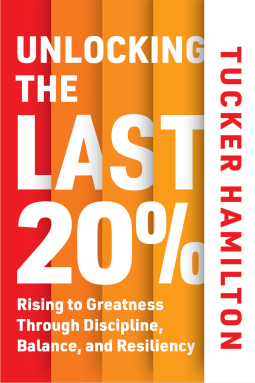
Unlocking the Last 20%
Rising to Greatness Through Discipline, Balance, and Resiliency
This title was previously available on NetGalley and is now archived.
Send NetGalley books directly to your Kindle or Kindle app
1
To read on a Kindle or Kindle app, please add kindle@netgalley.com as an approved email address to receive files in your Amazon account. Click here for step-by-step instructions.
2
Also find your Kindle email address within your Amazon account, and enter it here.
Pub Date Mar 24 2026 | Archive Date Mar 1 2026
BenBella Books | Matt Holt Books
Talking about this book? Use #UnlockingtheLast20 #NetGalley. More hashtag tips!
Description
Publishers Weekly Bestseller
Break through the barriers holding you back from reaching your full potential and leaving you stuck at 80% capacity, with this guide to the hidden paths that most people never find.
In Unlocking the Last 20%, Tucker “Cinco” Hamilton shares the framework that propelled him from high school dropout to commander of the military’s largest flight test organization. Drawing from his myriad of experiences flying aircraft, leading combat missions, and pioneering autonomous aircraft systems, Hamilton unveils the crucial mindsets and actions that separate those who merely achieve from those who truly excel.
Whether you’re an established professional looking to break through career stagnation or a young graduate building the foundation for future success, you will gain precise strategies to:
- Develop visualization techniques that program your mind for breakthrough performance
- Identify and eliminate the hidden distractions preventing your final push to excellence
- Apply the proven resilience framework that transforms setbacks into catalysts for unprecedented growth
- Leverage collective wisdom and cutting-edge innovation to amplify your individual capabilities
- Strike the precise balance between ambition and well-being that sustains long-term exceptional performance
Push beyond perceived limitations, establish meaningful success metrics aligned with your values, and catalyze breakthroughs in every aspect of your life. Through compelling personal narratives and practical insights, Unlocking the Last 20% is a mentor in book form, illustrating how visualization, purpose, preparation, balance, and resilience work in concert to unlock dormant capabilities.
Available Editions
| EDITION | Other Format |
| ISBN | 9781637748480 |
| PRICE | $30.00 (USD) |
| PAGES | 256 |
Available on NetGalley
Available to Buy
Buy on Amazon Buy on BN.com Buy on Bookshop.orgAverage rating from 1 member
Featured Reviews
 Demetris P, Reviewer
A Centrifuge, a Checklist, and a Philosophy of Follow-Through: Reading “Unlocking the Last 20%” as a Manual for Doing the Work
By Demetris Papadimitropoulos | February 16th, 2026
Watercolor Piece by Demetris Papadimitropoulos
“Unlocking the Last 20%” arrives wearing its thesis like flight test orange: impossible to miss, engineered for visibility, daring you to look closer. Tucker “Cinco” Hamilton, a retired Air Force fighter test pilot and AI leader, has written a self-help manifesto disguised as an adventure memoir, or perhaps an adventure memoir disguised as a field manual. The blend is the point. Hamilton’s proposition is simple enough to fit on a kneeboard card: most of us live at 80%, and the remaining margin – the last 20% – is where discipline becomes destiny, where preparation becomes execution, where the person you meant to be is finally forced into daylight.
That promise has the taut, recruitment-poster clarity of an airfield briefing. It also has the risk of any slogan: repetition can stand in for discovery; volume can masquerade as depth. Hamilton’s book, at its best, avoids that trap by doing what his flying stories insist upon: it makes the abstract physical. A centrifuge is not a metaphor; it is a machine designed to strip you down to the truth of your body. A rocket attack is not a thought experiment; it is a loud, indiscriminate referendum on calm. When “Unlocking the Last 20%” leans on these lived particulars, it earns its authority. When it tries to turn moral conviction into universal prescription, it sometimes narrows its own runway.
Hamilton writes with the cadence of someone who has spent a career speaking in checklists and debriefs: brisk, declarative, confident in cause-and-effect. He is fond of clean headings and clean moral arcs – “A STORY,” then “A LESSON,” then the practical steps, the “PRINCIPLES IN ACTION.” The method is evangelical in structure even when it is secular in application. You can almost hear the instructor voice in the headset: Breathe. Focus. Correct. Try again. For readers exhausted by the mushy permissiveness of much contemporary self-optimization literature, this can be bracing. For readers wary of certainty – especially the kind that shades into cultural or political certainty – the same voice can feel like a hand on the yoke that does not always ask permission.
The book’s organizing obsession is equilibrium, but not the Instagram variety. Hamilton wants balance across pillars – mental, social, physical, spiritual – and he is suspicious of the modern habit of calling burnout “ambition.” He treats distraction as a national weather system: omnipresent, corrosive, normalized. In that sense, the book is unmistakably of this moment, written in an era when attention has become the most contested resource on earth, when AI tools can either free time or further atomize it, and when institutions – from workplaces to militaries to democracies – have become more skeptical of their own capacity to renew. Hamilton’s emphasis on disciplined execution reads as a response to the contemporary disease of endless planning, endless posting, endless “thought leadership,” and very little follow-through.
Still, “Unlocking the Last 20%” is not primarily a book about productivity. It is a book about character, and about how character is formed in the friction between desire and restraint. Hamilton’s most revealing material arrives in Chapter 8, “Harnessing the Power of the Collective,” where the myth of the self-made person is punctured by family history. He tells a story of rupture and repair: a mother overwhelmed, an affair, a move west, an Ivy League father taking grueling jobs to keep a family intact, a community of service, and later, a father’s derailment into gambling addiction. Hamilton’s moral does not land where many self-help books would place it – on individual hustle alone – but on the ecology that makes endurance possible. Greatness, he argues, is communal; generational resilience is a relay, not a solo sprint.
The memoirist in Hamilton is strongest here. The prose slows down. The book admits ambivalence. His father’s flaws are neither excused nor weaponized. The lesson is not that virtue is easy, but that it must be chosen repeatedly, often against the grain of fear. For a reader coming from a left-of-center worldview, this chapter also contains the book’s most resonant political subtext: the insistence that social support systems matter, that people are shaped by their environments, that “community” is not a sentimental word but a material force. Hamilton does not frame it in the language of policy, but the implication is clear: private grit is insufficient without public scaffolding.
From that communal core, Hamilton pivots into the technological future in Chapter 9, “Innovation and Technology,” where the book becomes a parable about trust – trust in machines, trust in institutions, trust in the people who say, calmly, “You’re wrong.” His centerpiece is the long, delayed adoption of Automatic Ground Collision Avoidance System (Auto GCAS), a system engineered to save pilots by taking control only when death is imminent. The story is both thrilling and chastening: a technology proven for years, resisted for years, then mandated, then celebrated. Hamilton frames the resistance bluntly as ignorance and arrogance, and the moral is one our era keeps relearning with new nouns: the cost of refusing evidence because it threatens identity.
It is hard not to read this chapter through the lens of today’s AI anxieties. Swap fighter pilots for white-collar professionals, Auto GCAS for algorithmic decision support, and you have the same psychological battle – fear of losing agency, fear of being replaced, fear that a tool will become a tyrant. Hamilton’s insistence on “critical trust” lands well: do not worship technology, but do not sabotage yourself by refusing it. He also offers a counter-lesson that many tech evangelists skip: too many tools can create its own form of paralysis; sometimes a pencil beats an algorithm. His sharpest critique is reserved for bureaucracy that idolizes process over mission, a point illustrated by a petty queueing system that cannot accommodate human context. In an economy increasingly run by forms, portals, and automated “no,” this is one of the book’s most quietly radical insights: empower people to use judgment again.
If Chapter 9 is about integrating innovation, Chapter 10 is about integrating yourself. Hamilton’s centrifuge story – three attempts, two blackouts, one final pass – is an endurance narrative written in granular bodily detail. The reader is pulled into the tightening tunnel of vision, the burning breath exchanges, the ache of muscles held in disciplined contraction, the strange intimacy of fighting gravity with technique. Hamilton’s account has the cinematic charge of “Top Gun: Maverick,” but with the glamour scraped off; the heroism here is not swagger but breath control, not charisma but preparation.
This is where the “last 20%” idea stops being motivational wallpaper and becomes a lived ethic. Hamilton’s prescription is not mystical. He recommends visualization, honest correction, “chair flying” rehearsal, controlled adrenaline, and perspective – a blend of cognitive reframing and physical training that echoes both elite athletics and high-reliability organizations. You can hear, faintly, the lineage of “The Checklist Manifesto,” with its devotion to repeatable process under stress, and “Grit,” with its emphasis on sustained effort. Yet Hamilton is less interested in psychological nuance than in moral ignition. The lesson is always: do not settle. Get up. Push. Execute.
That imperative is the book’s engine, and also its limitation. There are moments, especially in the later “call to greatness” passages and in the legacy chapter, where Hamilton’s tone shifts from exhortation to indictment. The book warns against excuses, fragility, complacency, distraction. It invokes freedom and the Constitution as inheritance and obligation. It leans hard into virtue language and faith-rooted framing. For some readers, the effect will be galvanizing – a needed slap of cold water in a culture that often confuses self-care with self-avoidance. For others, particularly readers who see structural inequality as more than a backdrop, the rhetoric can feel like it underestimates how differently the centrifuge is calibrated for different bodies, different paychecks, different histories.
Hamilton’s strongest answer to that critique is, ironically, embedded in his own narrative. He knows people are not purely self-authored. He knows addiction is not defeated by slogans. He knows that communities can save or suffocate. When he tells readers to seek help, to find mentors, to join organizations, to build reciprocal bonds, he gestures toward a more generous framework than the toughest lines suggest. The book is at its most persuasive when it pairs personal responsibility with collective responsibility, when it insists that “living at 100%” includes how you invest in others, not only how you optimize yourself.
One of Hamilton’s most transferable sections is his treatment of communication as a performance system, not a personality trait. In his Air Combat Maneuvers vignette, brevity, standardization, and timing are survival technologies. The scene reads like a compressed seminar on crisis communications: if you speak too fast, the message is missed; if you improvise too freely, the shared mental model fractures; if you guess, you endanger people. In a year when rumor cascades and algorithmic amplification have made “what happened” newly contestable, Hamilton’s insistence on the humble sentence – “I don’t know” – feels like an ethical intervention. Accuracy, he implies, is a form of care.
Chapter 8 offers one of the book’s most unnerving stories in this vein: an MC-12 mission in which aircrew misinterpret a “mortar” flash and nearly direct lethal force at an innocent civilian – until an intelligence analyst on the ground replays the feed and corrects them. The episode is a masterclass in cognitive bias under pressure, but its deeper moral is communal humility. In a culture addicted to hot takes, Hamilton valorizes the person who slows down, checks assumptions, and says, in effect, the most courageous sentence of the information age: wait. That lesson belongs as much to newsrooms and boardrooms as it does to war zones.
Legacy, in Chapter 11, broadens the frame again. Hamilton tells the story of Charles DeShields, an early aviator who survives a catastrophic crash, later commands an airfield, and narrowly misses the Pearl Harbor devastation by moving his family off base. Hamilton threads this into “generational resiliency,” a family braid that includes Olympic sprinter Betty Robinson and his own near-death experiences. The claim is not that history is destiny, but that history is fuel – and that your legacy is not what you leave behind, but what others begin because you were here.
It is a stirring ending, and it reveals the book’s spiritual architecture. “Unlocking the Last 20%” is not content to be a guide to better habits. It wants to be a moral compass, a call to live in a way that will outlast you. Hamilton’s faith is not incidental; it is the book’s gravity, pulling every anecdote toward a thesis about virtue, service, and sacrifice. Readers who share that orientation will feel the book’s emotional voltage increase as it nears the finish. Readers who do not may still find the legacy chapter compelling as story, but may bristle at the moments when national myth and moral urgency blur together.
As a piece of writing, Hamilton’s style is functional rather than lyrical. He is not trying to astonish you with sentences. He is trying to persuade you with momentum. The prose tends to move in clean, forward thrusts – statement, example, lesson, action. When he slows down, as in the family chapters and the centrifuge sequence, he can be genuinely affecting. When he speeds up, the text can feel like a keynote that has been expanded into paragraphs. The best self-help books – “Atomic Habits,” “Deep Work,” “The War of Art” – use their simplicity to create precision. Hamilton sometimes uses simplicity to create certainty.
As a composite, “Unlocking the Last 20%” sits in a recognizable lineage that includes “Extreme Ownership,” “Make Your Bed,” “Team of Teams,” “Atomic Habits,” and “Deep Work.” What differentiates Hamilton is the degree to which the stakes are not rhetorical; his best insights come from environments where mistakes have blast radii. The tradeoff is that the genre’s default certainties sometimes sneak in: an overreliance on willpower, a scolding diagnosis of modern softness, a blur between personal grit and national mythology. The book is at its strongest when it counters that impulse with what it knows to be true – that people are shaped by systems, mentors, and communities, and that execution without humility is just another kind of risk.
For a reader on the left, the friction points are predictable: the book’s faith-forward vocabulary, its reverence for the Constitution as inheritance, and its impatience with “excuses” can read as culturally conservative. Yet Hamilton repeatedly complicates a purely individualist message. He credits mentors and organizations for changing his trajectory, treats analysts and maintainers as mission partners, and frames community as the engine of generational resilience. If you hold those two truths together, the book becomes less a slogan and more a study in tension – rugged execution paired, often uneasily, with relational dependence.
And yet: there is something undeniably attractive about a book that refuses to flatter the reader. Hamilton does not offer the luxury of endless self-diagnosis. He offers a demand: decide what matters, and live as if it matters. In an era when our devices constantly invite us to outsource attention, outsource memory, outsource effort, he insists that the human core remains nonnegotiable. Tools can help. Communities can lift you. Systems can save lives. But no algorithm can do your last 20% for you.
My rating: 79/100.
That number is not a shrug; it is a recognition of a book that is often powerful, sometimes repetitive, occasionally ideologically narrowing, and yet anchored by real stakes and real earned authority. “Unlocking the Last 20%” is a book you can argue with and still keep on your desk. It will not be everyone’s gospel. It will be, for many, a corrective – a reminder that the gap between who you are and who you claim you want to be is closed less by insight than by execution.
Hamilton closes with flight test orange, the color used to mark experimental systems so they can be seen and measured. It is a fitting emblem for his project. This book wants to make your life measurable again – not in the sterile metrics of apps and dashboards, but in the older, harder units: sacrifice, focus, courage, presence, follow-through. The question it leaves you with is the one Hamilton has been asking all along, in different forms, story after story, lesson after lesson: when the moment arrives, will you simply perform, or will you live at 100%?