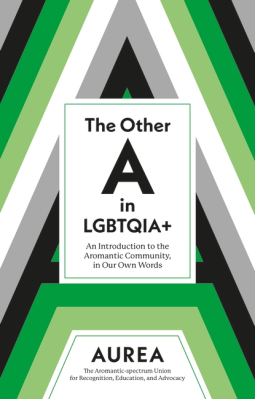
The Other A in LGBTQIA+
An Introduction to the Aromantic Community, in Our Own Words
This title was previously available on NetGalley and is now archived.
Send NetGalley books directly to your Kindle or Kindle app
1
To read on a Kindle or Kindle app, please add kindle@netgalley.com as an approved email address to receive files in your Amazon account. Click here for step-by-step instructions.
2
Also find your Kindle email address within your Amazon account, and enter it here.
Pub Date May 21 2026 | Archive Date Jun 11 2026
Talking about this book? Use #TheOtherAinLGBTQIA #NetGalley. More hashtag tips!
Description
Do you ever feel alienated by the way society presents love? Maybe you find the idea of romantic relationships off-putting, or maybe it's just 'not your thing'. Sound familiar? Aromanticism is a spectrum of identities where people have little to no interest in romance, or only feel attraction under certain circumstances.
This essential book weaves together insights and perspectives from aromantic people across the world, sharing their stories of self-discovery and community. Chapters explore how aromanticism interacts with mental health, dealing with stigma or dismissive attitudes, intersection with different cultural expectations, and more.
Whether you're new to an aromantic identity, have been part of the community for years, or just want to know more, this book will help you understand what aromanticism is and what it means for you.
Available Editions
| EDITION | Other Format |
| ISBN | 9781805012856 |
| PRICE | £18.99 (GBP) |
| PAGES | 240 |
Available on NetGalley
Available to Buy
Buy on Amazon Buy on BN.com Buy on Bookshop.orgAverage rating from 47 members
Featured Reviews
 Brynn C, Bookseller
I was so happy to see this on NetGalley's lineup of upcoming publications. There is so little aro/ace scholarship (although it is growing) that does not delegate us to disability. This would have been an excellent source for my most recent research paper on aro/ace representation in genre fiction! I feel seen, understood, and hopeful for the future of representation for the Other A.
 Chris H, Reviewer
This was incredibly well done. I don’t know what else to say.
This is very close to being a textbook, so don’t expect a fun story full of humor or other witty writing that will draw you in. Your reading experience is going to be directly proportional to your interest in the topic. This IS well written though. Its well organized and very thorough. There is discussion of the central topic, as well as intersectionality with several other interrelated topics such as gender and sexuality.
I wish that I had this book as a physical copy that I could hang onto, and not a digital ARC that will disappear from my phone after a time.
Thank you to NetGalley for providing a free ARC. This honest review was left voluntarily.
Stephanie L, Librarian
This is a great book for anyone wanting to understand more about Aromantics; either because they identify as Aro or they know someone who does. It presents the history of the way the term has developed and even presents some history of aromanticism that predates the use of the word. It has some great questions for both Aros and allies that should help you understand your own thinking on the topic.
Sara M, Reviewer
This is a really comprehensive book. It will help anyone aromantic who wants to feel less alone but it will also help family members and caregivers. There's even a section about supporting mental health for aromantic people. It draws on surveys and personal testimonies as well as referencing media representations.
The sections on neurodivergence are good too.
 Reviewer 1517194
This book is a great resource for anyone wanting to learn more about the aromantic spectrum. As someone who has only learned of the term fairly recently, I was able to learn a great deal from reading this. I really enjoyed the flow of the book, and how the authors presented the material and different sections. I found that the way they organized everything really helped the information build up and solidify in my mind.
I also really appreciated the inclusion of excerpts of personal narratives/experiences from folx in the community. I found it very helpful to learn about the concepts/ideas, and then be presented with the excerpts of people’s lived experiences in their own words. Additionally, I appreciated the “Reflection” sections at the end of the different parts. Each Reflection section included reflection questions and prompts “for people who identify with the aromantic spectrum” and “for allies of aromantic people.” I am also happy to say that I was able to learn a lot about myself through these reflection questions/prompts.
I want to thank the authors for doing the immense amount of research and community-building that they clearly did for this book, and, ultimately, for writing and publishing it. There is not a lot of literature out there for this topic yet, so I am happy to see it.
Thank you also to NetGalley and Jessica Kingsley Publishers for the ARC opportunity!
 Kate S, Reviewer
This book was interesting! I usually don’t read much non-fiction outside of work (psychology), however this title drew me in. It was nice to learn more about the aromantic-spectrum. I don’t know how this discipline (sociology?) references, but I found myself missing I text referencing (APA7) and discussions of existing literature. Thank you for the Arc!
 Raaven H, Reviewer
Thank you to NetGalley and the publishers for this ARC in exchange for my honest review!!
I am asexual and I love seeing nonfic books that discuss it! It’s so nice for others to get info or for others questioning. I really enjoyed this book and its information and I really hope a lot of people can get stuff out of it!
Reviewer 1017980
A good introduction to aromanticism. Well researched and much needed. Aromanticism, much like asexuality, is a much broader subject than many people not deep in the community may expect, and I think this did a good job hitting all of the areas it needed to while not being too excessively lengthy for an introductory text. Well done.
Amy Elizabeth R, Reviewer
Really informative and I definitely learned more about Aromanticism which means the book met its goal!
My Favourite parts were the personal anecdotes sprinkled throughout the chapters that bring lived-experience to the facts.
I think this would make a great reference book! It does unfortunately read quite like a dictionary, with a lot of definitions being listed. But if i had a physical copy it would be a great book to dip in and out of. Its just a bit harder to read in longer chunks.
 Amélie V, Reviewer
mix of self-help and beginner’s guide. drags at times (strongest chapters are definitely at the end) but it’s a good that things like this exist and more importantly get published.
if you’re already well-versed in a-spec identities, i’d suggest skimming the theory to focus on the experiences shared by other members of the community. there were two short essays related to amatonormativity (a term i hadn’t even even known about before reading which says enough) that really struck me.
in one of them, someone mentioned being aware of the fact that they didn’t want to get married from a young age, and how they didn’t feel guilty about that at the time. i think this is a sentiment shared by other queer people and is an excellent example of how societal expectations get to you from a certain age when they shouldn’t! the other discusses how very western and recent ideas about the ideal relationship of today are. it’s stories like these that help battle internalised struggles because they make you stop and question yourself.
Educator 601344
This is an extremely useful and detailed introduction to a human experience that is frequently overlooked, ignored, or actively dismissed. It provides historical context, detailed definitions, explanations and discussions, and showcases a range of voices and lived experiences. Reading this book will not only help you better understand the aromantic spectrum - it will also encourage you to think more deeply about the relational norms that underpin your society.
Thank you to NetGalley for the eARC.
 Mo D, Reviewer
I really enjoyed this one! I found it to be very enlightening and informative. I loved getting the chance to do more research on historical facts and other statistics that were mentioned in this book, as those were my favorite to learn. And most of them I didn't actually know anything about. So I was very happy with getting the chance to learn more about the aromantic spectrum.
As someone who is on the aromantic spectrum, I really loved the inclusivity of this one. Nonfiction is hard to come by that includes such factors, so it was refreshing in all honesty.
I will say that this book was a bit of a slow start, at least for me, however it may just be the fact that its in a genre that I took a break from for a bit. However I still very much enjoyed getting the chance to read about this identity.
 August S, Reviewer
This is one of those reads that seems extremely niche but is actually something that should be more broadly discussed and acknowledged. Aromanticism is one of those "silent identities" that frequently gets left out of discussions of queer identity and lived experiences. This book is an attempt to bridge that gap. I found one of the more powerful parts of this book being the way it so heavily draws on the submissions and experiences of actual aro-spec individuals and communities. This allows you (the reader) to really process how many different people, from many different cultures, experience relationships and attraction instead of just being told that it exists on some general level.
This is a great resource for people who are considering their own identities, trying to understand the identities of their loved ones, or who are just trying to further their own education. There are discussion style questions at the end of every chapter both for aro-spec people and allies which allow you to engage critically with the text.
My only drawback from this book is that it is a LOT of information thrown at you all at once. If you are trying to casually or gently ease someone into queer theory or discussion this is probably not the book for you. While it is very informative, it engages heavily with intersectionality and more complex experiences and identity that might make it difficult for a layman to understand or continually engage with.
 Autumn A, Reviewer
Thank you to Netgalley for the free read!
A comprehensive, clear and concise textbook guide to aromanticim. A good book to read if you're aro or questioning, as it explains the wide diversity within the spectrum. And even if you aren't, you might want to to expand your knowledge and understanding of aromaticism.
The other A is actually a trio of As ie Asexual, Aromantic and Agender also called the triple A.
The book provides excerpts of personal experiences from various communities, backgrounds and ethnicities. And how aromanticism intersects with the various other social constructs like race and disability. It also touches on its relation to the other queer spectrums of the LGBTQIA+ and introduces the split attraction model.
It does however go into an in depth analysis of the relationship between aromanticism and mental health - the connections, its influences and how aros relates it in their everyday lives, or how connections can be false positives due to confusion.
The book provides all the definitions and terms you'll probably need to know if you're arospec. What's mind boggling is the plethora of microlabels, which I'll probably won't remember all of it or use in my entire life, ever..
The final section talks about promoting awareness and visibility to the wider communities at large and to create understanding and tolerance. For its acceptance and integration into society in a positive and healthy way.
As a demiromantic demisexual myself, I can relate to some of the experiences in the book. Thinking back, during my high school and college days, I finally understand why almost all my friendships were intimate platonic (men and women inclusive). The thought of being romantically or sexually attracted never even crossed my mind. I remember how people called me naïve, childish, thick headed, a nice/shy girl or a prude! Though most were never said in a derogatory way, more in a playfully joking way.
 Marco C, Reviewer
Thank you NetGalley, AUREA, and Jessica Kingsley Publishers for providing this free ARC.
As soon as I spotted this book focused on the aromantic spectrum, I knew I had to read it: it’s quite difficult to find a book talking about aromanticisim in more than a vague mention in passing between other queer topics.
As an aromantic person myself, I often found that this romantic orientation is often either forgotten, or not considered “queer enough” to be even considered to be talked about. Probably, as the book itself explains, it’s because of the amatonormativity widely diffused – expecially in the Western world – where it is expected to want, pursue and enter romantic relationships, amatonormativity present even in queer spaces. “Love is Love” but what if love is not your thing?
The book is very educational, with lots of references and also resources to check, and – most importantly – made by people in the aromantic spectrum.
This is not only for other people in the aromantic spectrum, and for those questioning it, but also for those who want to understand and support aromantic people. There’s also a chapter towards the end, that is meant for mental health professionals so they can better understand and – instead of trying to “fix” them – how to properly care about their arospec patients.
AUREA's team put a lot of care in this text. Aromanticism is well explained, from the bare bones on this (lack of) romantic orientation, the microlabels within the spectrum, to the stigmas surrounding it – including dismissiveness and microaggressions –, to how it interacts with mental health, and the intersectionality with different cultural expectations regarding relationships (or lack of thereof). There are insights and perspectives by other aromantic/arospec people, shared to AUREA through their census and open calls for those who wanted to share their thoughts… and I think that the testimonies in the text are a great addition that also helps with some clarifications.
I appreciated the journal prompts you could find at the end of some chapters (divided in prompts for arospec people, and prompts for allies). Probably I will use them in the future for some self-reflection, but at the moment I don’t feel ready enough to open that can of worms. As for now, knowing that I’m aroace is enough for me.
This is the perfect book for anyone wanting to learn more about aromanticism, but also – and expecially – for arospec people and for those who are questioning themselves.
I honestly would love to buy a copy of this when it will be published.
Star Rating: 4.5 out of 5
Personal Rating: Finally a great nonfiction book about aromanticism!
 Audrey S, Reviewer
Actual rating: 4.5 stars
.
Slowly but surely we are starting to see more and more published material focused on Aromantic and it is making my heart so happy. This book is very much a textbook introduction into the Aromantic community while also leaving space for its relationship and intersectionality to gender, race, neurodiversity, privileges, and personal stories. I also really enjoyed the reflection questions at the end - especially since they were separated into different groups of questions based on whether you were Aro, learning to be an Aro Ally, and once even a section for professionals who could be working with the Aromantic community.
.
It was incredibly approachable information and discussed in clear ways that also left room for things to be challenged by personal experience. It was incredibly reassuring to read this as an Aromantic Allosexual as our side of the spectrum is usually left out in favour for the AroAce side - even if their representation is also tragically small.
.
This text will give you many things to think on while also giving space for those on varying degrees of the spectrum. I would happily put this in the hands of anyone who is questioning or curious about the Aromantic community and I am very glad we have this introductory text available.
.
.
Hisses & Kisses 🐍
.
*I received an eARC from Jessica Kingsley Publishers & NetGalley. All opinions are my own.*
Reviewer 1941544
The aromantic identity spectrum feels still fairly unknown to the public, so I'm glad there's been more resources appearing on the market exploring what does it mean to different people to be aromantic and how does it affect their lives. We live in a culture where romance is pervasive and put on a pedestal, so people who don't share that point of view are often discriminated, dismissed, vilified or pathologized.
This book will help both people on the aromantic spectrum and people who want to be allies and understand the phenomenon become more educated and accepting. There's a wealth of information both from the experts and from the members of the aromantic community sharing their experiences and perspectives.
A very informative title about a subject that desperately needs dispelling some myths. Highly recommend.
ashley m, Reviewer
I appreciated seeing a book specifically making space for identities that are often overlooked even within queer conversations.
The discussions around visibility, assumptions, and community felt thoughtful and accessible, especially for readers who may still be figuring things out themselves. It balances personal experiences with broader conversations in a way that keeps it engaging.
An important and affirming read.
Reviewer 755898
A nice overview of the other A. I found it informative and the personal stories were helpful. An overall good read.
Shelby M, Reviewer
I love consuming books like this. But I'm a queer nerd, so what can I say. However this is a part of queer life that I was not very knowledgable about. I knew enough to be considerate of others. But having been able to consume this ARC, I know so much more.
Beth M, Reviewer
One of the best resources on aromantacism, The Other A in LGBTQIA offers multiple perspectives on the issues the aro community faces in both the culture at large and queer culture. If it is true that none of us is free til all of us are free, then we all should be working to end amatonormativity, as it does harm us all.
Aromantic people will find in this book a deep dive into a variety of experiences, plenty of reflection questions to help them gain clarity on their own experience of being aro, and feel seen as the authors discuss the many ways the queer community and society in general makes it incredibly hard to hear about aromanticism, find others who are aromantic, and come out to their circle. At every turn it seems that romance is forced into daily life, and it has become so normal to equate the word love with romantic love that many aromantic people get accused of not having hearts, not being capable of love, or being non-human. While the LBTQIA+ community is supposed to provide solidarity, it is often not welcoming to people who don't see romantic attraction as the end all be all.
I would recommend this to people who are not aromantic but wish to learn more about it, or those who desire to reflect on their own impact on the aro community. There are also discussion questions for allies at the end of each part.
Reviewer 949472
What an excellent resource on learning more about aromanticism! I highly recommend to everyone, as it's an informative, accessible primer in educating ourselves on "the other a" (:
Librarian 1124177
A very thoughtfully compiled anthology of viewpoints and perspectives. Like many a-spec books, there is a lot of vocabulary to cover, so sometimes it comes across as more academic in tone (or more like Wikipedia - which is to say, rich with information while still accessible to the general reader!). A balm for readers who are part of a community that often feels unseen.
 Marlo B, Reviewer
Thank you NetGallery for the eARC!!
Everyone needs to read this book. I’ve finally succeeded in finding a book that’s not only about arospec identities, but solely that. Since discovering my experience with being aroace, I have been searching for books/media that can help me connect and understand myself more. This book opened up doors that I previously couldn’t find easily.
This book goes through all the motions. There is discussion about what being aro is, the amounts of labels/micro-labels, how to support both as an ally and within the identity, many resources to check out, personal narratives, and so so much more.
I would say that about 50% of this book I had previously knew/partially understood what we being discussed. But that other 50% was sincerely amazing to read and have access to.
This is definitely a book to pick up when learning more about the A+ identities, and please, please support that work that AUREA does!
 Josefa T, Reviewer
Very interesting book full of information covering different topics within the aromantic spectrum. I learned a lot!
Reviewer 420770
The Other A in LGBTQIA+ is a much-needed and deeply thoughtful introduction to a community that is far too often overlooked. The highlight of this collection is the personal narratives because hearing from aromantic people in their own words provides an authenticity that standard textbooks often lack. I particularly appreciated the book's strong emphasis on intersectionality, especially the section on disability. It shows how aromanticism interacts with different physical and mental health experiences rather than presenting a one-size-fits-all identity. It is a refreshing and eye-opening read that effectively deconstructs society's obsession with romance.
While the book is a landmark resource, the final section on moving forward as a community feels a bit too tethered to the specific politics of the moment. This might make it feel dated as the movement evolves in the coming years. However, this minor critique does not diminish its overall importance. As one of the few comprehensive titles dedicated specifically to the aromantic spectrum, it is an essential read. Many thanks to NetGalley and the publisher for providing an ARC in exchange for an honest review.
Reviewer 1303548
I am so so happy that this books exists. Over the last ten years or so we’ve seen a lot of emerging literature on ace voices and the asexual experience, so I’m glad to see this book really focus on aromantic voices.
It’s great that the book doesn’t assume knowledge, works both as a resource within the community and for people looking to educate themselves/support the aros in their life. To that end, i do wish it got a little deeper at times. I know that’s not the function of this text, and I’m glad it exists as a first step in this literature. But I wanna dig deeper personally (and it does give a lovely bibliography as a reference there for me).
I also appreciate how it highlighted how the internet has shaped and provided a haven for the aromantic community specifically, as it was a term coined online and that’s risen to recognition in the last 25 years or so, its history looks very different and much more digital than other LGBTIA groups.
I don’t usually review nonfiction, but a solid 4/5 from me! Thanks to NetGalley for the eARC.
Reviewer 2045393
It's always exciting to see new nonfiction resources on aromanticism, as for a while it's been lumped up with asexuality in publications.
Maybe it's because I've read my fair share of research on the topic, but it didn't go as thoroughly or as complex as I'd wanted it to explore even despite the many, many pages of theory. My favorite parts ended up being all the anecdotes which made me feel seen and the final section of the text which made me feel quite hopeful.
Despite this, I'd still highly recommend the book to anyone exploring their sexuality or learning more about the community. It's organized, packed, and intersectional, which is all you want with nonfiction these days. Also, it is incredibly important for resources like this to exist and continue publishing in the future.
Thanks to Netgalley for the eARC!
Reviewer 1121495
Really nicely written introduction to aromanticism, various microlabels, and the community around it. The information is presented in a manner that makes it easy to understand while also encompassing the many nuances that come with the definitions of aromanticism and other concepts connected to the aromantic community. I really appreciated the intersectionality and how the book introduced aromanticism from as many different viewpoints as possible, even though there were some limitations and things that could be discussed more than just in passing. But as it is with such wide spectrum, I think this book tackled its mission very well and offered a comprehensible guide to aromanticism in a way that can definitely be helpful for people who are both new and old to the community, and their allies. In this, I also liked the questions offered at the end of the chapters that presented space for reflection and discussion. Over all, this book is in my eyes a great resource for the community and AUREA did a wonderful job putting it all together.
 Zana A, Reviewer
3.5 stars
This was a pretty good primer for those who are looking for an introduction to aromanticism. Similar to how I felt about Ace: What Asexuality Reveals About Desire, Society, and the Meaning of Sex, if you're well-informed about the topic, then there might not really be anything new to learn.
I liked that this book was easy to understand and digest, especially when the informational sections ended and the self-help chapters started. This book ended up being more of a self-help/self-therapy text for people who are newly identified as aromantic, including any specific microlabels on the aromantic spectrum, and a mini handbook for therapists who want to be informed about aromanticism, its history as a queer identity, and the challenges that aromantic people face in society and queer spaces.
I won't lie. Being chronically online helped me understand my own aromantic identity and what it means to be aromantic, including how others on the aromantic spectrum identify themselves and find community within online spaces. So this book wasn't as revelatory as I thought it'd be. But for those who are unsure or are still trying to understand themselves, I think this book would be very helpful.
Thank you to Jessica Kingsley Publishers and NetGalley for this arc.
 Bee C, Reviewer
The Other A in LGBTQIA+ is a fantastic introduction to Aromanticism and the many micro labels that exist not only within the aromantic community but across the wider spectrum of identities that AUREA takes the time to explore. I think this would be a valuable read for anyone questioning or exploring their identity, as well as those already part of the LGBTQIA+ community and allies who want to broaden their understanding. In short, it's a book for anyone interested in learning more about what it means to identify and live as aromantic.
I really appreciated the level of detail throughout the book, particularly as it was written by two authors who identify as Aro themselves. Not only did I learn more about Aromanticism, but I also gained a greater understanding of the intersectionality that exists within the community. The combination of informative sections and personal accounts from Aro individuals provides valuable insight and helps bring the experiences discussed to life.
Of course, the Romantic spectrum is incredibly diverse, yet AUREA manages to cover a remarkable amount of information without ever making the book feel overwhelming. The writing is accessible and engaging, making it an excellent starting point for anyone looking to learn more about Aromanticism and the experiences of those within the community. I’d highly recommend this as an introduction to learning more about Aromanticism and am so glad there’s books like this now available to help people learn, and not necessarily feel that they’re the only one to feel the way they do.
Reviewer 2067143
Thank you, NetGalley, for the eARC!
As someone on the aromantic spectrum, I am always looking for non-fiction and fiction about the identity because they are typically few and far between. I find this an excellent introduction to the community. It gives a good basic overview of the identity and the struggles of those who share it.
Obviously, for me, the majority of the information was not new. However, there were microlabels I was introduced to in this book and important resources towards the end. I think having community contributions was also important, and has me eager to investigate AUREA a little further, as I had never heard of them before.
I will say that the chapters surrounding mental health and neurodiversity in relation to aromanticism could have been condensed into a couple of chapters, as I felt like there was a lot of repetition. However, as an introduction, I do think this book is pretty solid.
Readers who liked this book also liked:


Andrew Joseph White
LGBTQIAP+, Mystery & Thrillers, Teens & YA

John Ajvide Lindqvist; Marko Hautala; Steinar Bragi
Essays & Collections, Horror, Novellas & Short Stories