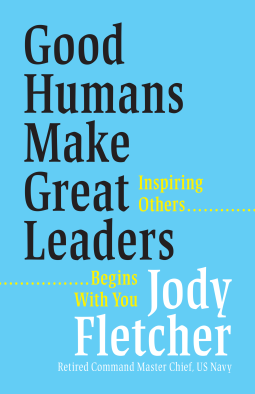
Good Humans Make Great Leaders
Inspiring Others Begins with You
This title was previously available on NetGalley and is now archived.
Send NetGalley books directly to your Kindle or Kindle app
1
To read on a Kindle or Kindle app, please add kindle@netgalley.com as an approved email address to receive files in your Amazon account. Click here for step-by-step instructions.
2
Also find your Kindle email address within your Amazon account, and enter it here.
Pub Date Jul 14 2026 | Archive Date Jul 15 2026
Talking about this book? Use #GoodHumansMakeGreatLeaders #NetGalley. More hashtag tips!
Description
Exceptional leaders start by looking inward and making big changes, one small step at a time.
In his three decades of military leadership, Jody Fletcher discovered two fundamental truths: If you don’t show up as a good human, you’ll never be a great leader. But being a good human doesn’t automatically make you someone worth following. These qualities must be learned, and the first lesson starts with taking a hard look at the person staring back at you in the mirror.
Well-meaning organizations often promote people into positions of leadership without offering much—if any—proper training. In Good Humans Make Great Leaders, Fletcher offers a simple and sturdy bridge between self-awareness and practical leadership skills to teach new and aspiring managers to lead with trust, respect, and empathy. Throughout, you’ll learn how to:
- Clearly define and cultivate your core values.
- Show up in the world with self-awareness, self-love, and self-care.
- Define the leadership traits that you want to embody the most—and why.
- Lead with influence, not control.
- Set clear expectations, hold employees accountable, and foster trust in your team.
With warmth and humor, Fletcher approaches the journey to better leadership with compassion—because your most powerful leadership tool is your humanity.
A Note From the Publisher
Marketing Plan
- NetGalley campaign and email blast
- Amazon A+ content
- Editorial reviews
- Ingram Reviews submission
- Book awards submission
- ebook discount campaign
- NetGalley campaign and email blast
- Amazon A+ content
- Editorial reviews
- Ingram Reviews submission
- Book awards submission
- ebook discount campaign
Available Editions
| EDITION | Paperback |
| ISBN | 9781967510504 |
| PRICE | $18.95 (USD) |
| PAGES | 272 |
Available on NetGalley
Available to Buy
Buy on BN.com Buy on Bookshop.orgAverage rating from 3 members
Featured Reviews
 Demetris P, Reviewer
Goodness Is Not a Management Style
Why Jody Fletcher’s Leadership Guide Is Strongest When It Turns Character into Conduct
By Demetris Papadimitropoulos | June 10th, 2026
Decency looks harmless in a leadership title until it has to answer for a missed deadline, a bad nickname, or a conversation everyone would rather postpone. Put “good” on the cover and it arrives with sensible shoes, laminated virtues, and an alarming supply of good intentions. “Good Humans Make Great Leaders: Inspiring Others Begins with You,” by Jody Fletcher, sees the trap and steps into it carefully. The title sounds soft enough to bruise, but Fletcher gives the word a harder job: goodness counts only when it becomes conduct other people can trust.
Early in the book, Fletcher makes the distinction that keeps the project from collapsing into office-friendly encouragement. You cannot be a great leader without being a good human, he argues, but being a good human does not automatically make you someone worth following. Nice people can be evasive. Kind people can be unclear. Generous people can avoid hard conversations until the team is quietly paying compound interest on their discomfort. Fletcher is most useful when he refuses to let decency remain a mirror-polished self-compliment. A leader’s character is not what he says into the mirror. It is what others have to work beneath.
Much of the book is a translation project: how private decency becomes the meetings, instructions, corrections, and silences other people have to live with. Fletcher, a retired Command Master Chief in the U.S. Navy and now a director of talent and performance excellence in software, writes against the borrowed thunder readers may expect from military leadership. This is not a reveille-and-push-ups book. Its authority comes from the practiced, sometimes comic insistence that leadership begins before the meeting, before the email, before the title – in what one notices, postpones, excuses, corrects, and repairs.
Expecting a hard-edged battlefield manual, one finds instead a book meant to be used up: a leadership guide with a beer-coaster sense of humor and a conscience. Fletcher tells readers to dog-ear the book, stain it, use it, make it look handled. That request tells you how the book means to work. “Good Humans Make Great Leaders” is built as a sequence of short chapters, each with an assignment, a portable metaphor, an anecdote or two, and reflection questions. It wants use, not admiration: a bent corner, a note in the margin, a question carried into Tuesday. This is a book that would rather be creased and underlined than placed behind the author on a video call.
The structure is plain-boned, and its order is one of the book’s quiet defenses against its own title. Part One, “Being a Good Human,” keeps the reader in the mirror: values, self-awareness, emotional awareness, self-care, empathy, assumptions, curiosity, listening, influence. Part Two, “Being a Great Leader,” moves the reader into the meeting: expectations, accountability, advocacy, trust, psychological safety, delegation, candid conversations, mentorship, harm reduction. The design does not dazzle, but it moves. First the inward habits, then the outward obligations. First the person who leads, then the people who have to live with that person’s leadership.
Rather than build suspense, the book builds readiness. Fletcher makes the reader earn the management tools by first sitting in the mirror’s less flattering light. Leadership advice before self-knowledge, in his account, is a wrench handed to someone who has not looked at the engine. First, define what you mean by goodness. Then define your values. Then learn the voices in your head, the emotions beneath your reactions, the assumptions tucked inside your sentences. Only after that does the book hand you the clipboard marked expectations, accountability, delegation, trust.
In this sense, “Good Humans Make Great Leaders” shares a shelf with “The Coaching Habit” by Michael Bungay Stanier, “Dare to Lead” by Brené Brown, and “Turn the Ship Around!” by L. David Marquet, though it is looser, warmer, and less formally disciplined than any of them. Stanier is more compressed; Brown is more research-shaped; Marquet is more narratively anchored. Fletcher is the companionable workshop leader with a marker in his hand and enough humility to erase himself.
Prose is where Fletcher’s refusal of grandeur is clearest. He will not dazzle you, but he will not hide from you either. He writes in short-to-medium conversational sentences, with rhetorical questions, quick comic pivots, sitcom and movie shorthand, and plain definitions. The diction keeps refusing the blazer. He calls himself a “dude,” disclaims academic expertise, and distrusts leadership prose that arrives lacquered in management-speak. The best sentences feel like a coach pulling up a chair before the next meeting: simple, direct, amused, and unwilling to let self-flattering intentions pass for good effects.
At times, the prose overfurnishes its own helpfulness. Fletcher is fond of portable images: candy, puppies, good seats, the voice in your head, the “Skull Gym,” weather systems, bridges, driveways, dry-erase boards. Many work. Some begin elbowing one another. The result can feel like a whiteboard after an energetic off-site: every arrow probably points somewhere useful, but the eye starts to miss unmarked space. The images are meant to come back when a reader is angry, embarrassed, or about to send the wrong email. That is a real virtue. It is also why the book occasionally feels crowded with its own mnemonics.
Part of the book’s appeal is its willingness to arrive in playground language and stay there long enough to make a point. Fletcher’s four-part definition of being a good human is: do not steal candy from kids, do not let others steal your candy, do not kick puppies, and give up your good seat. The phrasing is child-simple, but the meanings underneath are serious: respect other people’s time and energy, keep boundaries, avoid cruelty, and serve when service does not erase the self. One may roll an eye at the wording, then discover, inconveniently, that one has remembered it.
Accountability gives the book one of its better handles. Fletcher defines it with admirable plainness as being answerable, then turns the concept into questions a leader cannot answer with charm alone: Who or what did the mistake affect? What did I learn? Who did I teach, or how did I show I cared? Why should people trust me more after the mistake than before it? That last question turns on the fluorescent light. It makes apology answer to evidence. It also keeps accountability from becoming a scolding word, the kind leaders use when they mean consequences for everyone but themselves.
Definitions, in Fletcher’s hands, are not housekeeping; they are a way of keeping small harms from becoming culture. People often fail one another not because they disagree, but because they have never checked whether they mean the same thing. The messy-room example is domestic and exact: a parent says “clean,” a child hears “visible floor,” a closet prepares for detonation. This is Fletcher at his best: a household comedy opening into a larger claim about expectations, authority, and the damage caused by assumed understanding. Many workplaces have gone sour over definitions no more complicated than that closet.
Inside those small examples, Fletcher locates the real test of leadership: what authority does at close range. What happens when your private character becomes someone else’s working condition? What happens when your mood enters the room before your words do? What happens when your avoidance becomes a teammate’s confusion, your unclear standard becomes a performance failure, your good heart becomes a fog machine? The book keeps returning to the ordinary ways people are harmed by leaders who meant well and led badly. It is less interested in dramatic villainy than in the everyday abrasion of unclear, unexamined, self-protective behavior.
More than any abstract claim about advocacy, the Rudy story shows Fletcher’s argument under pressure. Rudy, a respected junior medic, asks Fletcher to stop using a nickname that undermines his authority. Fletcher apologizes and corrects course. It is a small correction, almost too small for a leadership book hungry for spotlight, which is precisely why it matters. Advocacy can look grand. Here it is smaller and harder to fake: letting someone with less power tell you that your joke is costing them. The leader is not diminished by the correction; he becomes more trustworthy because he can survive it.
In the second half, the book is most persuasive when care and accountability are allowed to sharpen each other. The expectations-accountability-advocacy-trust sequence gives Fletcher’s argument its firm middle. Expectations make accountability possible. Accountability gives advocacy substance. Advocacy and accountability together build trust. This will not make the furniture levitate, but it may prevent a manager from confusing kindness with abdication. A leader who will not correct, clarify, or confront may be pleasant. He may also be quietly unsafe.
This is why the book speaks naturally to the promoted-on-Friday problem: the employee rewarded for doing the work, then left to discover that leading the people is another job entirely. Fletcher understands that leadership is not a trophy awarded for competence. It is a new practice, with new debts to other people. A team does not experience your résumé. It experiences your clarity, your steadiness, your follow-through, your courage when a conversation becomes inconvenient.
Readers who want rigorous organizational analysis may wish Fletcher pushed harder. The book stays at meeting-room distance: faces, apologies, expectations, postponed feedback, small weather systems. It has less to say about budgets, fear, scarcity, bad incentives, or the ways institutions can punish humane leadership while praising it in slide decks. Fletcher often says leadership is simple or common sense, and while that lowers the barrier to entry, it can also conceal how costly the obvious becomes. People are not always unclear because they lack reflection; sometimes the room has been built to reward strategic fog.
Old tools, picked up again, are this book’s real instruments. Its materials are familiar: values, self-awareness, empathy, communication, psychological safety, trust, delegation, difficult conversations. Fletcher does not make these ideas new. He makes them approachable, memorable, and morally linked. Much of leadership failure comes not from ignorance of exotic theory but from the repeated neglect of ordinary obligations everyone claims to understand: say what you mean, answer for your impact, ask before assuming, repair what you break. The freshness lies less in the tool kit than in the pressure Fletcher puts on actually using it.
Put at its proper scale, “Good Humans Make Great Leaders” is not a major work of leadership thought, nor is it pretending to be. It is a primer for people suddenly responsible for other people, written with a distinctive enough voice, a sturdy enough sequence, and enough ballast in its final chapter to rise above much of the category’s conference-room uplift. I land at 77/100, which translates under the stated rubric to 3/5 stars. That is a favorable three: useful, generous, sometimes overly familiar, and better in application than in argument.
One of the book’s most interesting tensions is tonal. Fletcher’s humor disarms the reader, and often that is exactly what the material needs. A bullying book about self-awareness is a contradiction with page numbers. Yet the breeziness occasionally softens the stakes. References to “The Office,” “Anchorman: The Legend of Ron Burgundy,” and “Office Space” make the chapters companionable, but the floor beneath the jokes is load-bearing. Leaders can damage confidence, careers, marriages, sleep, health, and a person’s sense of competence. The jokes sometimes arrive wearing tap shoes at a funeral for avoidable harm.
Underneath the final chapter’s warmth, the book finds its severest idea. “First, Do No Harm” gives Fletcher’s project its strongest frame. He borrows the spirit of the medical oath not to inflate leadership into surgery, but to remind readers that managing people is never merely administrative. Work enters life. A leader’s evasions travel home in someone else’s car. A careless decision sits at another family’s dinner table. By the end, the mirror has become less a self-help prop than a site of professional answerability.
Leadership, as Fletcher finally frames it, is not the art of being admired. It is not charisma, dominance, polish, or even kindness by itself. It is the daily conversion of intention into conditions other people can safely inhabit: workdays, decisions, mistakes, growth, repair. That is the book’s best lesson and its best defense against its own title. “Good human” may sound like a phrase from a mug bought during a difficult quarter, but Fletcher keeps asking the harder question behind it: Can anyone else live well under the version of yourself you bring to power?
On that question, the book begins to sound less like a friendly workshop, flip chart and all, than a standard. It will serve readers who want plain language, margin-ready prompts, and an account of authority that refuses both cruelty and mush. Readers wanting sharper theory, leaner prose, or more pressure on the organization than on the person may step away early. But even they may find one useful rebuke tucked inside its friendly pages: the mirror is not the destination; it is the instrument panel.
Still, the book’s final image is not the spotlit leader at the front of the room. It is smaller, and better: someone pausing before the meeting, before the correction, before the nickname, before the email written in heat, asking whether the person about to walk in will have to carry the weather or be sheltered from it.
Readers who liked this book also liked:





Radha Agrawal
Business, Leadership, Finance, Parenting, Families, Relationships, Self-Help