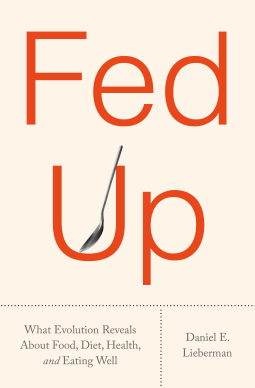
Fed Up
What Evolution Reveals About Food, Diet, Health, and Eating Well
This title was previously available on NetGalley and is now archived.
Send NetGalley books directly to your Kindle or Kindle app
1
To read on a Kindle or Kindle app, please add kindle@netgalley.com as an approved email address to receive files in your Amazon account. Click here for step-by-step instructions.
2
Also find your Kindle email address within your Amazon account, and enter it here.
Pub Date Aug 11 2026 | Archive Date Sep 10 2026
Talking about this book? Use #FedUp #NetGalley. More hashtag tips!
Description
Daniel E. Lieberman—bestselling author of The Story of the Human Body and Exercised, and founding chair of the Department of Human Evolutionary Biology at Harvard University—cuts through all the confusing and contradictory advice on diet and wellness to argue that there can be no simple, definitive answer. Drawing from evolutionary biology, physiology, anthropology, anatomy, medical science, and history, Lieberman examines, with brio and wit, the history and health effects of food from before the invention of cooking up to today’s industrially produced diets. He shows how we evolved to eat almost anything, and by evaluating and trying many of these diets (raw food, Paleo, Mediterranean, Blue Zone, intermittent fasting, Atkins, DASH), he helps you understand why none is flawless though some are better than others.
Lieberman explores the costs and benefits of cheap, energy-rich, tempting, and often unhealthy ultra-processed foods; the tangled roots of weight gain; how diet influences obesity, heart disease, and cancer; and the claims of benefits offered by high- and low-fat diets, meal replacements, intermittent fasting, carnivorism, vegetarianism, and veganism—while also showing how over centuries most cultures evolved ingenious ways to grow and cook healthy, delicious food.
This fascinating and entertaining science-based book on nutrition, digestion, and health will teach you how to be well fed instead of fed up with dietary hucksterism.
Available Editions
| EDITION | Other Format |
| ISBN | 9780593537992 |
| PRICE | $35.00 (USD) |
| PAGES | 416 |
Available on NetGalley
Available to Buy
Buy on BN.com Buy on Bookshop.orgAverage rating from 21 members
Featured Reviews
 Kari C, Reviewer
This was a really interesting take on the diets that social media encourages. I really enjoyed looking at the scientific nature of diets, as opposed to the social view. I would highly recommend it!
 Linda L, Reviewer
This highly informative book about human diets and dietary needs is written in an engaging style, and I felt as though I was reading a novel. At first, I thought Lieberman, a paleoanthropologist at Harvard University, would be writing at a level beyond my comprehension and that this book would be too much like a textbook. I was pleasantly surprised at how much I enjoyed it. I found I couldn't put it down at times, since he interspersed humor, anecdotes, and human-interest stories with bona fide scientific information and research.
I enjoyed the way the author described how food is digested from the moment it enters the mouth to all aspects of processing and excretion. There were easy-to-understand diagrams and explanations, summarized scientific research, and plenty of footnotes that did not interfere with fluent reading. These descriptions laid the foundation for well-known dietary advice, both for living a healthy lifestyle and for maintaining, gaining, or losing weight.
The discussion of fats, carbohydrates, protein, and other food components was instructional and easy to understand. I was amazed at how much I learned, even though I have heard and read about all of these umpteen times. I was glad to read about insulin, glucose, and how glycogen affects the body. Although clear descriptions are given of how the body's organs and systems respond to various foods, I believe I will have to reread many times to change some of my own assumptions and make better food choices. The author also includes GLP-1 drugs in the general discussion of modern and up-to-date dietary guidance.
One of the topics included that I found fascinating was whether it would be prudent to return to the hunter-gatherer ways of our ancestors and adopt diets such as the paleo, which mimics the diet of early humans. He debunks much of what is often included in social media posts and advertising campaigns about diets that supposedly promote the survival of the human species. He provides more accurate information about modern-day humans' actual ancestry and how eating habits were affected by adaptations, evolution, and climate change. Additionally, he gives examples of how early civilizations used "processing" methods and cooking to prepare their food.
Lieberman is clear that humans have spent much of their history finding enough food, and that the body is not necessarily designed to lose weight; it has evolved to survive and procreate. Although obesity was referenced in Shakespeare and other classic writings, it is mostly a modern phenomenon among those who have plenty. He attributes much of the obesity problem to modern technology and foods that have been manufactured to have a long shelf life, appeal to supermarket shoppers, and create addictions, resulting in large profits for food sellers.
Since so much of modern dietary information is published as weight-loss programs, Lieberman devotes chapters to well-known diets, such as Atkins, Mediterranean, DASH, intermittent fasting, and more. In each chapter, he describes the common understandings and the science behind how the diets work, as well as research on the effectiveness of each diet and the long-term results of following them. In effect, he covers the pros and cons of each as well as driving home important precepts about all diets, which include:
1. There is no such thing as an optimal diet.
2. All foods have costs and benefits.
3. Because people vary, and genetics and environment influence how bodies process food, understanding this can foster better dietary choices.
4. Almost all weight-loss diets can be classified as low-calorie, low-fat, or low-carb.
In summary, the book's gist is that food choices are varied and complex. There is no single diet that will work for everyone. Lieberman quotes a philosopher at the beginning of the book and refers to it many times. It has to do with the hedgehog and the fox. The hedgehog looks for one guiding principle and tries to confirm its own biases, whereas the fox checks a lot of data and is more self-critical. This comparison will stay with me as I reflect on the many aspects of nutrition and eating as they pertain to good health and reasonable eating.
Readers who liked this book also liked:

Melissa Dalton-Bradford
History, Nonfiction (Adult), Politics & Current Affairs











Susanna Clarke
General Fiction (Adult), Sci Fi & Fantasy