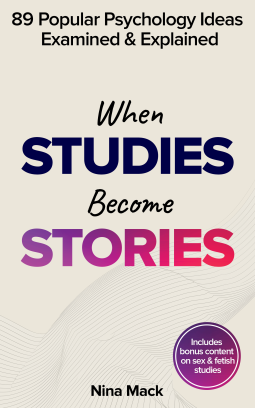
When Studies Become Stories: 89 Popular Psychology Ideas Examined and Explained
Sign In or Register Now to see if this title is available for request.
Buy on BN.com Buy on Bookshop.org Buy on KoboSend NetGalley books directly to your Kindle or Kindle app
1
To read on a Kindle or Kindle app, please add kindle@netgalley.com as an approved email address to receive files in your Amazon account. Click here for step-by-step instructions.
2
Also find your Kindle email address within your Amazon account, and enter it here.
Pub Date Jun 4 2026 | Archive Date Nov 30 2026
Talking about this book? Use #WhenStudiesBecomeStories #NetGalley. More hashtag tips!
Description
Every day, you hear things about how your mind works.
It takes 21 days to form a habit. You have a love language. Power poses can change your hormones. Your attachment style shapes your relationships. Dopamine is your brain's pleasure chemical.
Some of this is true. Some of it is partly true. Some of it was never backed by real evidence.
The problem is, it all sounds convincing.
When Studies Become Stories examines 89 of the most widely shared ideas in popular psychology and gives each one a straight verdict:
- Has Evidence
- Overstated
- Oversimplified
- No Evidence
Covering topics including relationships, memory, learning, personality, motivation, decision-making, trauma, emotions, and the brain - it explains what the studies actually show, where the popular version goes wrong, and what a more accurate version looks like.
Written in easy-to-digest, accessible language, this is psychology in plain terms. When you finish reading this book, you will be able to:
- recognise which popular psychology ideas are genuinely supported by evidence and which are not
- spot where research has been exaggerated, simplified, or misrepresented
- think more critically about self-help advice, viral psychology content, and behaviour
- explain common psychological concepts more accurately and with greater nuance
- make better sense of the gap between scientific research and pop psychology
If you have ever heard a psychology "fact" and wondered whether it was actually true, this book is for you.
Please note: This is not a book of stories. It is a guide to 89 popular psychology ideas, explaining the evidence (or lack of it) behind each one and how the ideas are commonly misunderstood.
Amazon reviews are appreciated - thank you.
A Note From the Publisher
Debut title from Whiteleaf Editions. Author has 20+ years in behavioural science and UX consulting. Open to blog tours and podcast interviews.
Advance Praise
Who hasn't heard a piece of advice that started with, "Studies show that..."? Sometimes it leaves us doubtful, sometimes it feels like a revelation, and sometimes we absorb it without even realising it.
When Studies Become Stories: 89 Popular Psychology Ideas Examined and Explained sets out to separate evidence from assumption. Drawing on some of the most widely repeated claims in popular psychology, Nina Mack carefully examines the research to show which ideas are well supported, which have been oversimplified or overstated, and which have little or no evidence behind them. Several of the conclusions are genuinely surprising given how commonplace these ideas have become.
The book is exceptionally well structured. Each section focuses on a particular area of psychology and examines some of its most familiar concepts. Every entry follows the same easy-to-use format: the popular claim, a clear verdict, an explanation of what the research actually shows, and practical guidance on how to think about or apply the idea. This consistent structure makes the book equally useful as a reference guide or something to read from cover to cover.
The explanations are clear, engaging, and refreshingly free from unnecessary jargon. No prior knowledge of psychology or research methods is required, making the book accessible to anyone curious about how much of popular psychology is actually supported by evidence.
— Reedsy Discovery
From introversion to impostor syndrome, Myers-Briggs and love languages to empaths, lizard brains and affirmations, discover the origins of 89 popular psychology ideas and find out whether you're using them correctly.
When Studies Become Stories is a clear, structured breakdown of widely used terms and ideas with apparent origins in psychology, examining whether they are supported by evidence and how they can be used more accurately. I particularly appreciated the book's clear layout. It begins by explaining the consistent format used for every concept: a brief overview, one of four straightforward verdicts, and an exploration of if, how, or when the idea can be be applied appropriately.
In a media-rich world where psychological terms can quickly become diluted shorthand that spreads rapidly, When Studies Become Stories encourages readers to pause and examine where these ideas originated and whether they deserve their popularity. Like the story of L. David Mech, whose original work on "alpha wolves" was later revised by the author himself, many popular concepts take on a life of their own long after the evidence has evolved. This book provides exactly the kind of thoughtful, evidence-based perspective needed by readers interested in popular psychology, offering both education and an invitation to think more critically about the language we use. A truly insightful and engaging read.
— LoveReading
The clarity of the book's prose shines throughout. Social science is often cluttered with technical terminology, competing definitions, and methodological caveats, yet Mack has an impressive ability to translate these complex debates into accessible language while preserving nuance.
Such reframings of popular ideas allow for more in-depth understandings and creates a launching pad for further research. The book's robust bibliography that links texts and papers to the sections that they were referenced in supports further reading and curiosity.
— Independent Book Review
Marketing Plan
Launch date June 4, 2026. Author platform includes ninamack.com with an established audience in UX, behavioural science and conversion optimisation. Targeted outreach to psychology, self-help and popular science book reviewers, bloggers and bookstagrammers. Social media campaign across LinkedIn and Instagram. Email list promotion at launch. The book covers 91 popular psychology concepts and is positioned for readers of Malcolm Gladwell, Daniel Kahneman and Rolf Dobelli.
Available Editions
| EDITION | Ebook |
| ISBN | 9781067654511 |
| PRICE | £4.99 (GBP) |
| PAGES | 203 |
Links
Available on NetGalley
Available to Buy
Buy on BN.com Buy on Bookshop.org Buy on KoboAverage rating from 26 members
Featured Reviews
 Lucy E, Reviewer
I was drawn to this book because of its title, so I was very pleased to receive an advance review copy from NetGalley and the publisher. When Studies Become Stories by Nina Mack identifies popular psychology ideas and examines them in order to explain their validity. Some of the theories, terms and syndromes discussed include neuroplasticity, toxic positivity, the positivity ratio and the five stages of grief, along with many more.
The book is really well structured, and the first part clearly explains how to use it. It sets out how each psychology idea will be presented, stating whether there is evidence to support it, or if it is oversimplified, overstated, or has no supporting evidence at all. The author then encourages readers to think about how to use the theory in the most helpful way.
I have a keen interest in psychology, but I’m a layperson, so I appreciated how accessible this book was. I enjoyed learning about these psychology ideas; some were familiar, but many were completely new to me. I think this is the type of book I would return to. There is also a glossary of terms at the back, which I found very useful.
 Anna G, Reviewer
This is one of those books that quietly becomes a permanent resource on your shelf.
What impressed me most was the structure. The author explains the framework at the beginning and then sticks to it consistently throughout the entire book. Each chapter examines a popular psychology concept, model, or belief and places it into a clear category based on the available evidence.
Is there strong evidence? Is the claim overstated? Oversimplified? Or is there little to no evidence at all?
This simple approach makes the book incredibly accessible. I read it in small chunks between work, cooking, playground visits, and bedtime routines, and it was remarkably easy to pick up again without feeling lost.
For anyone working in coaching, education, psychology, or simply interested in human behavior, the categorization alone is immensely valuable. We are surrounded by popular psychological concepts that get repeated endlessly online, often without anyone stopping to ask whether the evidence actually supports them. This book does exactly that.
What I appreciated most was the nuance. The author doesn't simply dismiss ideas or declare them "right" or "wrong." Instead, each concept is carefully examined and placed into context, allowing readers to understand both its strengths and limitations.
If you enjoy psychology but also care about evidence and scientific accuracy, this is a fantastic resource. Less sensationalism, more critical thinking and that is something I always appreciate.
A highly useful and thoughtfully structured read that I know I will return to again.
 Cinzia P, Reviewer
"When Studies Become Stories" is a collection of popular ideas rooted in psychology, analysed and broken down, each assigned a final rating (Has Evidence, Overstated, Oversimplified, No Evidence).
I really like the concept of the book and I would very much like to read a similar analysis about other fields, from medicine to nutrition to anything else really. The focus is very much on breadth rather than depth - many "stories" are discussed very briefly, with an explanation of what they are, a little bit of evidence, and their final rating. It is very matter-of-fact, and gives room to the reader to explore any specific topics more deeply.
It ends with a chapter on improving judgement on any claims we might come across in the future, which really transforms the book from a mere collection of psychological concepts to a tool to move forward better equipped to discern what is trustworthy and what isn't. I would certainly recommend this.
Thanks to NetGalley for an ARC of this book in exchange for an honest review.
Readers who liked this book also liked:




Michelle Maxstoke
General Fiction (Adult), Romance, Sci Fi & Fantasy