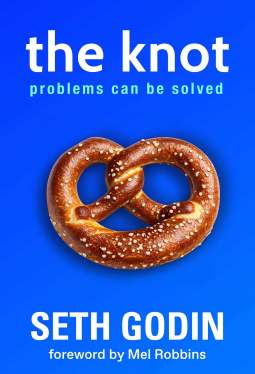
The Knot
Problems Can Be Solved
You must sign in to see if this title is available for request. Sign In or Register Now
Send NetGalley books directly to your Kindle or Kindle app
1
To read on a Kindle or Kindle app, please add kindle@netgalley.com as an approved email address to receive files in your Amazon account. Click here for step-by-step instructions.
2
Also find your Kindle email address within your Amazon account, and enter it here.
Pub Date Sep 22 2026 | Archive Date Not set

Talking about this book? Use #TheKnot #NetGalley. More hashtag tips!
Description
You’re not stuck because the problem is too hard.
You’re stuck because something invisible is holding it in place.
Most persistent problems—at work, in organizations, and in our own lives—aren’t unsolvable. We’ve tried harder. We’ve optimized. We’ve worried about it.
And nothing changes.
This is the kind of stuckness that shows up for people who lead, create, and build—for those who care deeply, think clearly, and still find themselves going in circles.
Some challenges are situations outside our control, best met with acceptance. But others are real problems, capable of being changed. The trouble is, we often can’t tell the difference.
That’s because we’re entangled.
An entanglement is a hidden commitment that creates conflict beneath the surface: wanting progress without risk, change without loss, or forward motion without letting go of who we were—or who we promised to become. When we want two incompatible things at the same time, effort doesn’t help. We stay stuck.
In The Knot, Seth Godin offers a clear, practical framework:
- How to tell the difference between problems you can solve and situations you need to accept
- How to see systems, understand what people actually want, and create conditions for change rather than simply hoping for it
- A practical guide to entanglements—time-based (sunk costs, premature optimization), social (phantom audiences, borrowed scorecards), and identity-based (who we were, who we promised to become)—each named, examined, and shown to be removable
The book leaves readers with a simple mantra for meaningful work:
Name the baggage.
Drop the baggage.
Ship the work.
If you’ve been pushing without progress, this book helps you see what’s really in the way—and finally remove it.
Available Editions
| EDITION | Other Format |
| ISBN | 9798893312492 |
| PRICE | $22.00 (USD) |
| PAGES | 96 |
Available on NetGalley
Average rating from 16 members
Featured Reviews
 Kelly P, Reviewer
Ever since I came across Seth on the Mel Robbins podcast, I have been intrigued. This book was super informative and helpful. I feel less confused about my long-term goals and have ideas of what my focus should be. Thanks to NetGalley for the ARC. The book is well planned and easy to read.
 Reviewer 1487476
The Knot feels aligned with what Seth Godin does best: taking a frustrating but common human problem and giving it clear language. The central idea — that we often stay stuck not because the problem is impossible, but because we’re tangled in conflicting commitments — is simple, useful, and easy to apply.
The book’s biggest strength seems to be reframing. It encourages readers to distinguish between situations that need acceptance and problems that can actually be solved. That alone can be valuable.
As with many business/self-development books, some of the ideas may feel familiar if you’ve read broadly in the genre, and readers looking for highly tactical step-by-step systems may want more depth. But for a concise reset on how to think about progress, identity, and unnecessary baggage, it appears to be a worthwhile read.
 Venkataraman G, Reviewer
An inimitable feature binding every Seth Godin book is the unravelling of intractable problems using startlingly simple solutions and fundamental ideas. The Knot: problems can be solved (the knot) is no exception to the norm. There are numerous occasions in life where we find ourselves in a frustrating bind unable to decide amongst competing choices and contradictory alternatives. How do we then extricate ourselves from such entanglements?
Godin’s slim book (has there ever been a Godin book that is otherwise?) begins with a riveting story involving Alexander the Great (before he became great that is). Riding into a small city in Central Turkey, Alexander is intrigued by the sight of an ox tied to a post with a complicated knot. Apocrypha held that many tried, but in vain to untie the knot. Whoever succeeded would become great, according to a prevailing legend. Alexander approached the rope and completely ignoring the knot, pulled out a pin at the centre, and instantly understanding the entanglements. From then on, the matter of untying the knot became a rudimentary chore.
We also get entwined in many an entanglement in both our personal life and professional endeavours. We are unable to see the “pin” that has us trapped. The art of solving problems is more likely than not the art of seeing the obstacle. Paraphrasing Godin, “name the baggage, drop the baggage, ship the work.” Godin asserts that, more likely than not, while working with people, we tend to inherently get lured by two kinds of compromises, the compromise of commitment, and the compromise of average. While commitment forces us to concentrate on a core audience and solve issues, the endemic average seeks to convert people who are entrenched in the dogma of status quo. Average is ‘but’ masquerading as ‘and.’
When Jackson Pollock, after attaining great fame and fortune, experimented with a radically new technique, critics savaged him mercilessly. Pollock’s dilemma was trying to walk an impossible tightrope. Having found the right audience he wanted to both please them and make them converts to what he felt was a new and ingenious art form. This impasse led Pollock towards depression, substance abuse, and an absolutely untimely tragic death. “Every hour we spend fighting a situation we cannot change is an hour we’re not spending on a problem we can solve.”
The key according to Godin is to never let go of this tenet: We Live with Situations. We (Try to) Solve Problems. “Gravity is a situation. Flying to the moon is a problem.” There are a few guidelines to identify problems that are worth solving or addressing. In order for a problem to be amenable for solving:
It has to be about something that matters.
It clearly articulates a gap between the current state and the ideal state.
It contains variables that can be understood.
It remains neutral about cause and solution.
Is it small enough to tackle?
Recurring problems are often the outputs and outcomes of intransigent systems. Hiding behind the convenient veil of culture, systems usually develop strong and almost unshakeable roots to maintain a presence in perpetuity. Rewarding people maintaining such systems with status and affiliation, systems try to keep users at a predetermined state, a state in which “just doing the job” means a great deal, irrespective of the discomfort caused and injustice created in the process.
New frameworks need to be built if systems need to undergo a transformation. One innovative way lies in using the very system to change it! For example, Dunkerque metro in France made bus usage free for their approximately 200,000 inhabitants. Car ownership since then is down 10%, parking is no longer a headache, there is a thriving city centre and downtown. A plebiscite following the institution of this rule revealed that 99% of the population claimed that the free buses constituted the most important government service.
the knot is a timely help in a world offering a deluge of opportunities and choices on the one hand, while on the other constraining those very opportunities by incorporating systems that bind down users in a vice like grip putting paid to ingenuity, optimism, and inventiveness.
“The knot: problems can be solved”, by Seth Godin is published by Authors Equity and will be available on sale beginning September 22, 2026.
Thank You, Net Galley for the Advance Reviewer Copy.
Media/Journalist 1125391
Seth Godin does it again. As a longtime fan, I could not wait to dive into this work, and he delivers in the way only he can. Godin has a gift for breaking ideas down so clearly that the reader cannot deny the point he is making. It never feels preachy. It feels direct, grounded, and intentional.
This book zeroes in on the antagonistic forces that pull us in opposing directions and leave us tangled in place. Godin presents a framework for understanding what gets us there, what keeps us there, and how to recognize the difference between a true entanglement and something that only feels like one. More importantly, he offers a way forward.
It is not a lengthy read, but it does not need to be. Its impact comes from precision, not volume. The ideas feel especially poignant right now, when, both as a society and within our personal relationships, we often feel caught between a rock and a hard place. There is a shared sense of inertia, of wanting movement but not finding it.
Godin ultimately calls for self-examination. As he aptly puts it, "Most of our stuck comes from wanting incompatible things at the same time. But we are not stuck because we can't move. We're stuck because we won't." That distinction lingers. It reframes frustration as something internal, something we have more control over than we might like to admit.
For anyone who feels like they are pushing the gas but going nowhere, for anyone who cannot seem to break out of a rut, this is the book to pick up. It does not overwhelm. It clarifies. And in doing so, it quietly challenges you to make a different choice.
 Rachel E, Reviewer
The Knot isn’t a book that hands you the answers. It’s a book that changes the way you look at the questions.
What I appreciated most was the practical framework. Instead of telling you to simply work harder or think differently, the book encourages you to step back, identify what’s actually holding you in place, and decide whether you’re facing a problem that can be solved or a situation that needs to be accepted. That shift in perspective alone makes the book worthwhile.
For me, this wasn’t a life-changing or deeply provocative read, but it was a valuable kickstarter. It challenged me to look at complacency differently and recognize how easily it can hide behind systems, routines, and “the way we’ve always done things.”
If you’re a leader, builder, creator, or someone responsible for driving change, you’ll probably find yourself highlighting plenty of passages and thinking about how to apply the framework to your own work.
A solid four-star read that gives you practical tools to help untangle the problems worth solving.
Kim S, Reviewer
This is an interesting and straightforward book that addresses how we do and do not make decisions and address problems. It provides some interesting ways to think about how we think about things, and to take some of the pressure off making some decisions.. Well written, not surprising, it's Seth Godin!
 Ronald G, Educator
This is a great look at problems from perspectives we often don’t consider. A lot of this book combines thoughts from key authors and books from the past forty years. Simon Sinek’s “Start With Why.” Kouzes and Posner on challenging the status quo. And much of marketing that notes the importance of showing people the problem. As Godin rightly points out, every human being has problems that need solving. We waste time and energy trying to sell a person something they don’t need. Here’s an example from the book: “If we’re going to solve the climate problem before the crisis worsens, it won’t happen with warnings or conferences.” The thought here is to shift the system so that people make new choices, choices not made begrudgingly, not made by guilt-tripping, but ones that are seen to benefit themselves. Again, many of these points have been made elsewhere, but for those starting to read in areas of leadership, innovation, and teams, this is solid addition to a library.
Readers who liked this book also liked:













Views expressed in promotions/advertisements do not necessarily reflect those of NetGalley or its affiliates.
© 2026 NetGalley LLC
• All Rights Reserved


Views expressed in promotions/advertisements do not necessarily reflect those of NetGalley or its affiliates.