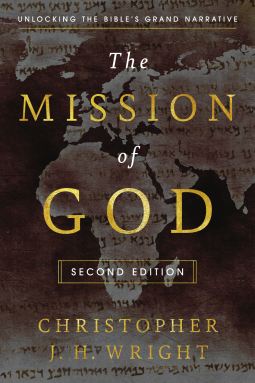
The Mission of God
Unlocking the Bible's Grand Narrative
This title was previously available on NetGalley and is now archived.
Send NetGalley books directly to your Kindle or Kindle app
1
To read on a Kindle or Kindle app, please add kindle@netgalley.com as an approved email address to receive files in your Amazon account. Click here for step-by-step instructions.
2
Also find your Kindle email address within your Amazon account, and enter it here.
Pub Date Oct 21 2025 | Archive Date Nov 20 2025
Talking about this book? Use #TheMissionofGod #NetGalley. More hashtag tips!
Description
Tackle Key Questions from the Past Two Decades in this Fully Updated Edition
Engage with the latest scholarship on the biblical theology of mission and missional hermeneutics with Christopher J. H. Wright's classic text—nowfully revised and updated!
Most Christians would agree that the Bible provides a basis for mission. But Christopher Wright boldly maintains that there is a missional basis for the Bible itself. The entire Bible is generated by and is all aboutGod's mission. In order to understand the Scriptures, we need a missional hermeneutic, an interpretive perspective in sync with the beating heart of its great mission.
Wright gives us a new hermeneutical perspective on Scripture through an understanding of:
- Who God is
- What he has called his people to be and do
- How the nations fit into God's mission
In this revised edition of The Mission of God, Wright extends his classic discussion to consider the ways that the conversation on missional hermeneutics has developed since its original publication. With fully updated citations and additional chapters focused on gospel-centered holistic mission and on the issue of election and supersessionism, this new edition addresses the questions, criticisms, and insights that have emerged during the intervening two decades.
God's mission is to reclaim the world, and God's people have a designated role to play. Whether you're a pastor, scholar, or student, The Mission of God will benefit your understanding of how the Bible shapes the story and purpose of God’s people.
Advance Praise
"Christopher Wright simply is one of our best scholars and writers today. His work on mission and missional readings of the Bible is peerless and vitally important. The Mission of God is a tour de force, and it is a delight to see it going into an updated second edition. This book deserves the widest possible reception and the closest study. It will enhance the mission of the church at this critical time."
-Craig Bartholomew, director of the Kirby Laing Centre for Public Theology
"With this second edition, one of the best works of biblical theology is even better thanks to new chapters on the future of Israel and evangelism. Christopher Wright holds before us a vision of a God with a holistic mission who creates a church that is to join in this all-encompassing mission. Excited for the new edition to reach a new generation of students who will deeply resonate with this biblical vision."
-Andrew T. Abernethy, professor of Old Testament at Wheaton College and author of Savoring Scripture
"Having assigned The Mission of God in my seminary classes, I welcome this thoroughly revised edition. The Mission of God is an ambitious work because Christopher Wright argues that the missio Dei is not merely one theme in the Bible set alongside others but is rather the central aim of the Scriptures. In order to accomplish this task, Wright engages his critics and demonstrates his expertise in hermeneutics, theology, biblical studies, and missiology. The result is a book that is academically rigorous while also eminently practical."
-Bo H. Lim, professor of Old Testament at Seattle Pacific University
"The Mission of God was one of the most important books I read in seminary. Returning to it has been such a joy! Christopher Wright is a master communicator whose expanded and clarified exposition is a true gift to our generation. His careful attention to the storyline of the Bible provides a rich feast of insight for pastors, seminary students, and laypeople committed to discovering how the whole Bible unfolds the mission of God and invites our participation in it as subjects of the Lord Jesus. I offer my hearty and unreserved recommendation!"
-Carmen Joy Imes, professor of Old Testament and author of Bearing God's Name
"The second edition of Christopher Wright's The Mission of God confirms and refreshes its status as a classic in the field. Its bibliographic updates are extensive; its new eighth chapter on election and supersessionism is a landmark. It affirms that God's covenant with Israel is unique and irrevocable and that God's purpose to become incarnate does not depend on the Fall. These revisions will jump-start an exciting season in biblical theology of mission."
-Collin Cornell, assistant professor of Bible and mission at Fuller Theological Seminary
Available Editions
| EDITION | Other Format |
| ISBN | 9781514000045 |
| PRICE | $64.99 (USD) |
| PAGES | 632 |
Available on NetGalley
Available to Buy
Buy on Amazon Buy on BN.com Buy on Bookshop.orgAverage rating from 9 members
Featured Reviews
 Educator 1166855
Wright traces a "missional hermeneutic" through the Bible, preferring this as a biblical foundation of mission rather than confining the mission of God to just the 'Great Commission' in Matthew 28:18-20. Wright explores what we mean by biblical authority, arguing that if mission is seen primarily as obedience to a command (i.e. restricted to imperatives), it leaves unanswered the question of what kind of authority is inherent to the many other genres in Scripture such as narrative, poetry, prophecy, song, lament, and visions (p 43). Wright thus argues that authority is "not just a list of positive commands; [it] includes legitimating permission to act." (p 43) Authority flows from reality – just as how gravity does not command things to fall, but simply asserts its authority by being the way things are, so too the biblical authority of mission flows from the reality it puts forward (p 44). Thus, the authority for mission flows from the whole Bible (not just Matthew 28) because in the biblical text, one encounters the reality of God, the reality of God's story, and the reality of God's people (pp 44-48).
Wright next expounds upon the identity of the God of Mission – beginning with God making Himself known in Israel through His acts such as creation, exodus, rule and kingship, judgment, and return from exile. Through the exodus, Israel learnt that YHWH is incomparable, sovereign, and unique (see the Song of Moses in Exodus 15). Through the return from exile, YHWH shows Himself to be sovereign over history (eg. using Babylon as His agent against Israel, then Cyrus as His agent against Babylon), sovereign over all creation (eg. Jeremiah 10:10-12, Isaiah 40:21), exercising sovereignty through His word, and the motivation for His action – for the sake of His name (eg. Ezekiel 36:16-38). God's motivation behind judgment is also so that it will be known that He is God (eg. the purpose of the plagues and the red sea crossing is so that the Egyptians and Israelites know that He is God and there is none like Him, see Exodus 7:5, 8:10, 8:22, 9:14, 14:18 etc.). Thus monotheism, more than a simple ontological claim of the existence of only one God, "is the affirmation of the transcendent uniqueness and universality of the YHWH, the Holy One of Israel. ... who has uniquely chosen, loved, and redeemed Israel[, but] is also the God of the whole world and all nations, for whose sake he has called Israel to be his servant and witness. His salvation and his judgment are for both Israel and the nations, for there is no other God." (p 93) And this living God YHWH makes Himself known in Jesus Christ, and this can be seen in Scripture's application of multiple traits that belong only to YHWH to Jesus, including affirming that before Him every knee will bow (Philippians 2:10-11, cf. Isaiah 45:21-24), showing Jesus performing the functions of YHWH such as being creator (eg. 1 Corinthians 8:4-6), ruler (eg. Acts 2:32-36), judge (eg. 2 Corinthians 5:10), and saviour (eg. Revelation 7:10). Thus biblical monotheism is missional – it is "the one true living God, known through his grace, his judgment, and above all his crucified and risen Messiah", "in Christ reconciling the world to himself", and who "has entrusted the mission and ministry of reconciliation to the people to whom Jesus said, echoing God's address to Israel (Is 43:10-12): "You will be my witnesses ... to the ends of the earth."" (p 125) I really liked how Wright elegantly connected the Old and New Testaments in this manner, showing how the Bible is one cohesive storyline by tracing the mission of God, in the span of two short chapters.
The last chapter in this section on the God of Mission concerns idolatry. Apart from outlining the Bible's critique of the absurdity of idolatry in comparison with the power and work of the living God, Wright also outlines how idols are shown to be (and critiqued as) demons (eg. 1 Corinthians 10:18-21) and the work of human hands (eg. 2 Kings 19:17-19) and therefore nothing (1 Corinthians 8:4-5) at the same time. This gives rise to a paradox – are such idols something or nothing? Some scholars opine that the acknowledgement of other gods demonstrates Israel's shift from polytheism to henotheism and then finally to monotheism, but Wright does not find this linear development convincing in light of the biblical data. Rather, the answer to whether idols are something or nothing is "Both. They are nothing in relation to YHWH; they are something in relation to their worshipers." (p 129) Nevertheless, Wright opines that idols as human construction "is the more significant theological truth and the more dangerous deception", as humans "creat[e] gods for ourselves... all the time and in great quantities", pointing to "The relative scarcity of texts connecting gods and idols to demons and the sheer abundance of texts describing them as human constructs" (p 151). When it comes to confronting idolatry, Wright sees four possible approaches in Scripture: tackling idolatry with theological argumentation (eg. Paul's epistles), confronting it with evangelistic engagement with worshippers of other gods, wrestling pastorally with issues within the church surrounding idolatry, and prophetic conflict to expose the futility of idolatry to the people of God (pp 167-177). Knowing when to use each approach requires discernment and wisdom (p 177). Ultimately, the thrust is to proclaim the universality and transcendence of YHWH and Jesus Christ while engaging the particular and local context in which idolatry is situated (p 178).
The next part concerns the People of Mission. Wright convincingly argues that Israel's election is not favouritism or anything close to it, but rather God always had the nations in mind, even from the calling of Abraham (see Genesis 12:3b, along with the command to Abraham to "be a blessing" in 12:2b). Wright spends a chapter unpacking Genesis 12:1-4 and what it means for Abraham and Israel to be a blessing to all nations. He then traces through the exodus, observing that Israel is to be a witness to the nations by reason of YHWH's blessing and their keeping of His commands (see eg. Deuteronomy 4:6, 26:19). This eye on the nations is maintained throughout the historical books, from knowledge of God going before Israel (Joshua 4:23-24) to David's proclamation that by his defeat of Goliath "the whole world will know that there is a God in Israel" (1 Samuel 17:46). Even after the fall of the united kingdom, this theme is maintained from Hezekiah's prayer (2 Kings 19:19) to the Psalms (eg. 22, 47, 67, 72, 145) and prophets (addressing Israel in exile, see eg. Isaiah 19:24-25). This universality then reaches its climax in the cross, as seen in the heavenly vision in Revelation (5:9-10). This is not as if Wright ignores the particularity of God's election – he recognises that Israel is indeed uniquely chosen by God. He simply reminds the reader that this election should be seen as purposeful in relation to God's intentions for all nations, and it fundamentally missional (p 256). Chapter 8 covers supersessionism (i.e. the view that the church has replaced Israel) – Wright argues against this view, arguing that God only has one people, beginning with the election of Israel, and Gentles are grafted in through Christ (Romans 11). Wright dedicates a whole chapter to developing his argument (and exploring other adjacent areas like what it means for "all Israel will be saved" (Romans 11:26) and the significance of Christ's incarnation – I do not cover them here for lack of space. Wright also traces "the covenant tradition in the biblical texts" (p 328), from Noah to Abraham, Sinai, David, and eventually culminating in the new covenant (pp 328-359), opining that these covenants are "both messianic (because they all lead ultimately to Christ) and missiological (because they lead to repentance and forgiveness being preached in the name of Christ to all nations)." (p 359) Covenant flows into ethics – from Paul's command to adorn the gospel (eg. Titus 2 and 3) to Peter's command to live good lives (1 Peter 2:9-10, flowing into chapters 2-4) to the commands in the gospels to love (John 13:35, 14:15) and of course, the famous Great Commission in Matthew 28. Human obedience "is connected to Israel's identity and mission within the universal mission of God for all nations" in the Old Testament, and the same is maintained in the New (p 396).
Wright also explores the question of how big is our gospel, or how big is our understanding of redemption, given that mission has to do with the redemptive work of God and our participation in it. He thus unpacks God's model of redemption from the exodus, observing at least four dimensions of the exodus: political, economic, social, and spiritual (pp 282-287), motivated by God's compassion for the oppressed and His covenant memory (pp 287-289). Thus while the exodus points forward to the deliverance from slavery to sin through the cross of Christ, Wright argues against viewing it as "the real meaning" of the exodus, as if all that "really" matters is the spiritual dimension (p 293). This view, Wright posits, is "not biblical enough" (p 295), as God delivered Israel "from the sin of those who oppressed them" (p 295), sin "is a power that affects every aspect of human life[,] resulting in injustice, violence, and immense suffering" (p 296), and a spiritualised interpretation and application of the exodus "dispenses with the socioeconomic and political dimensions" in "something akin to Platonic dualism" (i.e. "the assum[ption] that the material and historical realm is intrinsically inferior and transient, whereas only the spiritual and timeless is considered "really real."" (p 297) The implications for mission are thus that the pressing problems of human society are still of concern to God, and the living God of the Bible is "passionately concerned about social issues—political arrogance and abuse, economic exploitation, judicial corruption, the suffering of the poor and oppressed, the evils of brutality and bloodshed (pp 298-299)." Wright thus argues against social action without evangelism, as well as evangelism without social action (pp 304-308). Linked to this, the next chapter covers God's model of restoration by exploring the jubilee – its economic angle, social angle, and its future orientation pointing towards Jesus (pp 311-324). Wright also discusses what it means for mission to be integral, using the Lausanne Movement and the Cape Town Commitment as an example (p 422). I do not cover this fairly detailed chapter here for lack of space.
The last part concerns the Arena of Mission. Wright surveys multiple affirmations in Scripture that all the earth belongs to YHWH, and God is in the business of redeeming the whole creation. Wright thus argues that, in loving and obeying God and exercising our priestly and kingly role in relation to the earth, Christians are called to care for creation – which also shows God's compassion in response to the reality of sin, which infects all dimensions of the human condition (pp 444-450). The next chapter covers the imago dei – Wright surveys the implications of humans being created in God's image, including that all humans are addressable by God, accountable to God, have dignity and equality and are created for the mission of God and for relationship with God and each other (pp 456-463). However, sin affects every dimension of the human person. Mission must thus engage the wholeness of the earth and the wholeness of human existence and need (p 471). This is clear in the wisdom literature, which covers human concerns (eg. family life, marriage, friendship, working relations), while simultaneously critiquing the wisdom of the nations (see Job and Ecclesiastes). In the last two substantive chapters, Wright traces the relationship between God and the nations in the Old and New Testaments, once again balancing the uniqueness of Israel's distinct and holy calling and identity as God's elect and God's involvement with all nations, and tracing the theme to the cross. Wright summarises the missional line of reasoning like this (at p 528):
1. If the God of Israel is the God of the whole earth (which he is);
2. if all the nations (including Israel) stand under his wrath and judgment (which they do);
3. if it is nevertheless God's will that all nations on earth should come to know and worship him (which the Scriptures clearly teach);
4. if God had uniquely chosen Israel to be the means of bringing such blessing to all nations (which he did);
5. if the Messiah was expected to be the one who would embody and fulfill that mission of Israel, as the Servant of the Lord (which was expected, though in a variety of ways);
6. if Jesus of Nazareth, crucified and risen, is that Messiah, whose coming has inaugurated the reign of God and whose death and resurrection have dealt climactically with the evils of sin and death (of which his followers are now convinced);
7. then it is time for the nations to hear the good news of promised salvation and hope for the world! The gospel of God, the God of Israel, that his risen Son, Jesus, is the world's true king and savior must go to the ends of the earth! The Scriptures must be fulfilled!
Mission is more than just a task list or an obligation stemming from that one oft-cited verse in Matthew – it undergirds the whole Bible. I think Wright has done an excellent job in showing this, on top of showing how a missional hermeneutic should animate the whole life of all believers, not just the 'job' of missionaries. Highly recommended.
Readers who liked this book also liked:




Steven A. McKinion; Benjamin T. Quinn
Christian, Religion & Spirituality


DaySpring
Christian, Religion & Spirituality, Self-Help

Céline Fitzmaurice
Biographies & Memoirs, Mystery & Thrillers, True Crime

Dr. Anne Aspler
Biographies & Memoirs, Health, Mind & Body, Parenting, Families, Relationships


Robert Williamson Jr.
Christian, Nonfiction (Adult), Religion & Spirituality


John H. Walton
Christian, Nonfiction (Adult), Religion & Spirituality