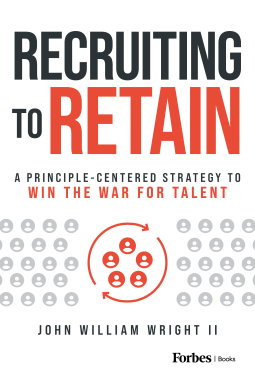
Recruiting to Retain
A Principle-Centered Strategy to Win the War for Talent
This title was previously available on NetGalley and is now archived.
Send NetGalley books directly to your Kindle or Kindle app
1
To read on a Kindle or Kindle app, please add kindle@netgalley.com as an approved email address to receive files in your Amazon account. Click here for step-by-step instructions.
2
Also find your Kindle email address within your Amazon account, and enter it here.
Pub Date Feb 24 2026 | Archive Date Feb 24 2026
Talking about this book? Use #RecruitingtoRetain #NetGalley. More hashtag tips!
Description
In an industry plagued by short careers and constant churn, Recruiting to Retain offers a better way.
John Wright II, managing partner of one of the most successful advisor firms in the country, reveals how a mutual selection process and personal mentoring lead to career retention—not just job placement. Drawing on two decades of leadership, this book outlines a replicable model for financial advisor recruiting, built on principle-based leadership and hands-on engagement.
Wright doesn’t sugarcoat the process. It’s time-consuming. It requires real investment. But it works. His selection process has produced the largest organically grown firm in his network, with career retention rates far above the industry average. From how to screen candidates to how to build advisor teams that thrive, Recruiting to Retain is a rare mix of candid memoir and practical handbook.
Readers will gain tools for:
- High retention attraction
- Mentoring financial advisors
- Creating a culture that values persistence and purpose
Wright’s process favors long-term success over quick wins—and demands that firm leaders reclaim responsibility for recruitment. If you’re tired of seeing good candidates fail, or watching your top talent leave, this book will show you what it takes to build something better.
Available Editions
| EDITION | Other Format |
| ISBN | 9798887502113 |
| PRICE | $29.99 (USD) |
| PAGES | 168 |
Available on NetGalley
Available to Buy
Buy on Amazon Buy on BN.com Buy on Bookshop.orgAverage rating from 4 members

Featured Reviews
 Educator 94862
The book is a comprehensive guide to hiring managers. It shows how to do it right from start to finish snd challenges its reader. It emphasizes the need for coaching and that is do crucial when hiring top talent. His stories are relatable and inspiring.
 Demetris P, Reviewer
The Anti-Funnel Recruiting Manifesto: Why This Book Argues Trust, Ritual, and Coaching Beat Speed, Charisma, and Conversion Metrics
By Demetris Papadimitropoulos | February 11th, 2026
Watercolor Piece by Demetris Papadimitropoulos
John Wright writes about recruiting the way a seasoned advisor talks about mortality: plainly, patiently, without the performative shudder that usually accompanies the subject. The ambition of his book is not subtle. He wants to change what the financial services industry thinks it is doing when it “hires.” Hiring, in Wright’s telling, is the wrong verb. You do not hire a future financial advisor any more than you hire a spouse or a pastor. You court. You test the chemistry. You tell the truth. You build a set of experiences sturdy enough to carry a person through the first bruising years of rejection, delay, and disappointment – and, if you’ve done it right, toward a career that eventually feels less like selling and more like counsel.
That framing, at once devotional and operational, is the book’s signature move. It is also its gamble. Wright is the CEO and managing partner of Northwestern Mutual Goodwin, Wright, a firm with the scale to afford rituals that many organizations would dismiss as extravagance or, worse, soft. In an era where recruiting has become a funnel metric and retention a dashboard lament, Wright proposes something almost old-fashioned: the table set with care, the long conversation, the two-hour meeting in a consistent room, the spouse at dinner, the letter read aloud. “Let’s talk,” he concludes, and he means it both as invitation and method. Conversation is not the prelude to the work. It is the work.
The book proceeds like the recruiting process it advocates: sequential, deliberate, allergic to speed. Wright’s “set of experiences” moves from an in-depth interview to a reverse in-depth interview to formal assessments, then to what he calls the C4 meeting – “Career, Calling, Company, Contract” – and finally to an offer dinner where the decision is made in public intimacy, witnessed by partners and parents, tested by manners and mutual presence. After the contract comes onboarding, licensing, and the long drumbeat of coaching. If that sounds like a lot, Wright would say: good. A profession built on trust ought to begin with evidence that trust has been earned.
The most persuasive chapters are the ones where Wright lets his philosophy show itself in scene rather than slogan. In “Two-Step Bonding,” he recounts the story of Alma Sucic, a survivor of the siege of Sarajevo, whose life contains more grit than any corporate assessment could ever measure. Wright listens to her history – the tunnel, the sprint under sniper threat, the three-day crossing through the woods – and recognizes not a résumé but a nervous system shaped by endurance. The anecdote isn’t merely inspirational. It functions as a thesis statement: the human story is the data set, and the question is not “Can she sell?” but “Can she live inside the emotional dissonance this work demands?”
That phrase, emotional dissonance, is one of Wright’s recurring truths. He returns to it when he describes the “head trash” that can sabotage even talented candidates: the fear of rejection, the reluctance to ask, the subtle shame that clings to a stigmatized industry. A financial advisor must talk about death, disability, divorce, loneliness, inheritance, and the fraught arithmetic of family loyalty – and must do so without flinching or performing expertise as armor. The in-depth interview, with its questions about parents and adversity, is not a sentimental flourish. It is a stress test for self-disclosure. If you cannot speak about your mother, Wright suggests, you may not be able to sit calmly with a client who cannot speak about dying.
There is something disarming about how insistently Wright resists the normal romance of recruitment. He does not want candidates dazzled by promises. He wants them sobered by clarity. In “Interested Versus Interesting People,” he draws a distinction that feels like a gentle rebuke to an age of personal branding: the best candidates are not those who perform charisma, but those who arrive with questions – pages of them – because they are genuinely curious about the life they might be entering. He tells a story about a candidate who brought twelve typed pages of questions and turned a ninety-minute reverse interview into four hours. Preparation pays off, Wright repeats, and the book believes in preparation with a near-moral seriousness.
Still, the book’s most complicated and, in its way, most literary material arrives when Wright turns the lens on himself. In a passage that refuses the usual business-book gloss, he writes about bouts of psychotic depression at twenty-six and thirty-six – about hospitalization, suicidal proximity, the Menninger Clinic, the eerie uncertainty of recovery. These pages are not mere confession. They are meant to justify the book’s insistence on coaching, mentorship, and sponsorship as non-negotiable infrastructure. The private pain becomes a public principle: no one succeeds alone, and the organizations that pretend otherwise are not tough – they are negligent.
This is where Wright’s written DNA shows most clearly. He writes like a man trained in sports and sales and faith, someone for whom metaphor is not ornament but navigation. The book is filled with “career arcs,” “fourth quarters,” “head starts,” “home field advantage,” “cement dries fast.” Coaching is explained through golf: the coach fixes the swing; the mentor plays the round; the sponsor gets you into the tournament. Wright’s worldview is the fusion of locker room, boardroom, and chapel. He references Parker J. Palmer’s “Let Your Life Speak,” Angela Duckworth’s “Grit,” and biblical archetypes of mentorship (Paul, Barnabas, Timothy) with equal comfort. In lesser hands, that blend might feel like brand positioning. Here, it reads more like a genuine biography of influences: the moral vocabulary of vocation strapped to the pragmatic demands of performance.
And yet the very coherence of that worldview can also narrow the book’s imaginative range. Wright is writing from inside a system he believes in, and his conviction can take on the sheen of institutional self-portraiture. The book presents Northwestern Mutual’s model – mutual company, policyholder-owned, long-term orientation – as not merely sturdy but morally superior. Wright makes whole life insurance a hero and differentiator, and he does so with the zeal of someone who has watched quick-hit hustle culture hollow out careers. But readers outside the industry may wish for more friction here, more acknowledgment of how even “noble” products can be misused when incentives, desperation, and human bias collide. Wright condemns crooks and overselling, and he welcomes candidates who ask hard ethical questions. But the book is most comfortable when it can answer those questions with confident reassurance rather than extended examination.
The “science” chapters – the assessments, the green-yellow-red lights, the warning story of Ann who “bombed” and was saved from the wrong career – are useful, and they carry the bracing humility of a professor who admits the bulb is only “about sixty watts.” Wright is not naive about prediction. He says outright that science cannot fully measure grit or coachability. And still, there is a tension here: the book wants to marry the sacred mess of human story with the clean confidence of tools. It wants both intimate disclosure and quantitative calibration. That tension is not a flaw so much as an accurate reflection of contemporary work itself, where algorithmic confidence and human complexity now coexist uneasily in the same room. If the book had pushed harder on that unease – on the way modern hiring has been shaped by automation, remote work, and the cost-cutting zeal that turns people into churn – it might have widened from an excellent industry playbook into something closer to cultural diagnosis.
It does, however, nod in that direction. Wright’s dislike of artificial deadlines, his suspicion of competitors who force next-day decisions, and his insistence on mutual selection feel like quiet resistance to the current moment. Many workplaces now recruit the way social media feeds scroll: quickly, compulsively, with shallow context and a hunger for conversion. Wright proposes a counter-liturgical rhythm. He makes candidates wait ten minutes in the lobby just to watch what they do with unstructured time. He seats them to his right so the table feels collaborative rather than adversarial. He repeats their first name throughout the conversation, not as manipulation but as a disciplined form of attention. The tactics are simple. Their cumulative effect is radical: treat the human being as a whole being.
The offer dinner – perhaps the book’s most distinctive ritual – reads like a manifesto disguised as etiquette. Wright wants a round table, not a long one. He wants fun, not negotiation. He watches how the candidate treats servers, not because napkins determine competence, but because this career is social and relational and will demand grace under scrutiny. He reads a letter tailored to the individual, on fine stationery, signed in ink. It is a small rebellion against the cheapening of decisions that now arrive by text message. One can imagine a skeptical reader rolling their eyes at the theater of it. But theater is one of the oldest technologies of meaning. Wright understands that the beginning of a career should feel like something more than a DocuSign link.
If this book has comp titles, they are less about genre and more about lineage. The emphasis on habits and inputs echoes “The 7 Habits of Highly Effective People,” though Wright’s voice is more regional, more locker-room candid. His insistence on grit and perseverance is in obvious conversation with “Grit,” but his application is less psychological theory than applied apprenticeship. The mentoring architecture evokes the leadership-development tradition of old corporate America, a cousin to the earnestness of “The Effective Executive,” filtered through the moral warmth of a Parker Palmer sensibility. And because Wright insists on the dignity of vocation – on calling, not just compensation – the book occasionally brushes against the spiritualized work discourse that has become newly urgent in a time of burnout, layoffs, and the thinning social contract. When he writes that money “ranks right up there with oxygen,” he is not being cute. He is naming the reality that work has become survival and meaning at once.
That duality may be the book’s most relevant current-event undertow. In a decade marked by public disillusionment with institutions, by an attention economy that rewards performance over sincerity, and by a labor market in which “fit” can become code for exclusion, Wright’s method insists that trust is built slowly and that retention is an ethical responsibility, not merely a financial one. He is right to describe turnover as not only inefficient but unfair – to clients, to families, to the people who take the leap into a commission-only model and find themselves stranded. The book reads, in that sense, as a quiet critique of the churn logic that has infected so many industries: hire fast, burn out, replace, repeat.
But the book also inherits the blind spots of the world it wants to redeem. Wright’s system is expensive – time, attention, dinners, coaching budgets, consultants. It presumes a firm with resources and a culture capable of sustained investment. It also presumes, even as it seeks diversity and tells the story of Derrick Murray as the first Black advisor at Goodwin, Wright, that the candidate can withstand a three-to-five-year period of feeling like a “peddler.” That is not equally feasible for everyone. The book does not ignore financial feasibility; it asks about savings history and appetite for risk. But it sometimes treats the capacity to absorb early-career volatility as a matter of mindset rather than structural reality. A more expansive version of this book might have grappled harder with who can afford the opportunity economy and who is kept outside its gates.
Still, it would be unfair to ask Wright’s book to become a different book. It is not trying to be an exposé or a sociological treatise. It is trying to be a usable manual with a soul. In that it largely succeeds. The prose is clean, the architecture is replicable, the anecdotes are memorable, and the author’s presence is consistent – confident without being slick, earnest without being naive. When the book falters, it is usually by being too sure of its own glow, too willing to let virtue stand in for interrogation. But even that confidence is part of its identity: Wright writes like someone who has watched people fail, watched families suffer, watched good talent churn out of the industry – and decided that the only responsible response is to slow down, tell the truth, and build a better set of beginnings.
A reader looking for a definitive literary achievement will not find one here. A reader looking for a serious, unusually humane blueprint for recruiting and developing trust-based professionals will. The book’s finest accomplishment is that it makes the ordinary machinery of hiring feel like moral design. It argues, with persuasive insistence, that the arc of a career should not be left to chance, speed, or charisma. It should be coached into existence, meal by meal, question by question, through a process that honors how hard it is to become the kind of person other people trust with their lives.
My rating: 77/100.
Readers who liked this book also liked:




Marie Bostwick
Historical Fiction, Literary Fiction, Women's Fiction









Lin Visel; Joseph Bergin III
Comics, Graphic Novels, Manga, Humor & Satire, Politics & Current Affairs

T Clark
General Fiction (Adult), LGBTQIAP+, Multicultural Interest