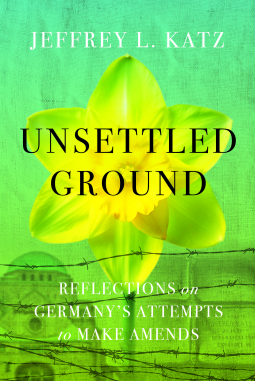
Unsettled Ground
Reflections on Germany’s Attempts to Make Amends
This title was previously available on NetGalley and is now archived.
Send NetGalley books directly to your Kindle or Kindle app
1
To read on a Kindle or Kindle app, please add kindle@netgalley.com as an approved email address to receive files in your Amazon account. Click here for step-by-step instructions.
2
Also find your Kindle email address within your Amazon account, and enter it here.
Pub Date Feb 3 2026 | Archive Date Mar 6 2026
Amplify Publishing | Mascot Books
Talking about this book? Use #UnsettledGround #NetGalley. More hashtag tips!
Description
Germany once felt the world’s wrath for crimes committed during the Nazi regime. More recently, it received extravagant praise for facing up to the atrocities. The country now boasts of new Jewish museums, Holocaust memorials, restored synagogues, and classroom lessons designed to honor its Jewish heritage and teach tolerance.
This effort was led not by politicians or historians, but by local citizen activists, few of them Jewish, almost all of them born after World War II. They could have shrugged off responsibility for evils done before they were born. Instead, they pushed past denials and threats to get at the truth, pressing their parents, grandparents, and neighbors—many of them perpetrators, collaborators, or bystanders to genocide—to find out what really happened in their hometowns during the Nazi era.
The activists’ work connected them with descendants of Germany’s former Jewish communities, now scattered around the globe. One of those descendants, American author Jeffrey L. Katz, provides perspectives on the emotional journey of returning to his ancestral homeland with Germans as his guides.
A Note From the Publisher
Advance Praise
“Jeffrey Katz has found a way to add something revelatory and powerful to the vast literature of the Holocaust: With a reporter’s eye for detail and a passionate drive for stories that tell larger truths, he has produced a heartrending history of his Jewish family’s journey in and out of acceptance in pre-war Germany. He has returned to the homeland that rejected—and murdered—so many of his kinsmen, not so much to revisit the scars of genocide, but to understand those who have dedicated themselves to breaking their fellow Germans’ silence about the Shoah. In the endless battle between the quest to remember and the human need to forget, Katz pushes to find what really drives people to dig among the shadows of a past that still hides so much pain.”—MARC FISHER, author of After the Wall: Germany, the Germans and the Burdens of History
“Jeffrey Katz has given us an engaging and sensitive account of two worlds moving hesitantly toward each other via the past of his Jewish ancestors from two villages and two cities in Germany. As he belatedly uncovers their history, descendants of their persecutors try to face up to it, too. This is a remarkably balanced and human portrait of the benefits and limits of reconciliation over time and space.”—PETER HAYES, author of the bestselling Why? Explaining the Holocaust
“Who are the German ‘memory activists’ who resurrect the stories of Jews the Nazis murdered, and do so not out of collective guilt, but a kind of righteous shame? Jeffrey Katz finds in the unsettled ground of the book’s title a common ground with these truth-tellers, who just might reclaim the phrase ‘ordinary Germans.’ At the same time, Katz deftly takes up larger, knottier questions of public history and collective remembrance in this courageous, nuanced, and generous book. And he shares enough of himself to deliver that richest of hybrids—a reported memoir with the sweep of historical saga.”—ALEXANDER WOLFF, author of Endpapers: A Family Story of Books, War, Escape, and Home
Marketing Plan
Extensive outreach for placement and events in the D.C. area, with confirmed events at Politics & Prose and Wonderland Books.
Social Media and website with biweekly updates and additions of supporting materials, author interviews, and more.
Registration with the Jewish Book Council for their wide-reaching speaking circuit and review opportunities. Good reads give away of 15 copies in the month of Janruary.
Available Editions
| EDITION | Hardcover |
| ISBN | 9798891388093 |
| PRICE | $28.99 (USD) |
| PAGES | 312 |
Links
Available on NetGalley
Available to Buy
Buy on Amazon Buy on BN.com Buy on Bookshop.orgAverage rating from 4 members
Featured Reviews
 The Secret B, Reviewer
Unsettled Ground is a work of narrative nonfiction that examines how Germany has confronted its Nazi past, not through official policy or grand gestures, but through the efforts of ordinary citizens determined to uncover the truth of what happened in their own communities.
The book focuses on post war German activists, most of them born long after the Holocaust, who refused to dismiss responsibility for crimes committed before their time. Instead, they pressed their families and neighbours to confront uncomfortable histories, uncovering stories of perpetrators, collaborators, and bystanders in towns and cities across the country. Their work led to memorials, restored synagogues, and educational initiatives, but also to conflict, resistance, and painful revelations.
Interwoven with this is the author’s own journey as a descendant of German Jewish communities destroyed during the Nazi era. Returning to his ancestral homeland alongside German memory activists, he reflects on the emotional complexity of remembrance, reconciliation, and shared history. These encounters are handled with sensitivity, acknowledging both genuine acts of reckoning and moments that feel performative or insufficient.
What makes this book particularly compelling is its refusal to offer easy conclusions. It recognises the progress Germany has made while also addressing the persistence of antisemitism, racism, and xenophobia. The book explores the limits of memorialisation and asks difficult questions about what meaningful remembrance really looks like as generations change and historical distance grows.
I found this an engaging and thoughtful read, grounded in personal experience while tackling much broader moral and societal issues. The writing is reflective without being sentimental, and critical without losing empathy. It encourages readers to think about responsibility, memory, and how nations and individuals live with inherited trauma.
A nuanced and timely book that explores remembrance not as a finished task, but as an ongoing and imperfect process.
Read more at The Secret Book Review.
Readers who liked this book also liked:

Céline Fitzmaurice
Biographies & Memoirs, Mystery & Thrillers, True Crime




We Are Bookish
Mystery & Thrillers, OwnVoices, Teens & YA
Deesha Philyaw
General Fiction (Adult), Literary Fiction, Multicultural Interest
We Are Bookish
Literary Fiction, Multicultural Interest, Women's Fiction

We Are Bookish
Arts & Photography, Health, Mind & Body, OwnVoices

We Are Bookish
Biographies & Memoirs, History, Nonfiction (Adult)
Melinda Taub
General Fiction (Adult), New Adult, Sci Fi & Fantasy

Audrey Niffenegger
General Fiction (Adult), Literary Fiction, Sci Fi & Fantasy