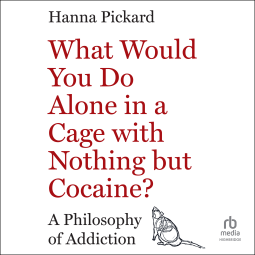
What Would You Do Alone in a Cage with Nothing but Cocaine?
A Philosophy of Addiction
with Sophie Roberts (Narrator)
This title was previously available on NetGalley and is now archived.
Send NetGalley books directly to your Kindle or Kindle app
1
To read on a Kindle or Kindle app, please add kindle@netgalley.com as an approved email address to receive files in your Amazon account. Click here for step-by-step instructions.
2
Also find your Kindle email address within your Amazon account, and enter it here.
Pub Date Jan 6 2026 | Archive Date Jan 6 2026
HighBridge | Highbridge Audio

Talking about this book? Use #WhatWouldYouDoAloneinaCagewithNothingbutCocaine #NetGalley. More hashtag tips!
Description
A revolutionary new paradigm for understanding addiction
Why do people with addiction use drugs self-destructively? Why don’t they quit out of self-concern? Why does the rat in the experiment, alone in a cage, press the lever again and again for cocaine—to the point of death? In this pathbreaking book, Hanna Pickard proposes a new paradigm for understanding the puzzle of addiction.
Drawing on her expertise as an academic philosopher and her clinical work in a therapeutic community, Pickard explores the meaning of drugs for people with addiction and the diverse factors that keep them using despite the costs. People use drugs to cope with suffering—but also to self-harm, or even to die. Some identify as "addicts," while others are in denial or struggle with cravings and self-control. Social, cultural, and economic circumstances are crucial to explaining addiction—but brain pathology may also matter. By integrating addiction science with philosophy, clinical practice, and the psychology and voices of people with addiction themselves, Pickard shows why there is no one-size-fits-all theory or ethics of addiction. The result is a heterogeneous and humanistic paradigm for understanding and treating addiction, and a fresh way of thinking about responsibility, blame, and relationships with people who use drugs.
Advance Praise
"Pickard convincingly shows that while the diseased brain model aimed to destigmatize addiction, it has largely failed to do so while amplifying some addicts’ pessimism about recovery. Addiction researchers and clinicians will be enlightened." ― Publishers Weekly
Available Editions
| EDITION | Other Format, Unabridged |
| ISBN | 9781696620598 |
| PRICE | $24.99 (USD) |
| DURATION | 13 Hours, 8 Minutes |
Links
Available on NetGalley
Available to Buy
Buy on Audible Buy on Kobo Buy on Libro.fmAverage rating from 8 members
Readers who liked this book also liked:








Osamu Tezuka
Comics, Graphic Novels, Manga, Entertainment & Pop Culture, Mystery & Thrillers

![book cover for Stagtown: Volume 1 [A Horror Graphic Novel]](https://covers.bksh.co/cover848321-small.png)
Punko
Comics, Graphic Novels, Manga, Horror, Mystery & Thrillers