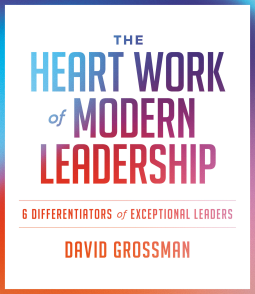
The Heart Work of Modern Leadership
6 Differentiators of Exceptional Leaders
This title was previously available on NetGalley and is now archived.
Send NetGalley books directly to your Kindle or Kindle app
1
To read on a Kindle or Kindle app, please add kindle@netgalley.com as an approved email address to receive files in your Amazon account. Click here for step-by-step instructions.
2
Also find your Kindle email address within your Amazon account, and enter it here.
Pub Date Mar 24 2026 | Archive Date Apr 29 2026
Talking about this book? Use #TheHeartWorkofModernLeadership #NetGalley. More hashtag tips!
Description
Turbulent times call for exceptional leadership.
Are you ready?
In his sixth book, organizational change and communication strategist David Grossman offers a groundbreaking exploration of the leader’s role in our era of unprecedented complexity.
Drawing on research with his longtime partner, The Harris Poll, Grossman reveals a troubling truth: Only 30% of leaders meet the fast-evolving needs of today's workforce.
In The Heart Work of Modern Leadership, Grossman illuminates the mounting pressures facing the C-suite—with shareholder value, AI-driven possibilities, geopolitical disruptions, and more.
The good news is, it’s not an impossible job.
Grossman identifies an adaptive mindset that helps executives thrive in today’s rapidly changing environments. Specifically, he cites that exceptional leaders integrate emotional intelligence with strategic thinking. Grossman calls this “leading with their heart in their head.”
What does that look like in practice? Compassion with calculation. Empathy with analysis. Values with decisions. And what is the impact? Greater, more sustainable performance throughout the organization.
At the book’s core are rare glimpses into twenty-nine founders and executives—each one an exceptional leader grappling with the accelerating changes of our age.
You’ll read about their tough decisions, pivotal choices, and unwavering commitments to their people. You’ll discover their shared themes and most practical takeaways. You’ll also learn about the six defining behaviors that set these outstanding performers apart.
Your rise from good to great starts now. With The Heart Work of Modern Leadership, you can move beyond simply managing your people and your pressures. You can build employees who thrive. Develop teams that innovate. And guide your organization to its greatest potential.
Advance Praise
“Everything about this book is exceptional! We come away from this not just as better leaders but as better people. It’s loaded with collective wisdom. Heart + Head; it’s about time. Backed by data, with thoughtful insights to support it. It gives us a road map to build better organizations. A grand slam!”
—Ric Bachrach, CEO, Celebrity Focus, Inc.
“I’ve known David as an incredible leader who leads with heart and head. Now we have an indispensable guide to how to be that kind of a leader. From gratitude to listening to so much more, David unlocks the mystery of how to become the kind of leader you’ve always admired and aspired to be.”
—Roger Bolton, Former CEO, Page
“Grossman masterfully bridges leadership and communication, showing how the best leaders inspire, empower, and connect with their teams to drive real results.”
—Bill Imada, Cofounder, Chairman & Chief Connectivity Officer, IW Group, Inc.
“In the same way David Grossman’s latest book astutely connects strategic insights with human empathy, it maps the connection between a thriving workplace and a rewarding life. What leader wouldn’t want to follow him there?”
—Anthony D’Angelo, APR, Fellow PRSA & Public Relations Department Chair & Professor of Practice, Syracuse University Newhouse School of Public Communications
“David Grossman is an icon, and now he has written one of the top leadership books to define success. His insights into gratitude, empathy, and communication provide a powerful playbook for leaders, from aspiring to seasoned.”
—Ray Day, Vice Chair, Stagwell & Former CCO, IBM
“The best leaders don’t just manage—they inspire. Grossman shows exactly how to create cultures of trust, innovation, and meaningful leadership.”
—Alim A. Dhanji, CHRO, TD SYNNEX
“A must-read for any executive seeking to focus, inspire, and empower teams to meet the moment and more. David provides smart insights as to what it takes to be an effective leader today, supported by research, learning and planning tools, and practical advice from successful leaders.”
—Mike Fernandez, Host of The Crux of the Story podcast & SVP of Public Affairs, Communications & Sustainability, Enbridge
“Leadership is critical to every industry and sector. Leadership skills can be cultivated and applied at any age. David, drawing on his years of experience counseling corporate leaders and leading his own firm, provides keen insights to help professionals and youth to thrive. Thank you, David.”
—Rochelle Ford, CEO, Page
“David’s storytelling gets straight to the heart. He is clear and insightful. A must-read for anyone who wants to make a positive impact.”
—Andreas Frank, CEO, Net32
“Inspiring, compelling, and refreshingly practical—a renewed sense of purpose and direction in a world where leadership is more challenging than ever.”
—Karmen Gardner, VP, Corporate Communications & Employee Experience, Pella Corporation
“The best leaders know that numbers might reveal yesterday's results, but people create tomorrow's possibilities. The Heart Work of Modern Leadership beautifully illuminates what many of us miss—the gap between how empathetic we think we are and how our teams actually experience us. David doesn't just point out the problem; he also provides a practical road map for creating environments where people feel safe to speak truth and inspired to innovate. This is an essential guide for anyone serious about transforming their leadership impact in today's complex world.”
—Jennifer George, SVP, Communications, The Aspen Group
“The Heart Work of Modern Leadership offers a timely reminder that great leadership starts with understanding an organization’s greatest asset: its people. David Grossman’s insights reinforce the power of clear, empathetic, authentic, human-centered leadership.”
—David Gitlin, Chairman & CEO, Carrier
“I loved everything about The Heart Work of Modern Leadership! It’s clear, compelling, actionable, and deeply insightful. Whether you’re leading a small team or a global organization, this book will change the way you lead.”
—Jodi Glickman, CEO & Founder, Great on the Job
“David Grossman’s insights have been invaluable to me as a CEO, board chair, and now as a mentor to senior leaders. His clear, memorable, and personal approach continues to resonate with every executive team I coach. The Heart Work of Modern Leadership distills what exceptional leaders actually do and why it matters, making it an essential read for anyone seeking to elevate their leadership.
—John J. Greisch, Chairman, Catalent Inc.
“We’re in a new era of leadership—one where only the most adaptable, human-centered leaders will thrive. This book offers a fresh and timely perspective on leading with both the head and the heart. Grounded in research and brought to life through the stories of respected leaders, it blends emotional intelligence with practical strategy. For leaders seeking to grow beyond their own experience, this is a vital and relevant resource.”
—Aedhmar Hynes, Corporate Board Director, including Fluidra, Jackson Family Wines & IP Group, plc
“David has done it . . . again. These new insights—based on experience, intelligence, instincts, and heart—are relevant, sensible, and (importantly) doable. They are critical to being a modern leader.”
—Rich Jernstedt, President & CEO, The Jernstedt Company
“Strong and effective leadership is evolving, and The Heart Work of Modern Leadership provides today’s busy leader with actionable takeaways to develop stronger teams and vibrant cultures within their organization. David delivers research-backed data and case studies from leaders who bring unique insights to the challenges facing all of us in an uncertain environment. This is a must-read for anyone who is committed to delivering results while being empathetic to those who we’re entrusted to lead and serve.”
—Matthew Marcial, CEO, Public Relations Society of America (PRSA)
“Grounded in new research and vivid stories, The Heart Work of Modern Leadership offers leaders a practical blueprint for balancing the head and heart. David Grossman shows how emotional intelligence, empathy, and creating a shared purpose can unleash human magic and fuel extraordinary results.”
—Hubert Joly, Former Best Buy CEO, Senior Lecturer at Harvard Business School & Bestselling Author of The Heart of Business
“David Grossman’s book arrives at a transition point in our world, when continuous disruption—technological, political, economic, societal, and environmental—is becoming the ‘new normal.’ This means leading organizations through constant change will be critical to enduring success. Leadership, not management, will determine the winners and losers. And because the younger generations of workers have different needs and expectations from the older employees, the emphasis this book puts on what used to be called ‘soft skills’ is spot on. Leading today’s increasingly diverse, psychologically and emotionally attuned workers requires a different kind of leadership than was true in the ‘my way or the highway’ approach that was in vogue when I joined the workforce decades ago.”
—John Onada, Principal, iQ 360, Inc.
“As a communications leader navigating today’s complex and nuanced environment, I appreciated the six differentiators identified in this book. Specifically, leading with gratitude and taking the time to listen and empathize are key indicators of exceptional leadership. David elevates these critical human skills necessary for building trust and forging stronger connections to achieve impactful results.”
—Trity Pourbahrami, Trustee of the Institute for Public Relations
“This book challenges the idea that leadership is only about business outcomes and reminds us it’s also about emotional courage, context, and connection. David Grossman gives a modern playbook to lead with your heart, without losing your head.”
—Matt Prince, Head of Brand Communications, KFC/Taco Bell
“A game-changer for leaders looking to create engaged, high-performing teams. The Heart Work of Modern Leadership belongs on every executive’s desk.”
—Michelle Russo, CCO, State Farm
“David asserts that these times require leading with heart in head, and he provides the data, demonstrations, and detail to make the theory immediately actionable. He brings in a cadre of voices—all students of leadership in their professional roles—to add dimension to the concept.”
—Kim Sample, President, PR Council
“The knowledge and teachings that David shares in this book are critical to anyone who aspires to be a better leader.”
—Dave Scholz, COO, Leger
“This is a timely and wonderfully useful guide for any leader or aspiring leader who wants to crack the difficult code of human-centered leadership. Real-world examples plus David’s beautifully articulated advice make this a book I know I will come back to often and share with my team.”
—Diane Schwartz, CEO, Ragan
“David’s Six Forces are to leadership what Porter’s Five Forces are to strategy. I walked away with a new commitment to leading with gratitude and being an effective listener.
—Stephen Smith, Chairman, President & CEO, Amsted Industries
“The Heart Work of Modern Leadership offers a thoughtful framework for developing leadership behaviors that better reflect the realities of today’s workforce. David Grossman provides practical, research-backed insights that can help bridge the gap between intent and impact—something every business leader and HR professional grapples with. The book is a useful resource for organizations working to align leadership development with evolving employee expectations.”
—Johnny C. Taylor Jr., President & CEO, Society for Human Resources Management (SHRM)
“Leadership is more than a cerebral exercise; it is a matter of the heart. Compassion, care, and investment are more important than what buttons to push to motivate employees. David has done a masterful job in this book of showing us what exceptional leadership does and should look like today!”
—Damien Waymer, Director, School of Journalism and Mass Communications, University of South Carolina
“This is the road map we’ve been waiting for. Leadership isn’t about titles—it’s about the choices we make, the courage we summon, and the humanity we refuse to lose. In The Heart Work of Modern Leadership, David Grossman puts language around what many of us feel but haven’t quite articulated: that amid complexity and chaos, the best leaders are those who lead with both head and heart. As someone who believes that it’s choice, not chance, that changes everything, I see this book as both mirror and map—a reflection of what leadership could be and a guide for how to rise to it. Grossman doesn’t just diagnose what’s broken—he delivers a deeply human blueprint for building workplaces where people can thrive, not just survive. This is heart work. And it’s hard work. But it’s also the only work that creates lasting impact.”
—Charlene Wheeless, Speaker, Leadership Strategist & Bestselling Author
Available Editions
| EDITION | Paperback |
| ISBN | 9798900260860 |
| PRICE | $19.95 (USD) |
| PAGES | 304 |
Available on NetGalley
Available to Buy
Buy on Amazon Buy on BN.com Buy on Bookshop.orgAverage rating from 4 members
Featured Reviews
 Paula G, Reviewer
I am in “lower level leadership“ and I still feel like I got so much out of this book. I’ve already purchased a hard copy of the book and will be giving it to my branch manager to read and possibly share with our supervisors.
Most of the training that I have gone through focuses on the people aspect of leadership and I fully expected this book to be like that. I am so very happy that it was not. Yes, it did focus on the “heart work” but it also focused on the analytical and logistical and business aspect of leadership.
I feel like I got more out of this than I did our leadership “academy“ that we do through work.
 Reviewer 294918
David’s The Heart Work of Modern Leadership redefines what it means to lead in today’s complex world. Backed by research from The Harris Poll, the book identifies six key differentiators of exceptional leaders: leading with gratitude, listening with empathy, fostering inclusivity, communicating with context, connecting strategy to employee growth, and enabling teams to adapt.
The research reveals that exceptional leaders—those who balance emotional intelligence with strategic thinking—create workplaces where employees feel valued, engaged, and motivated. In contrast, outdated, command-and-control leadership leads to burnout and disengagement. Notably, nine of the top ten traits of exceptional leaders are heart-focused, proving that empathy and gratitude drive performance.
David provides practical tools, including case studies, reflection questions, and action guides, making the book both insightful and actionable. The book is essential for executives, managers, and HR professionals navigating modern workplace challenges, particularly with younger generations demanding purpose and flexibility.
Ultimately, The Heart Work of Modern Leadership argues that the best leaders lead with both heart and head, fostering cultures where people—and organizations—thrive. It’s a must-read for anyone committed to transformative leadership.
 Demetris P, Reviewer
The Problem Isn’t That Leaders Don’t Care – It’s That They Don’t Build Conditions: What “The Heart Work of Modern Leadership” Gets Right About Work in 2026
By Demetris Papadimitropoulos | February 19th, 2026
Watercolor Piece by Demetris Papadimitropoulos
A leadership book is a strange kind of promise. It tells you, in effect: the world is loud, your calendar is louder, and the people you are responsible for are carrying more than you can see – but if you adopt the right habits, the right language, the right posture of mind, you can make work feel less like a machine that grinds and more like a place where human beings become more fully themselves.
David Grossman’s “The Heart Work of Modern Leadership” arrives in an era that has made that promise both urgent and suspicious. Urgent because work has become the stage on which so many of our public anxieties perform: the post-pandemic renegotiation of presence, the slow-motion crisis of burnout, the return-to-office culture wars, AI’s creeping redefinition of “value,” the churn of layoffs that can make “belonging” sound like satire. Suspicious because the shelves are already crowded with books that insist empathy is a “superpower,” that gratitude is “strategic,” that culture can be “built” like Ikea furniture if only you follow the diagram.
What Grossman offers, at his best, is a corrective to both cynicism and gush. He writes as someone who has lived inside organizations long enough to know that employees don’t quit strategies – they quit atmospheres. They quit the slow drip of being unseen. They quit the feeling that the future is happening to them rather than with them. And they quit, increasingly, the story that “hard” business outcomes and “soft” human needs are separate categories, as if the nervous system has no relationship to performance.
Grossman’s core proposition is simple enough to fit on a slide – and, in fact, he repeatedly writes in the language of slides, toolkits, and training rooms, a language that is both the book’s strength and its limitation. Modern leadership, he argues, is distinguished by six differentiators: lead with gratitude; listen and empathize; foster an inclusive culture; communicate with context; connect strategy to employee growth; enable employees to meet the moment. Behind this, he threads a phrase he clearly loves: leading with your heart in your head – compassion with calculation, empathy with analysis, values with decisions. “It’s not an impossible job,” he insists, “if you have the adaptive mindset required for fast-changing environments.”
That sentence captures the book’s tone: optimistic but not naïve, insistently practical, and always circling back to the question work has been asking in a more desperate register since 2020: How do we live here now?
The book’s most persuasive pages are the ones that treat leadership not as charisma but as conditions. Grossman is less interested in the myth of the heroic manager than in the everyday architecture that makes people feel capable. Consider the deceptively small move he repeats in different forms: connect the dots. Employees, he writes, are constantly running a private calculation: “Where do I fit into this company’s future?” If leaders don’t answer that question, employees answer it themselves – often by updating their résumé. The counsel is not revolutionary, but Grossman makes it vivid by insisting that strategy communication without personal translation is incomplete. You can host a town hall, publish a deck, declare a “north star,” and still leave your people stranded in ambiguity. What they need, he suggests, is context (the why), clarity (the what, in human language), and connection (the how, as it touches their own work). He calls this the 3C framework for strategic communication, and he offers a weekly rhythm – Monday huddles, Wednesday check-ins, Friday wrap-ups – that reads like a metronome for the anxious leader who suspects repetition is not redundancy but mercy.
There is, too, a very Grossman-esque delight in naming traps. The “one and done” trap: thinking one big communication covers it. The “too complex” challenge: using jargon as a substitute for truth. The “missing link” problem: explaining what without why. These are, on one level, familiar diagnoses. On another, they are the exact failure modes that have made so many organizations feel like they are permanently “in transformation” but rarely transformed.
If the book’s heart is in its insistence on human dignity, its muscle is in its emphasis on enablement. Grossman draws a bright line between the leader who manages – assigns, monitors, steps in to solve – and the leader who enables – creates the conditions in which employees “naturally step up, collaborate, and innovate.” This is not merely a semantic preference. It is a wager about sustainability. The manager-as-problem-solver is a bottleneck dressed up as competence; the enabler is a designer of systems.
To illustrate enablement, the book leans on a set of concepts that are almost fables: the “wall or castle” exercise (two bricklayers, same labor, different meaning), the call to “map invisible barriers” in workplace culture, the insistence that psychological safety is not soft but strategic. Grossman is at his most compelling when he refuses the caricature of psychological safety as coddling. In his telling, it is the precondition for candor, risk, learning – the ability to make mistakes once, and then not again, as one leader in the book memorably puts it.
This is where the book’s research scaffolding matters. Grossman and The Harris Poll survey 2,206 employed Americans in mid-2024, and he uses the data not as a cudgel but as a kind of weather report: here is what people experience; here is what they crave; here is where leaders are lagging. He reports that only 30% of leaders are rated “exceptional,” while a meaningful minority are experienced as “outdated” or command-and-control. The statistics are less interesting as numbers than as a mirror: most leaders are not monsters; they are habits. They are inherited operating systems. They are the managerial equivalent of muscle memory, repeating the motions of a world that no longer exists.
Grossman’s answer is not a revolution. It is a practice. And practice, in this book, looks like tools: reflection questions, quick implementation guides, prompts for weekly behaviors. Some readers will find this refreshing – a leadership book that doesn’t merely diagnose but prescribes. Others may feel the familiar fatigue of the workbook, the sense that one more framework is being offered as salvation. Yet the tools have a sincerity that keeps them from feeling like gimmicks. They are meant to be used, not admired.
The best example of this sincerity is how the book handles employee growth. Grossman is careful to say that connecting strategy to employee growth is not solely about annual reviews. It is about “creating genuine connections” between each person’s career journey and the organization’s path forward. He is attentive to the everyday ways uncertainty erodes performance: people disengage when they can’t see a future; they “play it safe” rather than innovate; top performers look elsewhere. In a moment when many organizations are simultaneously asking employees to do more with less and to feel grateful for the privilege, Grossman’s insistence on development as a strategic obligation feels like a rebuke – gentle, but firm.
What is most interesting, stylistically, is how Grossman writes leadership as a kind of moral practice without ever quite calling it that. He avoids the preachiness of some purpose literature, but he repeatedly circles the same ethical intuition: that leadership is stewardship of attention. You show people what matters by what you notice. You show them what is safe by how you respond to error. You show them what the organization truly is by what happens when circumstances change.
That is why the book’s most memorable moments are stories about tone. A CEO tells his team, after bad news, to absorb frustration – and then to walk out to their people with calm confidence. A leader’s “first guiding principle” during large-scale process change is: “We want every employee to get home in time to have dinner with their family.” These are not, strictly speaking, strategies; they are values made operational. They are the kind of phrases that become culture because they are repeatable and because they locate the human being inside the business.
If this book has a signature metaphor, it is the bridge. The bridge between strategy and meaning; between technology and the human experience; between “unpreferred reality” and a preferred future. In one of the more striking borrowed voices, Cy Wakeman’s concept of “given” appears as a pivot word: given that reality is messy, what can we do now? It is an antidote to helplessness disguised as grammar.
There are places, however, where the book’s corporate fluency becomes a kind of haze. Grossman’s prose often has the clean brightness of a keynote – declarative, earnest, occasionally overlit. The book likes its phrases in caps, its “REMEMBER:” callouts, its numbered lists that promise relief through structure. This is not a flaw in the same way cliché is a flaw; it is a deliberate genre choice. But it can flatten the texture of work’s contradictions. The contemporary workplace is not only a site of growth and meaning; it is also a site of surveillance, inequality, and fatigue. “Bring your best self” can be a beautiful invitation or an extraction strategy, depending on who holds power and who has options. Grossman gestures toward these realities – he notes fear, blame, burnout, disconnection – but he rarely lingers in their darker complexity. The book is a guide for leaders trying to do better inside the system, not a critique of the system itself.
That distinction matters when we consider the book’s relationship to current events. “The Heart Work of Modern Leadership” is saturated with the era’s anxieties: AI and automation as looming threats; geopolitical shocks that scramble supply chains and priorities; social justice awareness and the backlash against it; economic uncertainty and the pressure for quarterly results; the mental health crisis that has turned “well-being” into both a necessity and, too often, a branding exercise. Grossman’s approach is to treat these forces as environmental facts and to ask: what kind of leadership helps people meet them without breaking?
It is a humane question, and it yields humane answers. But readers hoping for a sharper confrontation with power – the ways “context” can become spin, the ways “culture” can become coercion, the ways “accountability” can slide into performance theater – may find the book a little polite. Grossman is not naïve about bad leadership; he simply believes the cure is better practice, not structural revolt. In a time when many employees feel that corporate language has been used against them, the book’s insistence on sincerity is both its gamble and its grace.
In the crowded field of leadership literature, Grossman’s book sits comfortably beside titles that have tried to make the emotional legible: Brené Brown’s “Dare to Lead,” Daniel Goleman’s “Primal Leadership,” Patrick Lencioni’s “The Advantage,” Amy Edmondson’s “The Fearless Organization,” Kim Scott’s “Radical Candor,” Simon Sinek’s “Leaders Eat Last,” and even the more systems-oriented optimism of “Team of Teams.” Like those books, Grossman believes culture is not a poster but a pattern. Unlike some of them, he is explicitly a communicator – and it shows. He is less interested in abstract theory than in message discipline, repetition, and the choreography of conversations.
You can feel his professional DNA in the way he organizes the book around frameworks, the way he translates lofty ideas into meeting agendas, the way he treats story as strategy activation. A section on strategic storytelling reads like a comms pro’s field manual: situation, action, strategic link, result, learning. He wants leaders to tell stories not for entertainment but for alignment.
The late sections, which move “from good to exceptional,” are where Grossman’s voice becomes almost devotional. He identifies seven elements – gratitude, culture, fit, listening, empathy, accountability, well-being – and writes them as principles to internalize rather than boxes to check. Each comes with reflection exercises that feel like small liturgies of attention. Write a note to the overlooked contributor. Audit how your team responds when someone struggles or a mistake is made. Map career paths. Practice the 80/20 rule in meetings. Share a recent mistake and what you learned. Create a holistic well-being strategy that addresses mental health, growth, work-life integration, personal development.
There is a risk, here, of making leadership sound like a self-improvement program for the already overworked: one more set of habits to master, one more virtue to perform. Yet Grossman keeps returning to the idea that you should choose one element per quarter, not all seven at once. Consistency, not perfection. Habit, not heroism. He seems to understand that the modern leader is not suffering from a lack of ambition; they are suffering from too many initiatives and too little follow-through.
That understanding is what saves the book from the “idea avalanche” it warns against. Grossman is aware that the modern workplace is addicted to novelty – new platforms, new priorities, new “transformations” – and he counsels leaders to subtract. He praises the leader who throws “liberation parties” to kill projects. He honors the leader who insists staff take their day off and cannot even come to the center – boundaries as policy, not suggestion. These moments feel like the book’s quiet radicalism: the idea that caring is not merely an emotion but a structural decision.
If I have one lingering critique, it is that the book’s language sometimes collapses the distance between aspiration and reality. It can make leadership sound like a set of choices any well-intentioned person can simply adopt. Yet power, culture, and constraint are not evenly distributed. A mid-level manager cannot always create psychological safety if the organization punishes dissent. A leader cannot always “connect strategy to growth” if budgets are frozen and roles are shrinking. Grossman would likely answer: given that reality, what can you do anyway? And that is, perhaps, the book’s deepest offering – not a guarantee, but a stance.
“Modern leadership,” Grossman implies, is not a brand; it is a refusal to let the pressure of the moment turn you into someone smaller. It is the ability to deliver results without hollowing out the people who deliver them. It is the courage to communicate with context in an age of slogans, to listen in an age of speed, to practice gratitude in an age of extraction, to care for well-being in an age of constant availability.
A leadership book cannot fix work. But it can reintroduce language that makes better work imaginable. Grossman’s book does that often enough – and with enough practical guidance – to feel like more than another glossy manifesto. It is, in the end, an argument for attention: to people, to meaning, to the small moments that accumulate into culture. And for many leaders who want to do right by their teams while the world keeps shifting underfoot, that argument may be exactly the bridge they need.
Rating: 85/100.
Reviewer 1363492
The Heart Work of Modern Leadership by David Grossman is a thoughtful and practical leadership book that flips the traditional focus from strategy‑only frameworks to the emotional and relational muscle that actually sustains influence. Grossman argues that leadership isn’t just about what you do; it’s deeply rooted in how you connect, communicate, and show up for others. That shift felt grounded and necessary in a world where technical skill alone no longer determines impact.
Grossman structures the book around core capabilities such as self‑awareness, vulnerability, presence, and empathetic communication. What sets it apart is how he ties these capabilities directly to workplace outcomes rather than treating them as nice‑to‑have soft skills. The guidance is actionable. Chapters on giving honest feedback, navigating conflict with care, and fostering psychological safety provide language and approaches you can use immediately. There’s a practical discipline here: reflection exercises, conversational templates, and diagnostic questions that make internal work visible and measurable.
The tone is encouraging without feeling simplistic. Grossman writes with authority born from experience, but he doesn’t preach. He recognises that emotional work is messy, that leaders hold real fear around vulnerability, and that relational gaps often show up in small daily interactions long before they appear in performance metrics. This realism makes the advice feel credible rather than idealised.
If you’re looking for a leadership guide that honours the human element alongside organizational goals, this book delivers both insight and utility. It reframes leadership as a practice rooted in deeper self‑understanding and sustained by authentic connection.
Readers who liked this book also liked:




Marie Bostwick
Historical Fiction, Literary Fiction, Women's Fiction




Shiv Narayanan
Business, Leadership, Finance, Nonfiction (Adult), Professional & Technical