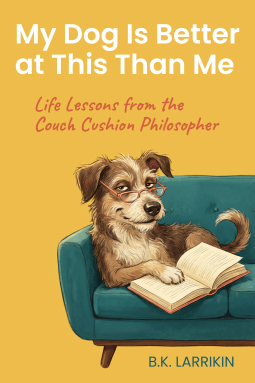
My Dog Is Better at This Than Me
This title was previously available on NetGalley and is now archived.
Send NetGalley books directly to your Kindle or Kindle app
1
To read on a Kindle or Kindle app, please add kindle@netgalley.com as an approved email address to receive files in your Amazon account. Click here for step-by-step instructions.
2
Also find your Kindle email address within your Amazon account, and enter it here.
Pub Date Apr 14 2026 | Archive Date Jun 24 2026
Terrapage Press | Independent Book Publishers Association (IBPA), Members' Titles
Talking about this book? Use #MyDogIsBetteratThisThanMe #NetGalley. More hashtag tips!
Description
You have spent the last decade trying to learn presence, calm, and joy. Your dog was born with all three and has been napping through your efforts.
Rosie is a sixty-pound rescue mutt who has never read a self-help book, never set an intention for her afternoon, and never once questioned whether she belongs on the couch. She greets every morning like it’s the best news she’s ever received. She naps without guilt, plays without purpose, and forgives without being asked. She has figured out everything you’re still Googling — and she did it without Wi-Fi.
Her human is... working on it.
My Dog Is Better at This Than Me is what happens when a stressed, scrolling, over-caffeinated human stops reading about mindfulness and starts watching it — in the form of a creature who practices it every waking moment (and, if the dream-twitching is any indication, several sleeping ones too).
Across ten chapters, B.K. Larrikin chronicles the lessons Rosie teaches without trying: how zoomies are a masterclass in presence, how a squeaky hedgehog is always the right prescription, how a frisbee faceplant can teach you more about letting go than a decade of therapy, and how a fire hydrant — examined properly — is an art gallery.
Each chapter pairs a true (and frequently humiliating) personal story with real psychology and neuroscience, delivered in a voice that is warm, honest, and laugh-out-loud funny. Each chapter ends with a short practical exercise that takes three minutes, costs nothing, and requires no app, no cushion, and absolutely no sitting cross-legged until your foot falls asleep.
The lessons are simple. The exercises are simpler. The dog is smarter than all of us.
But this book goes deeper than you expect. Beneath the comedy is a story about depression and recovery, about the specific loneliness of a Saturday afternoon with no one expecting you, and about a rescue dog who showed up at the exact moment a human needed a reason to get out of bed. Chapter Five will make you laugh for four pages and then land somewhere so honest it changes the temperature of the room. The epilogue — about the math we try not to do when we love something that won’t outlive us — will stay with you long after you close the book.
Part memoir. Part self-help. Part love letter to a dog who ate a sock and showed zero remorse.
Featuring charming original illustrations of Rosie the Couch Cushion Philosopher, a book club discussion guide, practical cheat sheet, and curated reading list — plus a sneak peek at Book Two in the series.
Perfect for dog lovers, recovering over-achievers, anyone who’s been told to “just meditate,” gift-givers who want to be remembered, and every human who suspects their pet has life figured out better than they do.
Sit. Stay. Read.
A Note From the Publisher
Hardcover: 9781972647011
Ebook: 9781972647028
Hardcover: 9781972647011
Marketing Plan
National influencer campaign across BookTok and Instagram launching March 2026. Active social media presence on X (@CCPhilosopher). Concurrent ARC distribution through other channels.
National influencer campaign across BookTok and Instagram launching March 2026. Active social media presence on X (@CCPhilosopher). Concurrent ARC distribution through other channels.
Available Editions
| EDITION | Paperback |
| ISBN | 9781972647004 |
| PRICE | $16.99 (USD) |
| PAGES | 182 |
Available on NetGalley
Average rating from 19 members
Featured Reviews
 Reviewer 1845510
I love that the author acknowledges people without a special dog as well and tells them to imagine their cat, or a child or the memory of a special pet they once had. I appreciated it as I often substitute my cats into it anyways but the acknowledgement was very thoughtful and made it an even more meaningful read right from the beginning.
Anyone who shares their lives with pets know just how much we can learn from them. From their unconditional love to their ability to live life fully in the present. They help regulate us and calm us and help us be a bit more present when we are with them.
I thought this book was a beautiful homage to our special relationships with our pets and think this is a wonderful read for anyone.
 Robin F, Librarian
This book is equal parts hilarious, heartwarming, and oddly profound. Rosie, the rescue mutt, is basically a mindfulness master with zero effort, and watching her human fumble through life while she nails presence, joy, and forgiveness had me laughing out loud more times than I can count.
B.K. Larrikin perfectly blends memoir, humor, and practical psychology. Each chapter is packed with laugh-out-loud moments—frisbee faceplants, zoomies, squeaky hedgehogs—but then sneaks in real lessons about letting go, being present, and finding joy in small moments. The exercises at the end are short, simple, and actually doable, which makes it more than just a funny read—it’s genuinely useful.
What hit me hardest, though, was how honest the book gets about loneliness, depression, and love. Rosie isn’t just cute comic relief; she’s the reason her human finds his footing again. I teared up and laughed on the same page more than once. If you love dogs, need a little life perspective, or just want to see a mutt school a human in mindfulness, this one is a gem. It’s funny, heartfelt, and unforgettable—a perfect gift or just a treat for yourself.
David W, Media/Journalist
B.K. Larrikin is a walking talking sucker for every lifestyle fad there is. He is lonely, neurotic, insecure, terribly self-critical, unconfident and worried about it all, all the time. If this were the 1960s, he would be called a nebbish, and everyone would know exactly. He can’t let go of anything that didn’t come out perfectly in what he fears are the eyes of others. He can dwell on an awkward handshake at a networking event for years afterward. He has a therapist, and his phone runs 11 apps to tell him how to improve himself. They post reminders to him all day long. Which he ignores.
And yet, sitting on the couch right beside him is his dog, Rosie. His therapist recommended getting a dog to help him get re-engaged, out of his funk, and into the real world. What Larrikin discovered is that his dog came with a total mastery of most of the things he does wrong. His book, My Dog Is Better At This Than Me, is a series of life lessons on how Rosie handles everything naturally and effortlessly. Larrikin calls it “the yawning chasm between my effortful pursuit of well-being and Rosie’s effortless achievement of it.”
Basically, Rosie doesn’t care what anyone else thinks. She is never self-conscious or hesitant about her actions or appearance. She has her way of doing things, is never embarrassed to do them, and has a totally positive outlook about life all day, every day. And she didn’t need years of therapy to come to that point.
Every time he comes home, even just minutes later, she greets him as if this were the best thing that has ever, or could ever happen to her, wagging her entire body in excitement and joy. She does not fear face-planting in front of every other animal in the park. She loves her daily kibble as if it were a brand new discovery every morning. The same walk every day is always a voyage of discovery into the unknown for her. Faking throwing her ball might humiliate her for a second, but she will wait anxiously for Larrikin to actually throw it. Life holds nothing but positive adventures and potential.
They are polar opposites. And she is winning.
The book is mostly how miserable his life is, and how wonderful Rosie’s is, even though they share the same space and time. By sharing her life more purposefully, he is slowly improving his. She even drags him to a new park for their walk, where he actually makes new friends and eventually joins the community garden club.
Larrikin writes with a gentle, self-deprecating humor, loving to put himself down: “I am a person who values humiliating self-knowledge.” “I am the kind of person who puts relaxation on a to-do list and then fails to complete it.” He calls his humor “armor”, and announces when he wants to make a direct point by saying “without the comic armor”. I think readers can probably handle it either way. His concern, as ever, is misplaced here.
The most valuable lesson is on play: play without rules, goals or winning. Running in a circle until you fall down is play. Play, he discovers with Rosie, is just fun, laughing out loud, silly fun. From this he determines that play “is not a luxury. It is not a reward. It is maintenance.” He recommends diving right in, and not recording any of it for anyone else. Just enjoy the experience. “The moment you document it for an audience, it stops being play and starts being content.” He recognizes we used to have all these attitudes internalized, but life has become so complex and goal/productivity oriented, that businesses strip it all away from us and sell it back to us as advice, therapy and apps – at a large markup.
Larrikin offers stories from their life together, followed by recommendations to readers to try a relevant experiment themselves, and a summary of why it is important. Unfortunately, these things are quite repetitive, and often not really significant. Larrikin likes to refer to the same story over again, to the point of repeating the same sentences.
I could find nothing about B.K. Larrikin, if that is his(?) name, anywhere, including his own website. He claims this book came out of a blog and then a newsletter, but there is no sign of them. Google came up with all of ten entries, all on this book. There are no photos of him. He appears to have written nothing else, ever. There is no clue as to where he lives, what he does for a living, or if he has a family at all. It is all very odd, but it is nonetheless a decently entertaining book.
David Wineberg
 June P, Reviewer
Yes, my dog is better at this life thing than me. I wish I had what I call Daisy's zen. She doesn't overthink things, She doesn't keep rehashing old memories with "I should have...." Me? I tend to overthink. I rehash events of years ago. We humans keep mental spreadsheets of our past and current inadequacies. Dogs? Nope. An oops of a moment ago is forgotten as they move on to the next thing. Nor do they constantly compare their lives in comparison to the lives of other dogs. Nope. They just sniff rear ends and are fine with their own life, plush or sparse. Yep. Dogs just, well, just "dog" without having to figure it out. We humans will be calculating and figuring and over-figuring things on a regular basis. This book tackles the differences between us and our zen dogs with both knowledge and humor, letting us get to know her Rosie (actually a compilation of her dogs) in the process that even includes a trip to the vet after eating a sock. Did Rosie learn anything from that experience? Well, she was trying to eat the vet's shoe laces when she came to after surgery if that tells you anything. Yep. Dogs. Gotta love 'em.
I honestly don't want to go into much detail of the contents as it's a fun, thought provoking read. It's also full of funny moments, both from Rosie and the author. Let's just say, doing a high stakes business meeting with something stuck between your front teeth would surely be a totally different experience for human and canine. The feel is almost conversational, so an easy read. The author offers up stories with real, easy to do "wellness activities". You can do each in a matter of minutes with no special equipment or really preparation. In other words, for the busy person who, unlike our dogs, has trouble focusing for more than a few moments at a time. All this is explained in the early sections of the book, plus the author even adds a section for those who aren't owned by a dog. The author also points out that none of this is a substitute for professional care if needed. It's basically a beginning, I guess we could say. A way of looking at things in a new light.
The chapter titles are fun, too, such as "The Zen of Zomies" and "The Church of the Walk". Given Daisy's love of her walks, that one was a must read for me, I assure you. In fact, I read it early, right after the zoomies chapter. While I did go back and read straight through eventually, you can read them in any order you want, another plus. Bottom line, a fun book that I highly recommend to not only dog lovers everywhere but those who, like me, tend to overthink things and have trouble letting negative thoughts go. Thanks #TerrapagePress - #IBPA for allowing me this early peek at this both thoughtful and humorous book. Who knew the most grounded, emotionally steady critter in our lives is our dogs.
Readers who liked this book also liked:



Yuzuru Kuki
Biographies & Memoirs, Children's Nonfiction, Comics, Graphic Novels, Manga
JUNO
Arts & Photography, Comics, Graphic Novels, Manga, Travel

Silvia Moreno-Garcia
Historical Fiction, Literary Fiction, Sci Fi & Fantasy

We Are Bookish
Sci Fi & Fantasy, Teens & YA





Frederick Douglass
History, Nonfiction (Adult)