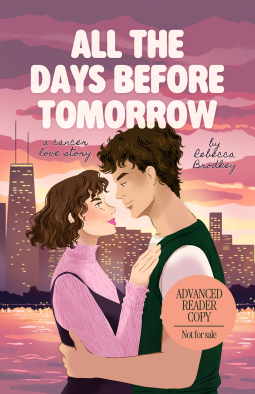
All the Days Before Tomorrow
A Cancer Romcom
This title was previously available on NetGalley and is now archived.
Send NetGalley books directly to your Kindle or Kindle app
1
To read on a Kindle or Kindle app, please add kindle@netgalley.com as an approved email address to receive files in your Amazon account. Click here for step-by-step instructions.
2
Also find your Kindle email address within your Amazon account, and enter it here.
Pub Date Jun 2 2026 | Archive Date May 25 2026
Talking about this book? Use #AlltheDaysBeforeTomorrow #NetGalley. More hashtag tips!
Description
a friends-to-lovers romance about cancer, healing, and love worth scouring the world for.
despite what you may have heard…
Ruby Hirsch is not a tragedy.
Sure, she lost touch with almost all her friends during the slog of breast cancer treatment. And okay, her writing career also screeched to a halt. But she’s trying!
Ruby’s (former) BFF Penelope has everything Ruby lacks: a bestselling book, a doting fiancé, and a solid friend group. But Pen needs something that Ruby has in spades: time. Pen asks Ruby to help plan her upcoming wedding, and in exchange, offers to introduce Ruby to her literary agent, the jumpstart Ruby needs for her writing career.
Ruby must rely on the sunshine best man, Eitan, who seems to have everything figured out—except wedding planning. The more time they spend together, the more Ruby sees beneath his sunny bravado, and learns about a grief that mirrors her own. Eitan, meanwhile, sees the reality of her and Penelope’s friendship and begins asking questions that threaten the entire wedding—and the writing career that Ruby has hanging in the balance.
As the wedding, her feelings for Eitan, and her own dreams for a life post-cancer collide, Ruby must reckon with what she’s actually fighting for, and what it means to survive.
A Note From the Publisher
A friends-to-lovers romance about cancer, healing, and love worth scouring the world for.
Advance Praise
"This book is not just 'a story about a girl who had cancer' it’s 343 pages of 'I want to live but I'm not quite sure how to find myself, but maybe I'll meet her along the way' and it was easily one of the most beautiful books I've ever read." – Goodreads review by Jenna's Corner
"A hopeful, beautifully reflective story about life after cancer, messy healing, and figuring out who still deserves a place in your future." – Goodreads review by Catherine
"I will be forever be recommending that everybody read this when it comes out in June!" – Goodreads review by Melinda
Available Editions
| EDITION | Ebook |
| ISBN | 9798990228641 |
| PRICE | |
Links
Available on NetGalley
Available to Buy
Buy on Amazon Buy on BN.com Buy on Bookshop.org Buy on KoboAverage rating from 24 members
Featured Reviews
 Reviewer 2039865
All the Days Before Tomorrow by Rebecca Brodkey completely swept me away in a way that feels hard to put into words this is one of those stories that doesn’t just tell you about love and loss it makes you sit inside it.
At the heart of the book are Ruby and Eitan and what makes their relationship so compelling is how deeply human , real & raw it feels. Ruby is written with this raw emotional openness and feels everything intensely, sometimes to her own detriment, and that vulnerability makes her incredibly easy to connect with. There’s also a quiet resilience in her especially in how she continues to move forward despite everything she’s endured.
Eitan is far more guarded and that emotional push and pull between them is what gives the story so much depth. His restraint his internal conflicts and the weight he carried especially in the wake of illness and its lasting impact create this constant tension between what he feels and what he allows himself to show. Watching those walls shift even slightly feels incredibly meaningful.
One of the most powerful aspects of the novel is how it explores the aftermath of cancer not just as a past event but as something that lingers in every part of life afterward. The story doesn’t romanticize recovery instead, it focuses on the emotional residue the fear that never fully leaves, the changed sense of self, and the way relationships are reshaped by something so life altering. It’s about survival, but also about what comes after survival the quiet complicated process of learning how to live again.
This theme is woven seamlessly into Ruby and Eitan’s relationship. Their connection is shaped not just by who they are but by what they’ve been through and there’s a constant undercurrent of fragility and urgency because of it. The book captures that bittersweet awareness that time isn’t guaranteed which makes every moment between them feel more significant and more heartbreaking.
Emotionally this story is incredibly immersive. It explores love, timing, regret, and the devastating weight of “almost.” The writing allows those feelings to breathe lingering in the small, quiet moments just as much as the bigger ones. You don’t just read about their story you feel it.
If there’s any critique, it’s that the emotional intensity can be overwhelming at times especially for readers who prefer lighter or faster paced narratives. But for those willing to sit with the heaviness, it’s deeply rewarding
Thank you to Rebecca & Netgalley for the opportunity to read this arc all opinions are my own
 Catherine B, Reviewer
A hopeful, beautifully reflective story about life after cancer, messy healing, and figuring out who still deserves a place in your future.
This isn’t just a story about illness, it’s about everything that comes after — survival, reinvention, grief, anger, hope, and the loneliness of being the one who is still here and expected to move on. Thank you @rebeccabrodkey for this ARC.
What really worked for me was Ruby’s voice. She’s funny, sharp, messy, angry, vulnerable, and very, very real. The humour lands, even when the subject matter is heavy. I also really loved that it made space for her to be furious about what happened to her instead of forcing gratitude or toxic positivity. The romance worked for me too, mostly because it felt rooted in real emotional baggage rather than just chemistry. Eitan definitely had moments where I wanted to shake him, but I still really liked him, and once the emotional walls started coming down I was fully invested. Also: consent king, emotionally complicated, and apparently in possession of slutty forearms. Powerful combination.
One of the strongest parts of the book was the way it handled friendship and community. Ruby slowly realising who is actually showing up for her hit hard. The side characters added so much, especially the people who gave her room to be honest rather than palatable all the time.
This is an emotional read, but not in a manipulative, tragedy-porn way. It felt much more reflective than devastating. More about learning how to build a life after everything has changed than about making the reader cry on command. And I really loved that.
 Demetris P, Reviewer
Come for the Wedding Planning, Stay for the Existential Meltdown, the Hot Dog, and the Seaglass-Eyed Boy
“All the Days Before Tomorrow” begins with post-cancer social panic and bridal labor but deepens into a surprisingly shrewd novel about survivorship, appetite, and the risk of choosing life anyway.
By Demetris Papadimitropoulos | April 5th, 2026
Some novels about illness still believe, a little too politely, that catastrophe will sand a person into wisdom. Rebecca Brodkey’s “All the Days Before Tomorrow” knows better. Cancer, in this novel, does not ennoble Ruby Hirsch so much as leave her stranded in the abrasive, unphotogenic afterlife of survival: medically managed, hormonally wrecked, sexually unsure, professionally stalled, socially displaced, and surrounded by people who were much more comfortable with her during treatment than they are with her once she is alive enough to need things again. The book’s great and prickly intelligence lies there. It understands that the crisis is not only getting sick. It is surviving without becoming easier for other people to consume.
That is why Ruby is such a strong narrator. She is not a saint, not a lesson, not a courage mascot in cute compression socks. She is frightened, horny, bitter, self-mocking, often funny in the precise way funny people become when panic has colonized the whole house and wit is the only room left to sit in. Brodkey gives her a mind that does not proceed by revelation so much as by ricochet. Ruby bargains, deflects, lusts, resents, panics, over-interprets, and occasionally says something so nakedly true she seems to surprise herself. The voice has real snap. It can turn a hot flash, a bad date, a post-treatment hormonal shot, or a florist appointment into an occasion for comic dread. At its best, it gives the novel both velocity and sting.
Ruby has, on paper, done what she was supposed to do. Treatment is over. She is in remission. She has, technically, survived. But Brodkey is superb on the insult concealed in that adverb. Survival is supposed to sound like arrival. Here it feels more like being dropped off somewhere without clear signage, proper lighting, or much sympathy. Ruby’s body has changed. Her confidence has thinned. Her relationship with sex is warped by reconstruction, numbness, menopause symptoms, and the memory of being left by Grant, the boyfriend who stayed long enough to count as decent and then departed early enough to leave a permanent bruise. Her writing career has stalled. Her friendships have hollowed out. One of the book’s smartest running devices is Ruby’s “Be Yourself (Again) List,” a numbered attempt to strong-arm her life back into shape. The list is funny because desperation becomes faintly ridiculous the moment it acquires bullet points.
Then Penelope comes back into her orbit, and the novel’s social machinery starts humming. Penelope is an old friend from Ruby’s writers-group past, now a poet-influencer bride with a booming platform, a coming wedding, a literary agent, and a preternatural talent for making extraction sound like intimacy. She invites Ruby into the wedding party and, more consequentially, into a deal: help me shepherd this monstrous wedding into existence, and I will help get your book in front of my agent. Ruby, who wants back into life with the hunger of someone who has spent too long watching it from behind glass, agrees.
This arrangement is the novel’s masterstroke, because it lets Brodkey yoke illness, friendship, class aspiration, female social performance, and literary ambition into one exquisitely stressful machine. The wedding is not mere backdrop. It is a delivery system. Florals, playlists, vendor meetings, dress fittings, camp itineraries, last-minute errands, conversion details, vows, escort cards, emotional triage – each task becomes another way of asking what exactly friendship means once labor enters the room wearing perfume and calling itself love. Penelope does not read as a cartoon villain for most of the novel. She is much worse than that: plausible. She is socially gifted in the most dangerous way. She knows how to make entitlement sound like vulnerability, how to convert other people’s effort into evidence of her own belovedness, how to let someone believe they are being chosen when in fact they are merely being used well.
Brodkey is especially sharp on the hierarchy of acceptable suffering. Penelope likes having Ruby near when Ruby can function as loyal witness, errand-runner, emotionally intelligent fixer, Jewish wedding consultant, and eventually marketable cancer survivor. What Penelope does not especially like is Ruby as a full person – messy, needful, desirous, intermittently angry, and no longer content to remain decorative. The novel’s most acid insight is that people often prefer illness when it is visible, noble, and finite. Survivorship is harder to romanticize. It keeps asking for time, sex, patience, practical help, and moral flexibility. It ruins the symmetry of other people’s stories about you.
The publishing subplot deepens that point rather than merely echoing it. Ruby spends much of the book believing that Penelope’s career represents a path she, too, might follow if she works hard enough, says yes often enough, and keeps proving herself useful. When she finally meets Penelope’s agent, Alice Sutherland, the fantasy curdles. Alice is less interested in the book Ruby has actually written than in the version that can be repositioned around breast cancer. It is one of the novel’s best turns, not because it exposes publishing as corrupt – that would be too easy – but because it reveals how thoroughly Ruby’s pain has been translated into opportunity by everyone around her. The wedding wants her labor. The industry wants her wound. In both cases, what matters is whether the suffering can be arranged attractively.
And then there is Louise, the character who blows the whole book open. If Penelope represents the sleek vulgarity of image culture and transactional intimacy, Aunt Louise represents appetite in its least apologetic form. She is wealthy, caustic, funny, vain, exasperating, affectionate, and living with metastatic recurrence. Brodkey does something braver with her than simple wisdom-distribution. Louise is not in the novel to provide tasteful perspective from the edge of death. She wants hot dogs. She wants the casino. She wants to complain, to joke, to meddle, to flirt with the world a bit longer. When she and Ruby go out for Chicago-style hot dogs after an oncology appointment, the book suddenly acquires a second pulse. It becomes not only a romance or a survival narrative but a novel about illness stripped of uplift. Louise will talk about recurrence, pain medicine, shrinking horizons, and the indignities of treatment without once pretending that suffering improves character. She refuses the role of moral décor.
That refusal matters because Brodkey’s prose, while mostly accessible and contemporary, is strongest when it leans into the body rather than the slogan. She is very good at altered sensation: the strange map of reconstructed breasts, the hormonal volatility, the hot flash arriving in the wrong place, the body as both self and traitor. She is very good, too, at weather. Lake water, storms, humidity, early autumn chill, aurora-lit sky – the atmospheric writing is sometimes a touch over-insistent, but usually it performs real emotional labor. Ruby experiences feeling as climate: sudden, physical, destabilizing, impossible to negotiate with. The imagery can recur a beat too often, and there are places where Brodkey explains what a scene has already made clear, but the prose has real tensile feeling. It wants to move. Even the jokes come attached to nerves.
Formally, the novel is more disciplined than it first appears. Brodkey straps nearly everything to the countdown toward Penelope’s wedding, and that choice gives the book a tautness that saves it from becoming merely episodic. Florist consultation, beach day, open mic, camp trip, rehearsal dinner, wedding collapse, biopsy dread – each episode does its own work while also tightening the screw. The calendar structure is not especially flashy, but it is effective. It makes every emotional hesitation costlier. It turns delay into plot. It also lets Brodkey stage a nice tension between ritual order and bodily disorder: weddings demand timelines, bookings, matching looks, formal entrances, perfected surfaces; cancer has other ideas.
The romance with Eitan Moreno arrives right where it should: at the point where Ruby most wants back into life and least trusts herself to re-enter it. Eitan is charismatic in a way many readers will either surrender to quickly or resist on principle. He is very handsome, emotionally intuitive in bursts, grief-marked, funny, maddening, tender, occasionally avoidant, and given to gestures that would be insufferable in a lesser book. Here, mostly, they work. He works because Brodkey refuses to make him a cure. He does not heal Ruby’s fear. He does not erase the medical plot. He does not even always know what to do with his own feelings. What he does offer is legibility. He reads her correctly. He notices that the jokes are cover, that the competence is overcompensation, that the so-called improvement project is often just fear wearing sneakers. Ruby, in turn, understands that his buoyancy is partly generosity and partly a defense against grief. Their connection has charge because it is built not only on attraction – though the book is pleasingly frank about attraction – but on the unnerving relief of being recognized without being simplified.
Some readers will find the romance almost too winning. I suspect those readers will be the same ones who distrust charm in fiction on moral grounds. I am not among them. Brodkey knows exactly what she is doing with the bathroom-door meet-cute, the beach scenes, the dance-floor electricity, the camp-tent intimacy, the hand-on-the-cheek near miss, the eventual sexual reawakening. Yet what rescues these scenes from generic uplift is the fact that they are not about Ruby becoming desirable again so much as about Ruby becoming inhabitable to herself. Eitan returns her, however briefly and contingently, to the possibility of feeling like a body instead of a diagnosis, a case file, a management project, a lesson in resilience.
The novel’s central achievement, then, is not that it tells a moving story about cancer and love. Plenty of books can do that. Its achievement is that it understands the humiliations of partial recovery – the way desire, ambition, fear, grief, and social hunger can all coexist inside one person without arranging themselves into a better moral order. Ruby does not come out of illness with serene wisdom or a tidier soul. She remains petty, funny, terrified, ambitious, jealous, desirous, self-aware in flashes and delusional in others. The book does not punish her for that. Better still, it does not ask her to become inspirational before granting her feeling.
Its central limitation is that by the end Penelope begins carrying slightly too much symbolic freight. For most of the book she is painfully recognizable: vain, charming, insecure, acquisitive, intermittently warm, socially lethal. In the final act, especially around the rehearsal dinner and wedding implosion, she becomes just a shade too perfect as a vessel for everything the novel wants to indict – influencer narcissism, prestige hunger, exploitative friendship, self-mythologizing literary culture. The confrontation is dramatically satisfying, but it is also one of the few places where the book’s appetite for payoff slightly outruns its patience for complexity. A few speeches elsewhere also arrive a touch over-shaped, as though the novel momentarily wants us to underline them.
Even so, I would rather take that excess than a more tasteful, flatter book that never risked ugliness. “All the Days Before Tomorrow” earns its mess. It is willing to be hormonal, funny, lusty, cruel, sentimental for a second and then embarrassed by its own sentimentality. It lets a hot dog matter. It lets an open mic matter. It lets a ruined wedding matter less than one dead woman’s final days. It lets a romantic reconciliation stand not as proof that life is fair but as proof that unfair life can still contain gifts. That is a much tougher claim.
I’d place the book at 88/100, or 4 stars. That score suits its temperature: genuinely moving, structurally shrewd, often very funny, occasionally over-emphatic, and more ambitious than its packaging first suggests. It is strongest where it refuses to confuse illness with enlightenment. It is weaker where it presses too hard for moral clarity. But it keeps insisting on something harder, stranger, and finally more convincing than triumph. Not that suffering makes life meaningful. Not that love cures fear. Not that surviving entitles anyone to coherence. Only that life, even half-healed and badly timed and medically shadowed, remains worth wanting in its vulgar particulars.
That is what the ending sharpens. By the time Brodkey arrives at biopsies, burial, cancelled weddings, agent disillusionment, broken friendships, and hard-won love, the question is no longer whether Ruby will become her old self again. It is whether she can stop treating life as something that begins after fear ends. The novel’s answer is no, and thank God for that. Fear stays. The body stays precarious. The future refuses to clarify itself. But the book denies fear the final aesthetic word. It leaves Ruby not purified but awake – hot dog in hand, weather shifting overhead, phone about to ring, life still messy enough to choose.
Readers who liked this book also liked: