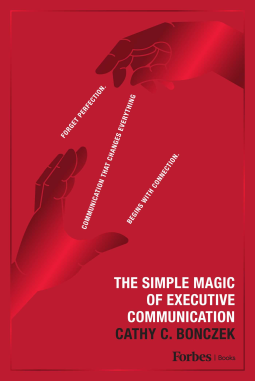
The Simple Magic of Executive Communication
Forget Perfection. Communication That Changes Everything Begins With Connection.
This title was previously available on NetGalley and is now archived.
Send NetGalley books directly to your Kindle or Kindle app
1
To read on a Kindle or Kindle app, please add kindle@netgalley.com as an approved email address to receive files in your Amazon account. Click here for step-by-step instructions.
2
Also find your Kindle email address within your Amazon account, and enter it here.
Pub Date Jun 9 2026 | Archive Date Jun 9 2026
Talking about this book? Use #TheSimpleMagicofExecutiveCommunication #NetGalley. More hashtag tips!
Description
In high-stakes business environments, executives are expected to deliver with clarity, confidence, and authority. Yet too often, leaders focus on getting every word, slide, and gesture “just right,” only to end up sounding scripted, stiff, and disconnected. The real key to effective executive communication? Connection over perfection.
In The Simple Magic of Executive Communication, Cathy C. Bonczek—renowned executive coach and former Wall Street banker—delivers a practical, insightful guide to mastering high-impact communication. Drawing from decades of experience coaching top executives in global finance, Bonczek reveals the strategies that separate forgettable presenters from those who captivate and persuade.
Through engaging stories, actionable frameworks, and expert advice, you’ll learn how to:
- Speak with authority and presence—without sounding rehearsed.
- Master audience engagement—so people actually listen.
- Craft compelling stories that make your message memorable.
- Overcome public speaking nerves and think on your feet.
- Use persuasion techniques to win buy-in and influence decisions.
- Command a room—virtually or in person.
This isn’t just another public speaking manual. It’s a must-read for senior executives, rising leaders, and anyone who wants to be seen as a strong, confident communicator. Whether you're pitching to investors, presenting to the board, or leading high-stakes meetings, The Simple Magic of Executive Communication gives you the tools to communicate with impact, authenticity, and ease.
Forget trying to be perfect. Focus on being heard.
Advance Praise
“Cathy’s work with KKR over the past 15+ years has been based on a simple principle—the power of connection. Her ability to cut through the noise to develop impactful communication strategies has proven invaluable to many of us at KKR, including me. I’ve seen firsthand how her approach can help transform good communicators into exceptional ones, and she does so with great empathy, warmth, and clarity each step of the way.”
—SCOTT NUTTALL
Co-Chief Executive Officer, KKR
“At KKR, one of our guiding values is the importance of ‘like and trust,’ which often begins with authentic communication that helps cultivate better connections. Whether advising a rising star or seasoned executive, Cathy is extraordinarily talented in empowering leaders to effectively engage with their audience through practical advice and actionable feedback. This book is essential reading for any executive looking to harness the ‘simple magic’ of communication to make a lasting impact in their organizations and beyond.”
—JOSEPH BAE
Co-Chief Executive Officer, KKR
“Whenever a leader is facing a high-profile, high-stakes presentation situation, I call Cathy. She is an astute observer of communication style and provides valuable insight and actionable tools for communication mastery. If you are a leader seeking to improve your presentation, communication, and/or influencing skills, you should have Cathy on speed dial.”
—JOAN LAVIN
Former Chief Talent Officer, KKR; Executive Coach and Talent Management Advisor
“Cathy Bonczek understands the power of connecting to, communicating, and engaging with clients, coworkers, and anyone else. Her insights have helped me and can help you be a more effective communicator, leader, and colleague.”
—KEN MEHLMAN
Partner, KKR; Campaign Manager, Bush-Cheney 2004; 62nd Chairman of the RNC
“Cathy’s approach elevated our team’s ability to communicate with clarity, confidence, and authenticity—giving us the tools to tell our story, in our voice. Her blend of warmth and directness made her not only a trusted coach, but a true partner in helping us lead with presence and purpose.”
—JULIE SOLOMON
Partner, Co-Head of Real Estate, Ares Management
“Working with Cathy over the years has been one of the most valuable investments our team has made. In a high-performance, client-facing environment, great communication isn’t optional—it’s essential. Whether we’re trying to win business, build trust with clients, or lead a team, the ability to communicate with clarity, confidence, and authenticity is the difference between being good and being great. That’s where Cathy shines. Her ability to provide guidance that is incisive, pertinent, and immediately actionable—especially for senior professionals who value efficiency—distinguishes her. She’s an indispensable extension of our team, and her impact cannot be overstated.”
—ANTHONY PAWLOWSKI
Partner, Ares Management
“Cathy has been an exceptional coach, a trusted advisor, and a wonderful friend to me and well over a hundred of my colleagues over the past decade. Regardless of corporate title, industry tenure, or speaking level, Cathy delivers significant value to our professionals across the globe by helping them speak with greater passion, purpose, and punchiness. Thank you very much, Cathy, for your incredible partnership.”
—RYAN BERRY
Partner, Chief Marketing and Strategy Officer, Ares Management
“Effective communication is a prerequisite for success. Cathy helps to elevate an executive’s message, so that he or she can have a bigger impact on their most important constituents.”
—HENRY MCVEY
Head of Global Macro & Asset Allocation and Firmwide Market Risk, CIO of the KKR Balance Sheet, and Co-Head of KKR’s Strategic Partnership Initiative, KKR
“Cathy has been an outstanding partner to Arctos, helping us elevate the way we communicate and present with confidence. Her coaching has not only strengthened each of us as individuals but also enhanced how we collaborate and deliver as a team. Cathy’s expertise and practical guidance have made a lasting impact.”
—GREGORY C. BAECHER
Partner, Arctos Partners
“Coach Cathy has been instrumental in my career, helping me find clarity and confidence in both what I say and how I carry myself as a leader. She’s not just a coach, but a trusted guide in all things communication and professional growth.”
—ELEANOR MCENANEY
Director, Global Impact, KKR
“I’ve found myself repeatedly thinking back to my notes from our sessions and applying them in real time to interactions with others (and not just at work!). I’ve not only improved in my ability to speak with conviction and impact, but feel like my confidence has increased tenfold in meetings that I previously would have felt surges of anxiety throughout in anticipation of having to speak... I found Cathy’s style of directness and relatability incredibly impactful—it created a comfortable space for us to experiment with our presentation approach and learn from mistakes without fear of judgment. I feel so fortunate to have gotten the opportunity to be part of this program.”
—EMILY RICHNER
Manager, Human Capital Business Partner, KKR
Available Editions
| EDITION | Other Format |
| ISBN | 9798887507033 |
| PRICE | $29.99 (USD) |
| PAGES | 216 |
Available on NetGalley
Available to Buy
Buy on Amazon Buy on BN.com Buy on Bookshop.orgAverage rating from 6 members
Featured Reviews
 Demetris P, Reviewer
The Art of Continuing
Cathy C. Bonczek’s “The Simple Magic of Executive Communication” finds its real subject not in flawless speech, but in the craft of recovering the room.
By Demetris Papadimitropoulos | May 17th, 2026
In business books about communication, perfection often arrives overdressed: an immaculate deck, a laminated smile, a conclusion polished until it no longer sounds like anyone who has ever needed coffee. Cathy C. Bonczek’s “The Simple Magic of Executive Communication” is useful because it distrusts that fantasy. Its best lesson is not that executives should become smoother. It is that they should become easier to reach.
Through a pause. A shorter sentence. A better question. A willingness to look up from the page.
The book’s “magic” is not really magic at all. It is rehearsal, attention, compression, feedback, and recovery – the unshowy practices that make people look up, answer, object, laugh, lean in, or trust the speaker at the front.
Bonczek, a former banker and coach of consequential rooms, writes for the person who knows the numbers, knows the meeting may decide whether trust advances or stalls, knows the room can bite, and still finds refuge in a PowerPoint deck dense enough to require its own customs declaration. She has spent decades coaching senior executives through pitches, investor meetings, annual meetings, panels, fundraising launches, and client conversations where trust has a clock on it. Those rooms give the book its weather. It is not an abstract essay on eloquence. It is a coach’s pocket map to conference tables, Zoom grids, auditorium stages, pitch books, anxious dry runs, compliance-approved messages, and the small corporate hush after the air goes out of an hour.
The load-bearing metaphor arrives early, and it earns the weight Bonczek puts on it. She distinguishes “perfect pitch” from “relative pitch.” Perfect pitch is the seductive, mostly useless fantasy of the flawless presenter: exact, rare, rigid, impressive from a distance and perhaps maddening up close. Relative pitch is the daily practice. It means tuning oneself to other people: pace, silence, volume, resistance, mood, appetite, fatigue. This gives “The Simple Magic of Executive Communication” architecture sturdier than many books on executive bearing manage to find. Speech, in Bonczek’s account, is not the recital of something sealed before anyone has listened. It is a form of harmony.
Someone else must be heard before one can find the note.
The first half of the book, “Getting Ready to Step Into the Spotlight,” builds the working method. Many professionals, Bonczek argues, prepare in exactly the wrong direction. They gather more data, borrow old decks, add more charts, search for more proof, and discover only at the end that they have not practiced saying anything aloud. They arrive with information but not with a message, with pages but not presence. Her correction is plain, not thin: know the audience, know the objective, identify persuasive evidence, shape the message as a story, use visual aids as aids rather than shields, rehearse the transitions, and decide what the audience should think, do, or feel when the exchange is over.
Its originality is not in the topics, most of which have long résumés of their own. Know your audience. Tell a story. Practice. Be concise. Listen. Be yourself, though not so vigorously that everyone in the room begins looking for an exit. The value lies in translation into things one can actually do. Bonczek takes workplace virtues that often float around as office vapor – clarity, confidence, authenticity, rapport – and gives them handles small enough to grip before Tuesday’s meeting. “Rehearse to converse” is the sharpest hinge phrase because it contains the paradox of good preparation: you practice not to sound rehearsed, but to earn enough freedom to stop clinging to the script. A run-through, in her terms, lets one “put one’s mouth around the words.” A rehearsal teaches the speaker where the story is going, so that the speaker can recover when the room starts talking back.
The book keeps returning to the second after the stumble, when authority is still negotiable. In a community-theater production of “Dracula,” another actor jumps to the wrong part of the play, and Bonczek, because she knows the story rather than merely her lines, gently steers the scene back into order. During a presentation on presentation skills, she backs off the stage and vanishes from view; her partner deadpans that Cathy will be back in a moment, and she gets up and continues. In a client meeting she has helped arrange, a group of men tries to usher her out once her male colleague has been introduced. She collects herself. Takes a chair from reception. Opens the closed door. Drags the chair in. Sits among them. Life, annoyingly, sometimes blocks the scene better than art. She says little. She does not need to. A chair makes the claim speech cannot.
That bodily intelligence is one of the book’s sanest corrections to the deck-lit culture of business speech. Bonczek does not discuss messages as if they float freely through rooms. She cares about eyes, hands, posture, breath, clothing, pacing, volume, stillness, entrances, exits, the angle of a speaker’s head toward a confidence monitor, and the deadening effect of reading aloud to a slide as if it were a hostile witness. Her delivery categories are standard; the proof arrives in the particulars. A private equity client in a tailored suit, gold Rolex, and gold pen is asked to consider what message he sends when he visits union workers. A banker visiting Greek shipping clients learns the opposite lesson when casual dress disappoints clients who preferred the formality of his usual attire. Dress, in Bonczek’s telling, is not vanity. It is context made visible.
Her theater training gives the book much of its texture. Bonczek studied acting, voice, and performance, and she repeatedly resists the idea that using acting techniques makes business speech fake. The point is not to pretend to be someone else. The point is to understand entrance, stillness, listening, projection, emotional intention, and the power of a pause. One of her teachers tells her that one cannot act an emotion; one has to feel something first. Bonczek carries that principle into the boardroom. The problem with many presentations is not only that they are too long or too cluttered. It is that no one can detect what the speaker feels about the point. The result is competence without charge, a roomful of facts looking for a pulse.
The prose is plainspoken and companionable, built for use before admiration. Bonczek is most alive when scene outruns lesson. She is funny about being “Mr. Cathy” over telex at a French shipping firm because shipowners and officials would not work with a young woman; funny, too, about a boss entering her in a Miss Maritime Beauty Contest, after which she sensibly decides to go find a job “where the women were” and walks, with the innocence of youth, into a bank. She has a good ear for the absurdity of professional life, including the client who responds to a twenty-five-page deck limit by bringing four decks of twenty-five pages each. Somewhere in that scene lies the whole history of modern business speech, bound, footnoted, and unread.
The prose is less distinctive when it shifts into the soft argot of leadership books. Words such as connection, authenticity, purpose, impact, presence, and confidence recur often, and at times they blur into a kind of conference-room Esperanto: everyone understands it, yet no one would write home about the accent. Chapter endings sometimes explain the lesson after the scene has already done the work. Bonczek is more persuasive when she trusts the incident: the stage fall, the wrong line in “Dracula,” the closed meeting door, the imperfect apartment, the son’s school meeting, the broken arms. Her stories have edges. Some of the summative language polishes away their burrs.
The structure is more workbench than cathedral, but it holds the tools where the reader needs them. Part 1 moves from mindset to preparation; Part 2 moves into the stress test of fear, body, meetings, annual meetings, engagement, and authenticity. The design works because each chapter moves a little closer to the moment when the script has to survive contact with people. First the speaker imagines the talk; then plans it; then embodies it; then survives it. The conclusion turns the microphone inward, asking not only how one speaks to an audience, but how one reframes an experience for oneself.
The SOCIAL STYLE® chapters are among the book’s most practical and most vulnerable to overmapping. Bonczek uses the framework to discuss Driving, Expressive, Amiable, and Analytical behavioral preferences, stressing that style is not personality and that no style is superior. Her best example comes before any chart can stiffen the air. She repeatedly asks her CEO, “Do you have a minute?” believing she is being courteous. The CEO hears weakness. Bonczek learns to enter with a more direct Tell style: “I NEED YOU NOW,” “SIGN THIS.” To Bonczek, it feels like shouting. To the CEO, it sounds like confidence. This is the model at its best: not a box to put people in, but a reminder that intention and reception are not the same event.
Still, any quadrant model risks making people seem more legible than they are. Bonczek is careful, but the framework can feel too cleanly mapped beside the mess of real workplaces: gendered dismissal, hierarchy, toxic cultures, cultural difference, psychological safety, and who is permitted to be forceful, vulnerable, imperfect, or “authentic” without penalty. She knows these pressures exist. She has lived some of them. Being “Mr. Cathy,” being told she was “too nice,” being dismissed from a room she had helped open – these are not minor footnotes. Yet the book is more interested in adaptation than in sustained analysis of the systems that make such adaptation necessary. That pragmatism keeps the book usable, and keeps some of its hardest implications at the door.
The same is true of its research buttressing. Bonczek includes endnotes and invokes familiar studies or claims about public-speaking fear, attention span, visual processing, persuasion, and conversation. The citations may steady the scaffolding, but the rooms do the persuading. A reader may not remember the statistic, but will remember the private equity executive who once ran an hour over his allotted time, exhausting an audience that might have been persuaded by half the words. He later learns to compress his message and becomes more enjoyable, not less substantive. That is Bonczek’s domain: the difference between having knowledge and making knowledge hearable.
Her chapter on meetings is especially strong because it addresses a meeting illness everyone recognizes: the gathering that begins vaguely, drifts conversationally, and ends with a procedural splutter. Bonczek’s rubric for opening – Who, What, Why, How, Outcome – is not glamorous, but glamour has rarely saved a Tuesday afternoon. She is good on endings, too. A meeting should not conclude merely because no one has another question. It should close with a next step, a decision, a request, or a clean articulation of what has changed. In a work culture drowning in meetings, decks, and summary language, this is not revolutionary. It is better than revolutionary: a reader can try it before the next pitch.
The annual-meetings chapter, drawn from Bonczek’s investor-facing experience, gives the book welcome specificity. She knows the choreography of those events: brief presentations, panels, compliance-approved messages, leadership showcases, the firm’s year compressed into a sequence of tightly managed appearances. Her best insight here is that even a large audience listens one person at a time. Speakers intimidated by the mass should learn to make eye contact by sections, allowing clusters of people to feel addressed. Again, the advice is practical because it is physical. Bonczek knows that a confidence monitor with too many tiny words can bend a speaker’s head as if in prayer. She recommends fewer words, bigger font. One could do worse as boardroom discipline.
The most emotionally clarifying chapter may be the one on storytelling, where Bonczek recounts advocating for her son, who has dyslexia, while she herself is living with a stage 4 chronic lymphocytic leukemia prognosis. In a school meeting, she tells administrators about infertility, adoption, her son’s struggles, and her fear that she may not be there to advocate for him.
The room breaks open; the administrators rally.
The anecdote could have felt manipulative in a lesser book. Here, it clarifies the difference between story as ornament and story as moral context. She does not tell the story to decorate a point. She tells it because the stakes require the listeners to understand what they are being asked to hold.
The chapter on authenticity is more measured than the word often permits. Bonczek remembers a period when professional women in banking were expected to wear skirts, blazers, stockings, polished heels, pulled-back hair, and little silk scarves that nodded toward men’s ties. She asks whether the work self is inauthentic or simply another facet of the self. Her answer is sensible: not mask, not confession. Authenticity does not mean saying whatever comes to mind, nor does it mean ignoring context. It means being honest and respectful, flawed but not careless. She also notes that not every workplace is safe enough for authenticity. Hierarchy can punish the very honesty it requests. That caution is a necessary brake; without it, the book’s emphasis on connection would risk becoming sentimental.
The conclusion is uneven, but its opening scene knows exactly what book it belongs to. In June 2023, Bonczek falls on a pickleball court and breaks both arms. She is hospitalized, undergoes surgery, spends time in rehab, and finds herself dependent in ways she had not planned. The scene is full of failures of attention: bystanders urging her to sit up, rolling her over, squeezing her arms, asking too many questions while she is managing pain; club representatives seeking personal information when she is trying to locate her husband; medics asking which arm hurts more when both are broken. Later, her oncologist reframes the accident: if her arms had not taken the force of the fall, her head would have.
She might not be alive.
With that sentence, the accident changes shape. She is not merely the victim of a stupid summer calamity. She is lucky to have survived.
That turn broadens the book’s meaning. Speech is no longer only what a leader does in a room. It is also the story one chooses to live inside after the room, the court, the meeting, the body, or the plan has failed. After this vivid scene, the conclusion slips into more familiar exhortation about voice, purpose, passion, and leadership. Yet the accident has already done what the closing pages want to do. It shows that communication can be instruction, repair, witness, misfire, and mercy.
“The Simple Magic of Executive Communication” is not a new theory so much as a disciplined correction. Its advice is sometimes well-traveled, its research support less persuasive than its coaching intelligence, and its language occasionally too comfortable in the padded chair of executive uplift. But it is far better than a mere presentation manual because it understands that speech is not a display of control. It is a relationship with the part of the room one cannot control. The speaker prepares, yes, but only so she can meet what actually happens.
That is the book’s finest service: it makes authority teachable without reducing it to choreography. It breaks the aura into gestures, pauses, questions, endings, rehearsals, and repairs. It gives readers permission to stop chasing the perfect presentation and start practicing the more difficult art of being present enough to be understood. I’d rate it 84/100, which translates to 4/5 stars under the stated rubric: a strong, useful, humane book whose practical wisdom outweighs its familiar passages.
So perhaps Bonczek’s title promises magic because craft sounds too plain for a business title. Magic suggests disappearance, transformation without labor, a silk scarf pulled from an empty hand. Craft is steadier. It rehearses the opening. It cuts the deck. It looks up from the page. It asks one more question. It drags the chair back into the room. It falls off the stage, climbs back up, and discovers that the audience is still there, waiting not for perfection, but for the person who knows how to continue.
Readers who liked this book also liked:



Gaëlle Nohant
General Fiction (Adult), Historical Fiction, Religion & Spirituality








Publishers Lunch
General Fiction (Adult), Nonfiction (Adult), Teens & YA


Shiv Narayanan
Business, Leadership, Finance, Nonfiction (Adult), Professional & Technical