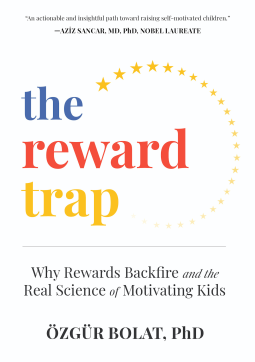
The Reward Trap
Why Rewards Backfire and the Real Science of Motivating Kids
This title was previously available on NetGalley and is now archived.
Send NetGalley books directly to your Kindle or Kindle app
1
To read on a Kindle or Kindle app, please add kindle@netgalley.com as an approved email address to receive files in your Amazon account. Click here for step-by-step instructions.
2
Also find your Kindle email address within your Amazon account, and enter it here.
Pub Date Aug 18 2026 | Archive Date Jul 7 2026
Talking about this book? Use #FamiliusBooks #NetGalley. More hashtag tips!
Description
Avoid the hidden trap of rewards and raise confident, self-motivated kids with revolutionary, science-based parenting strategies from international sensation Dr. Özgür Bolat—featuring a foreword by Nobel Laureate Aziz Sancar.
Every loving parent uses rewards—gold stars, treats, praise, privileges—believing they’re nurturing their child’s motivation and self-esteem. But what if seven decades of scientific research reveal we’re doing the exact opposite? What if the rewards we depend on are creating power struggles, screen dependence, and children who act only when there is something to gain?
Drawing on groundbreaking research and real-life cases, The Reward Trap explores the hidden psychological cost of rewards and how parents can avoid the pitfalls of external validation on the road to internal motivation. With expert strategies from award-winning researcher Dr. Özgür Bolat—proven to work at home, not just in a lab—this is the connection-based alternative you've been looking for.
Free from the hidden trap of rewards, you will raise children who
- take initiative—from homework to daily responsibilities—without being asked, reminded, or pressured;
- stay engaged and persist through challenges, even when there’s no reward or recognition; and
- make good choices because they believe in them, not because they’re told to.
No more battles over motivation. No more anxiety about whether you’re doing enough. Just genuine connection and a confident, emotionally secure child who is motivated from within. It’s the kind of inner happiness no reward can buy.
Advance Praise
“Dr. Özgür Bolat brings intellectual rigor and uncommon clarity to one of the most important questions in parenting and education: how do we truly motivate children?”
-Prof. Aziz Sancar, MD, PhD, Nobel Laureate in Chemistry
“Drawing on decades of research, including his own empirical studies, he shows how rewards can unintentionally push children toward pressure and approval-seeking rather than a genuine love of learning.”
-Prof. Andrew J. Elliot, Department of Psychology, University of Rochester
“This eye-opening and important book shows what really leads to greater creativity and well-being.”
-Dr. Scott Barry Kaufman, Psychologist
“This book is a compelling read. An accessible book that provides such persuasive and convincing arguments for supporting autonomy and intrinsic motivation gets my vote.”
-Dr. David Frost, Faculty of Education, University of Cambridge
Available Editions
| EDITION | Other Format |
| ISBN | 9798893961805 |
| PRICE | $18.99 (USD) |
| PAGES | 208 |
Available on NetGalley
Available to Buy
Buy on Amazon Buy on BN.com Buy on Bookshop.orgAverage rating from 6 members
Featured Reviews
 Chelsea W, Reviewer
Dr. Özgür Bolat’s The Reward Trap is a provocative and deeply researched challenge to one of the most common parenting tools: the reward system. If you’ve ever relied on gold stars, treats, or extra screen time to get your child to cooperate, this book will likely make you rethink your entire approach.
The Good:
Bolat does an excellent job explaining the "why" behind the failure of external incentives. Drawing on decades of scientific research, he illustrates how rewards can actually crush a child's natural internal motivation and self-esteem. The book is filled with real-life cases that make the data feel accessible rather than academic. I particularly appreciated the focus on building "genuine connection" and authentic development rather than just looking for short-term compliance.
The Critique:
While the theory is sound and the evidence is compelling, implementing these strategies in a world that is essentially built on "the reward trap" can be a massive undertaking. The transition from external validation to internal motivation is a slow process that requires a lot of patience. Some readers might find the "no more battles" promise a bit idealistic for the initial phase of the transition, as breaking the cycle of rewards often leads to more resistance before things get better.
Final Verdict:
This is a must-read for any parent or educator who feels like they are on a "motivation treadmill." It’s an essential guide for raising children who do the right thing because they want to, not because they have to. I’m giving it 4 stars only because the practical application requires a significant lifestyle shift that might feel overwhelming for some busy families.
 Andi A, Educator
This book 100% changed how I will parent and use rewards in my classroom as a teacher. This was incredibly enlightening. There were several things I had not thought of before. However I do feel that the author over-simplified some of it. For example- it doesn't matter what level it is, a child will never "want" to do homework or eat their vegetables for that matter.
I did appreciate how it said there were times that rewards were useful- to spark curiosity. The main things that it talked about to reinforce behaviors you want to see are modeling and seeing the impact on others. I also liked how it said children who are consistently rewarded feel that they have no control over their future, everything depends on external factors.
I do feel that it failed to hit on verbal praise and the repercussions of it. Is it as harmful as external rewards? I feel that the author could've done a better job exploring this.
 Melanie G, Reviewer
As a homeschool mom, I was interested in The Reward Trap because motivation is something every parent and educator wrestles with at some point. The book takes a closer look at the use of rewards and challenges many assumptions about what actually encourages children to learn, grow, and develop lasting habits. I found the discussion thought-provoking, particularly the sections that explored intrinsic motivation and the difference between short-term compliance and long-term engagement.
While I didn't agree with every point, I appreciated that the author supported his arguments with research and encouraged readers to think more carefully about common parenting and educational practices. The book gave me plenty to reflect on and sparked a few conversations in my own home about learning, effort, and achievement.
Readers who liked this book also liked:

Amber Emily Smith
Biographies & Memoirs, Christian, Religion & Spirituality

Caroline Maguire
Health, Mind & Body, Parenting, Families, Relationships, Self-Help


Bernadette Murphy
Biographies & Memoirs, Nonfiction (Adult), Parenting, Families, Relationships