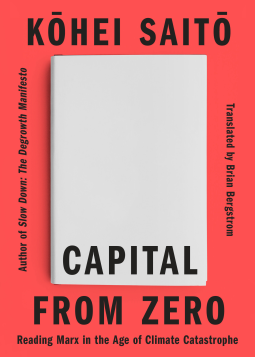
Capital From Zero
Reading Marx in the Age of Climate Catastrophe
This title was previously available on NetGalley and is now archived.
Send NetGalley books directly to your Kindle or Kindle app
1
To read on a Kindle or Kindle app, please add kindle@netgalley.com as an approved email address to receive files in your Amazon account. Click here for step-by-step instructions.
2
Also find your Kindle email address within your Amazon account, and enter it here.
Pub Date Jul 21 2026 | Archive Date Aug 4 2026
Astra Publishing House | Astra House
Talking about this book? Use #CapitalFromZero #NetGalley. More hashtag tips!
Description
For readers of David Harvey and Thomas Piketty comes a new introduction to Marx’s Capital from the author of the internationally bestselling book Slow Down.
The follow-up to his global bestseller Slow Down and a new introduction to Marx's Capital, Capital From Zero is a reading guide, a manifesto, a revision, and a reclamation of Marx's foundational work of political theory. Building on his signature argument of "degrowth communism", Saito's introduction brings Capital squarely into the 21st century, offering a uniquely non-Western, non-dogmatic and eco-socialist reading of the famous text.
Saito is a singular intellect with an essential and innovative point of view—a fresh new voice in Marxist theory who will sit alongside David Harvey and Thomas Piketty in educating and guiding the next generation of radical intellectuals. The book reconstructs Marx’s Capital from a totally new perspective based on more recent research findings, liberating Marx from old dogmas of the Soviet socialism and aiming to rekindle our ability to envision a more equal and sustainable society beyond capitalism.
A Note From the Publisher
FOR READERS OF BIG RADICAL IDEA BOOKS: Fans of David Graeber, Arundhati Roy, and Alan Weisman are likely already familiar with Saito's work and will be eager to read this book.
CLIMATE CHANGE AND MARXISM: Saito is a fresh, non-Western and eco-socialist voice in Marxist theory who breaks down exactly why and how capitalism causes climate change.
AWARD-WINNING INTERNATIONAL BESTSELLER: A companion to Slow Down, which was named a Best Asian Book of the Year at the Asia Book Awards in 2021 and sold over half a million copies in Japan. Capital From Zero was published in January 2023 in Japan, and it sold 150,000 copies in four months.
Marketing Plan
Profiles and features capitalizing on the international star power of Kohei Saito • Original op-eds in national outlets tied to the news • Radio and podcast interviews • Academic outreach to environment, economics, and political science departments at US universities • Big mouth mailing to fans like Sally Rooney • Marxist, Leftist, and climate change book club outreach • Cover reveal on Astra House social media • Library promotion • Influencer outreach • Bookseller outreach
Available Editions
| EDITION | Other Format |
| ISBN | 9781662603419 |
| PRICE | $22.00 (USD) |
| PAGES | 256 |
Links
Available on NetGalley
Available to Buy
Buy on BN.com Buy on Bookshop.orgAverage rating from 17 members
Featured Reviews
 Reviewer 1870399
Thank you, Astra Publishing House, for providing this book for a voluntary review via NetGalley. All opinions are my own.
In Capital From Zero Kohei Saito provides a modern interpretation of Karl Marx’s magnum opus Capital. Saito expertly explains Marx’s concepts through examples from contemporary life, interspersed with quotes from Marx. This presentation method provides one with a understanding of Marx’s concepts in a relatable format while also providing insight into the dense work of Marx. For this reason, reading Capital From Zero prior to tackling Marx’s Capital could reap benefits in absorbing the content of the latter.
Saito explains that capitalists seek to separate the means of production from the laborers, thereby separating the conception and execution of their labor, and to commoditize everything, including one’s labor power. Prior to the development of capitalism, artisans had the ability to conceive (i.e., design) and execute (i.e., manufacture) their craft themselves, and by doing so avoided excessive competition and protected their ability to control the conditions and environment in which they worked. The capitalist divides the artisan’s labor process into individual steps and gives each step to different workers, which transforms the know-how of the artisan into standardized and simple steps. This system of divided labor pressured artisan guilds to lower prices, which eventually led to their dissolution.
Ironically, Marx points out that technological improvements don’t lead to better lives for workers. Rather, such improvements increase the speed of the treadmill on which workers are running. The most effective way to combat the commoditization of labor power is to reduce the length of the working day. This discussion enters into the “degrowth economy” being discussed recently in political circles (e.g., France shortened the work week to 35 hours compared to the typical forty (or more) hours a week for American and Japanese workers) and that Saito has written about in Slow Down: The Degrowth Manifesto. Marx also foresaw the creation of unions, what he called “associations”, as a defense of workers against capitalism.
Saito discussed the nationalization of industries occurring in China and Russia and notes that nationalization isn’t socialism, but rather state capitalism, where the modes of production are owned by the government instead of capitalists. So, the opportunity for the exploitation of workers remains. Saito cites Amsterdam as a country embracing Marx’s vision. Their government committed to eliminating carbon emissions by 2050 and adopting the “doughnut economics” model espoused by Oxford University economist Kate Raworth. Doughnut economics seeks population well-being and environmental sustainability, the boundaries of which metaphorically correspond to the inner and outer rings of the doughnut, respectively. Raworth’s contention is that humanity must live between each of these rings; that is, within the doughnut itself.
Saito closes by saying, “The future society envisioned by Marx is none other than the restoration of the commons. A society founded on shared access to the commons is the true endpoint of “communism.” In his last years, Marx imagined a world in which societal wealth was no longer defined by commodities— rather, the economy functioned in a steady state based on equality and sustainability, with everyone participating in its autonomous self-governance.”
In these precarious and turbulent times where the suitability of capitalism for providing the best outcomes for a country’s citizens is increasingly being questioned, it becomes important to understand Marx’s timeless concepts to determine if there is a better way forward for humankind. Whether you agree with Saito’s thesis or not, you will come away with a valuable perspective.
 Thomas S, Reviewer
Thank you NetGalley for this ARC! Having previously read Kōhei Saitō's other book, the Degrowth Manifesto, I was excited to read this. And I was right to be! Kōhei corrects many popular misconceptions around Marx's ideological beliefs. So much comes from the Communist Manifesto, and very little from Capital, at which point many of his beliefs had changed to some degree or other. The biggest change to me seems to be a belief that taking over the state is not the answer, as it more than likely produces state capitalism rather than a true socialist or communist society. Instead, what is needed is unions, community engagement, people/labor power making decisions about production. The second piece is Marx's highlighting of our need to balance necessary production and consumption with nature's metabolic rate. Today that understanding rings true even more as we deal with climate change. Overall, a fantastic read!
 Maricruz R, Reviewer
Thank you to NetGalley and Astra House for this ARC.
Capital From Zero is part reading guide, part reinterpretation of Marx's Capital, and part introduction to the concept of degrowth. Kohei Saito takes ideas that can often feel intimidating or inaccessible and presents them in a way that feels surprisingly approachable.
I was excited to read this one, and thankfully it lived up to my expectations. One of the things I appreciated most was Saito's willingness to challenge some of the common assumptions people have about Marx and his beliefs. So much public discussion tends to revolve around The Communist Manifesto, while Capital often gets overlooked, and Saito does a great job explaining why that matters.
The writing is clear, engaging, and refreshingly free of excessive jargon. Economics and political theory books can sometimes feel tough to get through, but that wasn't the case here. I especially appreciated how Saito frequently stepped away from Marx's text to provide historical context and real-world examples. Those moments helped ground the material and made it much easier to follow.
I think this would work well for readers who have always been curious about Capital but felt intimidated by it, as well as those looking for a refresher on Marx's ideas. It also serves as a solid introduction to degrowth for anyone interested in learning more about the concept.
 Hallie M, Reviewer
Fascinating read. Kōhei Saitō simplifies Marx's Capital and also corrects the historical record on some of Marx's thinking with the benefit of some of his newly-available unpublished writings. It really is astonishing how prescient Marx appeared to be back then, looking at where we are now. Saitō also explains where the purported "communism" of the Soviet Union and China went wrong, and why those failures should not be enough to consign communist/socialist thought to the dustbin of history, especially as we face a future of climate uncertainty. I thoroughly enjoyed this book.
Netgalley and Astra provided me with an ARC in exchange for an honest review.
 Andrew M, Reviewer
Kōhei Saitō’s latest is a great framing of Marx’s work for the 21st century and those looking to dabble in views beyond your average Green New Deal. It might not have blinding optimism like Abundance (which I’ve admittedly never read but oft had talked about to me), but maybe Saitō’s premise, mainly that Marx has provided us the tools we need to imagine life beyond global exploitation and endless consumption, is enough to attract the right folks to read this. By incorporating the latest research into Marx’s later thinking and writing on the environment and the finite nature of the world, Saitō breathes new life into Marx’s Capital and invites the reunification of leftist, green, communal, and anarchistic thinking toward a sustainable future for us all.
Thank you to #AstraHouse and #NetGalley for this ARC of #CapitalFromZero
More detailed review **with spoilers** below!!
______________________________________________________
Chapters 1 and 2 are introductions to some basic concepts on Marx but what I love about the framing is that Saitō does such a great job at weaving constant themes together across the book. So while the reader is learning or being primed for concepts like Enclosure as Privatization, the themes of nature, the natural world, and the byline that Marx has given us the clues to solve the ecological problems of our times are present and feel stylistically pleasant. The concept of use-value vs. value is a big one here in my opinion because it comes up later, in relation to the fairy tales of consumerism, as well as imagining a world post-capitalism (where use-value comes out on top). The second chapter does a great job of connecting all that concept stuff to our real lives we live today (or know of at least), again showcasing Saitō’s compelling ability to frame his argument so well. This is rounded out by the first of a few concrete calls Saitō makes throughout the text on how we could immediately change the world for the better and oppose the capitalist structure, by shortening the workday over raising wages. The idea is solid, it avoids the pitfall counterpoint to the “raised wages means raised prices” strategy but still gives more power to the worker by giving them back more of their time, which as he points out, gives the worker more time to envision how to resist capitalism. Although the average reader of this book is probably not the blue-collar worker that the author talks about so often in his examples, it is again a great framing tool to the audience that would read this.
In the third chapter, Saitō says the first two chapters have been about manipulation of the worker through commodity, and manipulation of the worker through the capitalist movement. This chapter will be about manipulation of the worker by machine or the modes of production. Saitō provides examples through time of capitalism repeatedly alienating the worker from the enjoyable aspects of their work. From the replacement of Guilds across Europe to streamlined Taylorism - the drive for profit and efficiency in the name of increased margins seems locked in contention with the fulfillment of the worker, the longevity of the work, and the community or association that give our work purpose.
The fourth chapter does a good job at pointing out the paradoxes that thrive in capitalism, and those inherent to the prevailing theories about how capitalism reformed some way can save us all, even as we continue to feel the increasingly devastating consequences of climate change brought on by the system itself. By pointing out that there are still millions of people in slave like conditions today, and connecting the theme of exploitation in the global south for the benefit of the global north to the view that capitalism thrives when suffering it causes is pushed out of sight, Saitō encourages us to remember that capitalism only runs one way, toward growth, while the natural world and nature are cyclical. This is a tenant of Saitō’s repeated claims about the obvious state of things and leads to the natural conclusion that the two things cannot be reconciled.
In the fifth chapter Saitō invites us to abandon the idea that communism looks like Soviet Russia or modern China. These are not real examples of sustainable communism or degrowth communism to Saito, but rather political capitalism or state controlled capitalism. While these states may or may not have delivered material benefits to people in the name of communism, they almost certainly operated within the overall capitalist system of the globe to do so. Before giving a final
nail in the coffin and providing a detailed breakdown of the limitations of the welfare state, which is arguably seen as the current remedy for societal inequality, Saitō does something interesting. He says that Marx was not actually on the side of state capitalism in his later life, favoring anti-reification or de-commodification instead. An example of this that he provides is that associations like unions and clubs have long provided mutual aid outside capitalism and existed before the nation state in its current form.
In the final chapter, Saitō connects his conceptualization of Marx as eco-conscious in his work criticizing capitalism to older examples of communal lifestyle, and how they might work in the modern era. By providing examples of life in decentralized and egalitarian life in antiquity, life around the era of industrialization, the short-lived Paris commune, and modern cities involved in a movement known as “municipalism”, the book is rounded out on a hopeful and pragmatic tone. It could leave a familiar reader of Marx with a deeper sense and faith of his work’s ability to sustain leftist conversations in the modern era, or bring green and eco forward folks who might not be as familiar with Marx as others into more politically theoretical realms.
Amanda F, Educator
I read "Slow Down" by Saito earlier this year, and it had a strong impact on how I view the economy and the future of the planet. My only issue was the sections discussing Marx were sometimes too dense. "Capital From Zero" did an excellent job pulling ideas from Marx (quotations) and then explaining them clearly. Saito also provided many helpful examples when possible. Though there was repeated information from "Slow Down," I felt it increased my understanding; I did not find the review tedious. I think Saito's ideas are crucial to consider and find a way to implement in the immediate future, if we want to have a hope for salvaging the planet.
 Jessica C, Reviewer
Thank you Astra for providing this book for review consideration via NetGalley! All opinions are my own.
Kohei Saito’s Capital From Zero: Reading Marx in the Age of Climate Catastrophe is both timely and accessible. Though designed at its core as an introduction to Marx in an effort to make his work more approachable, this volume is valuable for readers with varied purpose, current stance on political theory, or familiarity with Marx. For those wanting to understand some of the terms being thrown around in political debates — such as capitalism, socialism, communism, neoliberalism, association etc. — Saito breaks down these concepts in layman’s terms. He thoughtfully outlines the viewpoints of not only Marx, but other important philosophers as well. This allows the reader to confidently participate in future discussions in a more knowledgable way, come to their own decisions whether they ascribe to some of the negative connotations attached to some of these terms, and whether some of the ideas may be a path forward, either in piece or in whole. It is a compelling standalone read for anyone just beginning to contemplate an option other than capitalism, as well as an excellent springboard for those planning to read Marx’s work.
I will post this review elsewhere next week when it is a little closer to the review date. I'll come back at that time to post links to those reviews.
Reviewer 317847
Love this after reading Marx's Capital. Great follow up to his last book. Excited to pick this up next week.
 Elizabeth S, Reviewer
Kohei Saito explains in a very accessible way the thoughts and views of Karl Marx. I have always been intimidated to read Marx’s Capital but after reading Capital from Zero, I feel like I have a good basic foundational understanding for the ideology of Marxism. Saito brought the concept’s of Marx into the 21st century by using his writing’s to show how Marx’s views evolved and then compared them to events in today’s world. The no-nonsense approach helped me realize the positions of Marx and other philosophers regarding capitalism are really not so extreme if at all. Who can argue that our wold is hurting because of the constant need to deregulate so corporations can keep growing beyond the necessary means. Most everything discussed seems so obvious as it is explained. For one, capitalism’s number one goal is making money and having it grow continuously. So there is no way the health of the environment would ever take precedent over what is best for the shareholders even if that means worsening of environmental factors.
One thing that Saito brought up that I had never even thought of was the idea that capitalism and the need to be efficient with your time leads to more service industries like Uber Eats and Instacart to pop up. Which in turn, since your time is worth more working, volunteering for things like PTA, local festivals, or even helping family and friends become a thing of the past. Communities are no longer a thing because everyone is just trying to work enough to pay for the bills that are necessary to survive. It is not sustainable. In a capitalistic society no one’s basic needs are guaranteed. As Marx says, workers are always facing the risk of being potentially poor.
Capital from Zero was an enlightening read that was very thought-provoking. Marx’s views will not fix everything but I feel his ideas and thoughts could be useful in solving a lot of economic and social problems. If nothing else, this book helps to highlight when people mislabel what Marxism represents.
Thank you, Kohei Saito and Astra Publishing House for providing this e-ARC via NetGalley for review.
Nichole S, Reviewer
This is a very approachable, but not overly simplified look into Karl Marx’s Capital and what is means for our modern, hyper-capitalist world. What i value about Saitō’s insight is that he is critical but support’s Marx’s overall theory. This is something i don’t find a lot when an author supports a theory wholly. How are we living in an age where imperial capitalism meets climate disaster? What can we do about it and what are realistic expectations for the way forward?
As someone who reads a lot of climate books and has done climate organizing, I find myself increasingly frustrated that so many books point to green capitalism with renewable energy as the answer. Saitō’s honesty, that green capitalism is just business as usual is refreshing.
The way the author uses Marx’s later works to show how Marx’s thinking evolved and the lessons we can draw from that are vital. Not only does it showcase how we are always learning and maturing our ideas and opinions, but it shows that the work is also ongoing and always evolving into something better. Or at least it can.
I have not read Marx’s Capital but I feel as if the author gives the reader a good foundation on approaching a dense book that many might feel overwhelmed by. I also find this as a potentially good read before one picks up Slow Down as it narrows the vision for degrowth and what that means with Marx’s communist theory.
 JL P, Reviewer
This modern green take on Karl Marx's ideas tackles climate catastrophe and explains why capitalism is actively hurting the planet. It is the ultimate manifesto for the eco-anxious besties, making dense political theory super readable and urgent. Kohei Saito makes valid, hard-hitting points without ever feeling preachy or boring. It is a total eye-opener that will completely shift how you view the world.
Justin P, Librarian
Capital has always been one of those monumental touchstone works that I’ve shied away from diving into, so this new analysis from Kōhei Saitō was very exciting to see pop up on my radar for the summer.
While Saitō does an excellent job distilling the core theories of Marx (or at least, of his Capital) into something contemporary, understandable, and relevant, the book’s main angle of “reading Marx in the age of climate catastrophe” didn’t really come through, to the extent that upon finishing I happened to notice that subtitle on the cover and was reminded for the first time since beginning that this was the crux of the book. It wasn’t entirely absent, and even is the focus of the last several chapters, I had just somehow entirely internalized that reading. Climate, especially in relation to economics/politics/industry (really, to “capital” as a whole) is such an omnipresent monolith in all aspects of culture currently, that it just becomes a given and its intentional centering here just becomes redundant.
All that being said, I got a lot from Saitō here and his very informative and not-nearly-as-daunting introduction to a foundational work I swear I’m going to delve into one of these days.
Hannah K, Reviewer
Fantastic, thorough explainer of Marx's Capitalism in our current capitalistic and climate nightmare hellscape, and actually takes a look into going beyond just the text and what Marx was looking into when he passed, and how it plays into our current world and what's going on in it. Highly recommended read.
Media/Journalist 1170014
I’m not a Marxist, but I still got a lot out of this book. It’s a plain-language exploration of Marx’s Capital, with an emphasis on what makes his teachings particularly relevant today. I think a very cool thing about this book is that the author is Japanese and brings their own cultural lens to their reactions to Marx. Things like the emphasis on overwork in many Japanese workplaces felt particularly relevant.
I also appreciated that the author took time to explain why they feel that communist states like the Soviet Union and China are actually a misapplication of Marx’s proposals, and explored what an actual Marxist society would look like. While I’m not fully on board with their vision, I came away from this book with a much more solid understanding of Marxist beliefs.
Thank you to the publisher for giving me access to an eARC of this book!
Readers who liked this book also liked:



Paul S. Rothenberg
Biographies & Memoirs, Entertainment & Pop Culture