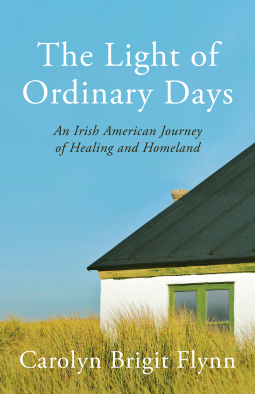
The Light of Ordinary Days
An Irish American Journey of Healing and Homeland
This title was previously available on NetGalley and is now archived.
Send NetGalley books directly to your Kindle or Kindle app
1
To read on a Kindle or Kindle app, please add kindle@netgalley.com as an approved email address to receive files in your Amazon account. Click here for step-by-step instructions.
2
Also find your Kindle email address within your Amazon account, and enter it here.
Pub Date Aug 11 2026 | Archive Date Aug 10 2026
Talking about this book? Use #TheLightofOrdinaryDays #NetGalley. More hashtag tips!
Description
A deeply moving memoir of healing and ancestral reconnection, weaving an intimate personal story with the epic history of Ireland.
In 2013, exactly a century after her grandparents emigrated from Ireland to America, Carolyn Brigit Flynn returned to her ancestral homeland in the wake of a family tragedy. Raised in a boisterous Irish Catholic family in 1970s Washington, DC, Flynn grew up amid traditional music, stories, and blarney—but also with silence about the poverty and hardship her grandparents left. Her charismatic father bore his own wounds and shunned her when she fell in love with another girl in high school.
In her thirties, Flynn realized she could not build an authentic life until she reckoned with the Irish ghosts she felt coursing through her blood. Her journey took her from the sacred stones of Newgrange to a windswept Irish island where she lived alone for a month. In the coming years, she braided her own experience of trauma and healing with the deeper thread of Ireland’s history of colonization, ancient spirituality, and profound resilience. At once intimate and expansive, Flynn’s memoir is both a personal love letter and a historical excavation. Ultimately, The Light of Ordinary Days invites readers to consider how we reassemble ourselves after tragedy—how we make a true home, across the sea or within the soul, by honoring the places and people who came before.
A Note From the Publisher
If you'd like to leave a review on Amazon, please use this link: https://a.co/d/01YmTyLd
ABOUT THE AUTHOR
Carolyn Brigit Flynn is a poet and essayist whose works include the poetry collection Communion, and three literary anthologies, most recently Sacred Stone, Sacred Water: Women Writers and Artists Encounter Ireland. Her poems and essays have appeared in many journals and anthologies nationwide, and she is currently publishing new essays and poetry in her Substack newsletter. Carolyn has taught writing groups and retreats in California and Ireland for more than twenty-five years. She lives in Santa Cruz, California, with her wife, the poet Jean Mahoney
Advance Praise
“In The Light of Ordinary Days, a European American writer discovers her own native ancestors across the sea and practices the ancient rituals of light, stone, and vision. These are the teachings and guidance we need. An exquisite rendering of ancestral reconnection—brave, honest, and transformational.” —Deena Metzger, award-winning author of La Vieja: A Journal of Fire and A Rain of Night Birds
“To read The Light of Ordinary Days is to immerse oneself in the holiness of the land and waters, the holiness that has the potential to heal what is broken in our families, our souls, and even in our world. There are books that must be written, books that save lives, and this is one of them.” ––James Janko, author of The Wire-Walker
“In this deeply moving love song to Ireland and the human heart, Carolyn Brigit Flynn brilliantly explores the legacy of her Irish ancestors and the true meaning of homeland.” —Laura Davis, author of The Burning Light of Two Stars and coauthor of The Courage to Heal
“Carolyn Brigit Flynn’s grasp of Ireland is superb. I have relations in New York and Georgia, and as a child, my encounters with them as they returned to Ireland were so similar to Carolyn’s accounts of her first visits to Ireland that, at times as I read, I was transported back to my youth and those brash, exotic American visitors. A beautiful book.” —Gerard Clarke, Irish ecologist and history guide
“Carolyn Brigit Flynn walks old paths and explores new stories, her writing as grounded as the stone walls she walks between. The Light of Ordinary Days will resonate with anyone who has ever looked across water and felt the tug of a land they’ve never known. This book reminds us that home isn’t just where we’re from, but where our spirit finds solace.” —Carina McNally, author of Mithim and Irish guide in the Beara Peninsula
“This is a graceful, beautiful journey through the life and land of a deeply caring woman. It took me in gently, then carried me through intimate stories, ancient green fields, old towns, and voices resonating off stone walls in an echo of eternity. It is a vital remembering, a connecting with the love at the center of our lives, and a truly exquisite read—one that invites and beckons my heart each step of the way.” —Stan Rushworth, author of We Are the Middle of Forever: Indigenous Voices from Turtle Island on the Changing Earth
“The Light of Ordinary Days shows how an Irish Catholic daughter, who is thrown out of the house and the family for being queer, finds her own people, both historically and in the present moment. Her deep dive into intimate personal experiences, rendered with breathtaking honesty, is given in the context of many larger Irish stories. She explores the suffering of the Great Hunger, the continuation of that trauma in our own time, and where and how both countries and individuals can find healing.” —Mary Dingee Fillmore, author of An Address in Amsterdam
“In Carolyn Brigit Flynn’s beautiful, spirited memoir, we find ourselves on a pilgrimage of the mind, heart, and soul of the author and her ancestral country, Ireland. Each chapter shimmers with deep reflections the way a river casts back our own reflections in the flow of our lives and history. Flynn’s sacred task is connection with self, family, ancestors, and this nurturing earth, Gaia. We truly find ourselves as we read and experience this profoundly courageous, honest, far-reaching journey that, in the end, brings us home to what matters.” —Regina O’Melveny, author of The Sea-Cure and A Good Broom
“Carolyn Brigit Flynn has written an Irish wool blanket to wrap around your shoulders while you travel with her on her journey to Ireland and to herself. Her sense of place and her elegant descriptive powers impel you to keep traveling as she weaves Irish history and culture with her own insights. This is a book you might need to read in one sitting.” —Sue Boothe-Forbes, director, Anam Cara Writer’s and Artist’s Retreat, Eyeries, Ireland
“Carolyn Brigit Flynn’s The Light of Ordinary Days treats ancestry as something active, not decorative. . . . The memoir moves through family history, Irish history, and Flynn’s attempt to understand what can still be restored after a life breaks open. . . . The prose is lyrical and often reverent. . . . For readers who like literary memoir with historical and emotional weight, this is a thoughtful and searching book.” —Manhattan Book Review
“Carolyn Brigit Flynn’s generous memoir The Light of Ordinary Days chronicles her travels and weighs ancestral tragedies to reinforce ideas about the Irish people’s resilience. . . . The memoir’s musing, sometimes poetic prose is elegiac, distinctive, and observant. . . . An affecting memoir.” —Foreword Clarion Review
“Flynn’s journey takes the form of a historical and spiritual pilgrimage . . . and herein lies the special quality of The Light of Ordinary Days. Its connection between healing, a sense of place, and new discoveries invite readers to walk alongside Flynn as she contemplates the nature of what is revealed and celebrated of the past and what can remain hidden. . . . readers seeking a blend of travelogue, memoir, family and country history, and Irish lore and spirituality will relish how deftly The Light of Ordinary Days weaves together all these facets to create an inviting, contemplative journey readers will want to take for themselves." —Midwest Book Review
Marketing Plan
- Targeted outreach to author’s community through author’s website and Substack
- Digital galley distribution on NetGalley
- Book review submissions
- Award submissions
- Post publication eBook discount campaign
- Targeted outreach to author’s community through author’s website and Substack
- Digital galley distribution on NetGalley
- Book review submissions
- Award submissions
- Post publication eBook discount campaign
Available Editions
| EDITION | Paperback |
| ISBN | 9781967510467 |
| PRICE | $21.95 (USD) |
| PAGES | 338 |
Links
Available on NetGalley
Available to Buy
Buy on BN.com Buy on Bookshop.orgAverage rating from 5 members
Featured Reviews
 Demetris P, Reviewer
The Metaphysics May Enter, but They Will Be Frisked at the Door
Sacred Wells, Supervised Symbols, and Hard-Won Ordinary Life in Carolyn Brigit Flynn’s “The Light of Ordinary Days”
By Demetris Papadimitropoulos | August 5th, 2026
During a kitchen renovation years after her sister Kathy’s suicide, Carolyn Brigit Flynn lingers over a tile and thinks that Kathy would have liked it. The suicide returns only a few beats later. That tiny delay is the most convincing measure of recovery in “The Light of Ordinary Days”: Kathy has briefly escaped the manner of her death and reappeared as a woman with taste, someone who noticed rooms, chose things, laughed, worked, irritated people, loved them. Flynn asks to be read as an Irish American pilgrim seeking ancestry and healing. Her finer achievement occurs away from the shrines. She restores to the dead, the estranged, and the difficult the daily dimensions catastrophe tries to confiscate. The title’s light is not epiphany but the return of preference: a tile, a meal, a hand one can finally take without rehearsal.
Even before Flynn lands in Ireland, three histories have crowded into the car: her grandparents’ 1914 departure from the rural west, her expulsion from an Irish Catholic household after falling in love with another girl, and Kathy’s death followed by Flynn’s psychological collapse. Her father, Bob, is the hinge among them. Magnetic, volatile, and theatrically Irish American, he turns devotion to Ireland into a travel business while treating his daughter’s sexuality as an offense on which he may pass sentence. In 2013, decades after leaving home, Flynn returns to Ireland with her wife, Jean. That journey opens onto an earlier one in 1996, when she traveled with her mother, traced the family line, visited Newgrange, and spent a month alone on Bere Island.
Memory, rather than itinerary, sets the real route. Bob enters first as a dazzling patriarch; only gradually do his rages, corporal punishment, queer condemnation, and Flynn’s recollections of sexual abuse darken the portrait. Flynn’s mother appears at first as overwhelmed and insufficiently protective, then as the woman who finds records, insists on family therapy, introduces Irish relatives, recommends Newgrange, and makes the ancestral journey possible. Jean arrives in the opening pages as the steady wife who survived Flynn’s breakdown, but later chapters show the therapy, fear, compromise, and unphotogenic repetition that built that steadiness. Information is delayed because judgment is delayed too. First impressions become evidence, then error, then partial truth. That sequence is the book’s ethic as well as its method: fuller knowledge complicates a verdict without automatically overturning it.
Each chapter title looks elemental and immovable – “Wake,” “Hunger,” “Home,” “Judge,” “Mother,” “Wife,” “Well,” “River” – yet the narrative keeps changing what the word can hold. A wake is communal ritual and suicide’s long aftershock. Home is the house that expelled Flynn, the ancestral country that receives her, and the domestic life she makes with Jean and her daughters. The judge is Bob, the Church, and the punitive voice that survives them both. A well can be psychic enclosure or sacred water; a river can carry loss without pretending to wash it clean. The book’s cleverest formal move hides in the chapter headings: it revises nouns. Later knowledge travels backward and alters the moral weather of scenes already read.
The scenes that convince most are rarely the most ceremonial. Flynn lies among wildflowers after hearing a radio discussion of suicide. A loom worker tells her that punishing repetition becomes bearable once the body finds its rhythm. Her mother waits inside Dulles Airport after the month on Bere Island. Jean grips the passenger seat on an Irish mountain road. On the island, Flynn introduces her simply as “my wife” and receives not a thunderclap of recognition but a handshake. Wool, wet grass, a car seat, a tile, a hand: none performs a miracle. They give feeling somewhere to land.
Rhythm is Flynn’s governing prose habit. A sentence begins in sensation, widens into memory, then settles into interpretation. The air is wet, the stone old, the river moving, the garden crowded with seeds. She gives Ireland texture before she gives it meaning, and she is especially alert to thresholds – airports, ferries, graves, passage tombs, doorways, bridges, harbors – and to the uneasy cargo of crossing them. After these gathering sentences, a blunt declaration often arrives as a point of impact. The cadence suits pilgrimage and mourning. The shorter sentences do not decorate the rhythm; they arrest it, like stones breaking the surface of a current. At its finest, the sentence seems to walk: observe, remember, pause, arrive. Its regularity can also make revelation feel scheduled.
Interpretation is both the prose’s hospitality and its recurring trespass. The loom is not allowed to remain a loom; it must become grief accommodated within life. Seeds arrive already briefed on renewal. Newgrange becomes womb and tomb, then birth canal, ancestral chamber, psychic passage. The repeated lexicon of healing, sacredness, spirit, light, land, ancestry, and belonging often carries genuine feeling, but the words wear smooth. Flynn seldom doubts that meaning exists. At times she doubts that the reader will find it without an escort.
Prayer, dream, blessing, Brigid: Flynn writes these words without the protective wink contemporary literary prose often supplies. That exposure is part of the book’s appeal. Readers willing to enter its spiritual grammar may find the memoir absorbing; those who prefer their metaphysics frisked at the door may see bodily recognition promoted too quickly into historical evidence. “Thin Places” by Kerri ní Dochartaigh also joins Irish land, inherited violence, and recovery, but its strangeness remains rougher and less resolved. Flynn is warmer, more declarative, and keener to bring the pattern home for dinner. Her sacred language is not décor. It records how she understands survival, even when the reader does not share the cosmology. Memoir need not notarize the soul, but it should keep felt truth and historical claim from impersonating one another.
Authority, more than ancestry, is the hidden subject. Bob defines Flynn’s love as sinful. The Church claims jurisdiction over sex, marriage, women, children, and the borders of belonging. The family decides which stories may be spoken. Later, Flynn treats dependence, medication, and collapse as proof that she has failed the role of the strong one. She survives through psychiatric care, therapy, friends who sit with her, and Jean, who does not demand improvement as the price of company. Witness replaces verdict, not as a slogan but as a series of people staying in the room. At the worst point of collapse, company matters more than explanation. The memoir’s care ethic is practical before it is philosophical.
Practical acts, not confession, revise Flynn’s mother. For years, Flynn understands her as the parent who did not protect her from Bob. The later chapters do not cancel that failure. They add the dissenting priest her mother chose, the family therapy she insisted upon, the records she gathered, the trip she took, the relatives she introduced. There is no grand apology. There is work. By the time her mother dies, she has become a guide through accumulation rather than declaration, which is both less satisfying and more believable.
A harsher enlargement occurs with Bob. When Flynn confronts him about the abuse she remembers, he acknowledges her suffering but accepts neither full responsibility nor the apology the scene seems to demand. Soon afterward, he dies. Flynn interprets his daily prayers for her as a limited form of restitution, and the adjective does ethical work. He remains charismatic, loving, culturally generative, frightening, abusive, and cowardly in accountability. The memoir does not improve his conduct after death. It revokes his office as judge.
Death first annexes Kathy’s story. Flynn recounts the attempt, emergency call, surgeries, removal of life support, and final note in detail that is emotionally understandable, though sometimes more explicit than the narrative needs. The harder work comes later, when Kathy returns as sister, wife, mother, worker, decorator, wit, companion, and difficult person. “Memorial Drive” by Natasha Trethewey performs a more compressed and formally severe recovery of a mother from violent death. Flynn’s method is roomier, but the ethical claim is related: the dead deserve biography, not merely a cause of death.
Ireland enlarges the memoir and strains it. Flynn places her collapse beside histories of colonization, famine, emigration, religious domination, and social reform. Those histories belong here. Famine, law, Church authority, migration, and queer shame enter households; they do not wait politely outside for the personal story to finish. The notes show serious reading, and the strongest historical passages change how a family habit, silence, or fear can be understood. They ask which injuries began before anyone now living had words for them. A grandmother’s thrift, a father’s patriotic theater, a family’s reluctance to name deprivation: history becomes persuasive when it alters the pressure inside such particulars. The family history matters most when it changes the grain of a present-day scene, not when it merely deepens the backdrop.
Metaphor, however, is not equivalence. A nervous breakdown is not colonization. Expulsion from a family is not famine. Flynn usually knows this. The architecture sometimes forgets. Ireland becomes country, ancestor, wounded body, spiritual mother, healer, and evidence that recovery is possible. That is a heroic workload for any island, even one accustomed to saints. The desire to connect can harden into a demand that every strand approve the braid.
In “The Long Field” by Pamela Petro, another queer American writer recognizes a Celtic country as an ancient home, but Petro’s Wales remains more linguistically and culturally resistant to possession. Flynn’s Ireland is most convincing when it resists her too: when relatives, guides, and friends disturb inherited stories; when Gerard Clarke argues that British rule cannot explain every Irish failure; when the country appears not as a shrine but as a place capable of complicity, argument, hospitality, and change. History earns its space when it brings friction. It flattens when the nation merely reflects Flynn’s recovery. That tension remains visible in Flynn and Jean’s bodies long after the law has changed. Public recognition arrives before public ease; the hand still hesitates before it is held. Homeland is most persuasive here not as an answer but as another presence capable of surprising, correcting, and receiving her.
The pacing obeys the same law: relationships move; surveys pause. The 2013 journey, the mother-daughter pilgrimage, Bere Island, and the chapters on Jean advance because each discovery changes how one person understands another. The accounts of famine, Church authority, queer law, archaeology, and national reform are often relevant and carefully sourced, yet sometimes stop the memoir to explain a world it has already made us feel. The book is not shapeless; it is overstocked. Its braid can resemble a beautifully labeled drawer in which nothing has been discarded because everything, by some route, is ancestral.
Readers will divide over Flynn’s appetite for integration. Some will hear repetition as incantation and reverence as moral openness. Others will find the symbols supervised and the healing vocabulary too total. The fault line is not simply belief. It is tolerance for resolution. Flynn’s chief virtue and vulnerable habit spring from the same conviction: no person should be reduced to the worst thing done by, or to, her. She proves this with people, whose contradictions she preserves. History receives less freedom; its contradictions are more often arranged into answer.
Ordinary life enters most convincingly through Jean. Flynn sometimes burdens her with symbolic employment – wife, gardener, witness, standing stone, home – and the reader may wish for more of Jean’s unborrowed interior life. Yet her presence keeps pricking the grandeur. She gets frightened in cars. She makes maps. She tends plants. She helps Flynn survive medication changes, terror, and the slow humiliations of dependence. When Flynn names her as wife on Bere Island, the word performs political, emotional, and formal labor at once. The ancestral land receives the queer family the childhood house rejected. No choir appears. Someone shakes Jean’s hand. Equality, at its best, can be wonderfully uneventful.
Pilgrimages usually promise arrival. Flynn’s ending gives up that luxury. At Saint Brigid’s Well, she offers thanks while admitting that no single miracle cured her. Beside the River Boyne, she understands that the self she was before the breakdown has not returned. What remains is a woman less invested in appearing invulnerable and more able to accept another person’s care. She can eat, drive, remember Kathy before remembering the suicide, and sit beside pain without improving it into silence. Healing here is not a return ticket. It is continued life without a counterfeit homecoming, an acceptance that altered capacity is still capacity and dependence need not be disgrace.
On the River Boyne, the book earns its final image and its rating: 81/100, or 4/5 stars. “The Light of Ordinary Days” is a searching, emotionally exact memoir whose portraits of damaged love are more convincing than its effort to make one woman’s recovery and Ireland’s reconstruction share a single design. Flynn discovers something smaller and more durable. Catastrophe loses its monopoly on meaning when daily life resumes speaking beside it. The river does not return her to the woman she was; it carries the dead, the living, the beloved, and the unatoned-for forward together, while on the bank another person stays.
Readers who liked this book also liked:

Edited by Atlas Obscura, Doug Baldinger, and Louise Story
History, Reference, Travel

Lin Visel; Joseph Bergin III
Comics, Graphic Novels, Manga, Humor & Satire, Politics & Current Affairs

T Clark
General Fiction (Adult), LGBTQIAP+, Multicultural Interest

Shiv Narayanan
Business, Leadership, Finance, Nonfiction (Adult), Professional & Technical
Adam Crawshaw
Business, Leadership, Finance, Nonfiction (Adult), Professional & Technical