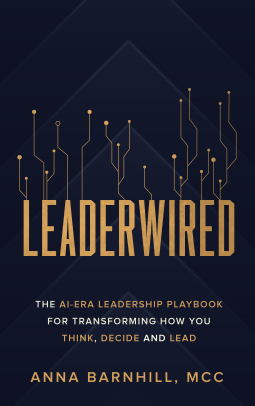
Leaderwired
The AI-Era Leadership Playbook to Transform How You Think, Decide and Lead
This title was previously available on NetGalley and is now archived.
Send NetGalley books directly to your Kindle or Kindle app
1
To read on a Kindle or Kindle app, please add kindle@netgalley.com as an approved email address to receive files in your Amazon account. Click here for step-by-step instructions.
2
Also find your Kindle email address within your Amazon account, and enter it here.
Pub Date Mar 4 2026 | Archive Date Aug 31 2026

Talking about this book? Use #Leaderwired #NetGalley. More hashtag tips!
Description
AI is the new fire. Some leaders will learn to use it. Others will fear getting burned, and quietly fade from relevance. This book is about which one you become.
With a foreword by Ronan Dunne, former CEO of Verizon Wireless.
Artificial intelligence doesn't replace leaders. It amplifies them, their clarity and their blind spots, their wisdom and their limitations. Amplification is unforgiving. Whatever you haven't addressed in how you think, decide, and lead, AI will expose.
While organizations race to adopt AI tools and digital strategies, the most critical upgrade keeps getting ignored: the human leader.
Every leader runs on an internal leadership operating system, the beliefs, patterns, leadership mindset, and decision-making defaults shaped by past success. This operating system built your reputation. It drove your performance. It feels like who you are.
But it was built for a slower, simpler world.
The certainty that once made you decisive is now a blind spot. The control that once ensured quality is now a bottleneck. The expertise that once gave you authority has been commoditized by AI.
This is why leaders who understand leadership theory and best practices still struggle with executive decision-making under pressure. The problem isn't motivation. It isn't knowledge. It's architecture.
In LeaderWired, Anna Barnhill, MCC, reveals what's actually creating the friction leaders can't explain, and introduces a neuroscience-based leadership methodology for upgrading the internal systems that drive strategic leadership, executive performance, and organizational decision-making.
Grounded in neuroscience and forged through more than sixteen years of executive coaching and leadership transformation, this book goes where most leadership development books stop, beneath skills and strategies, into the internal operating system that determines whether leadership actually works when complexity, speed, and uncertainty increase.
Through the proprietary Human Upgrade Code™, you'll learn how to:
• Diagnose the hidden patterns in your leadership operating system that undermine decision-making and performance
• Understand why insight alone doesn't create lasting leadership change, and what neuroscience shows actually does
• Rewire how you process complexity, make decisions under pressure, and lead in AI-accelerated environments
• Build the internal architecture that enables human-AI collaboration and turns AI into a true leadership amplifier
• Create the cultural and cognitive conditions where leadership transformation scales beyond you and into the organization
This isn't a book about AI tools. It isn't another collection of leadership principles you already know.
It's a leadership framework and diagnostic playbook for executives who are ready to transform how they think, decide, and lead, and who understand that the future of leadership depends on upgrading the human operating system behind it.
Every leader will face the AI era. AI-enabled executives will define it. LeaderWired is how you become one.
A Note From the Publisher
Advance Praise
From Foreword: "Anna has built something fundamentally different, a comprehensive, multi-layered system that moves from personal transformation to team culture to the unique challenge of leading through AI. She doesn't shy away from the hard truths about why we get stuck, nor does she sugarcoat the discomfort of change. This book is a companion to a complex and challenging leadership journey and Anna is the sherpa you want by your side." - Ronan Dunne, Former CEO, Verizon Wireless
“AI is transforming all industries at an unprecedented speed and complexity, leaving many executives unprepared to successfully navigate today’s volatile landscape. In Leaderwired, Anna Barnhill masterfully combines neuroscience and executive insight into a practical, actionable framework that cultivates agility, resilience, and a forward-thinking mindset. Executives who want to thrive amid disruption by improving their decision-making and value creation will find this book required reading”. - Ruth Jacks, Executive Vice President and Head of Client Growth Segments, Wells Fargo
“ If transformation was easy, then it would not need people to change to succeed. While you cannot predict the future, you can prepare for it. Forward looking leaders focus not just on survival, but on leveraging change for opportunity. That includes changing ourselves as leaders. If you want to learn about the "me" component of transformation, this is a book for you” - Claus Torp Jensen, former Chief Innovation Officer and EVP of R&D and Technology for Teladoc Health
“Leaderwired reframes leadership transformation by focusing not on new behaviors, but on the internal operating systems that shape how leaders think, decide, behave and act. Drawing on academic rigor, neuroscience-informed insight, and deep experience developing senior leaders, Anna Barnhill offers a clear framework for why so many transformation efforts fall short in the AI era. Her book challenges the reader with insightful questions and self-examination of our thinking systems. As someone who has long championed leadership development and its relationship to technology transformation, I see this book as a timely and substantive contribution to how we prepare leaders for the future of work”.- Jill Bruning, Chief Technology Officer, Amentum
Available Editions
| EDITION | Hardcover |
| ISBN | 9798994649329 |
| PRICE | $29.95 (USD) |
| PAGES | 232 |
Links
Available to Buy
Buy on BN.com Buy on Bookshop.orgAverage rating from 4 members
Featured Reviews
 Demetris P, Reviewer
When Your Strengths Start Betraying You: “LeaderWired” and the Quiet Panic of Leading in the AI Era
By Demetris Papadimitropoulos | February 28th, 2026
Anna Barnhill’s “LeaderWired” opens with an image that is both quaint and quietly ruthless: a screensaver. Not the sleek, ambient kind we now forget exists, but the older impulse behind it – the belief that an unchanging picture will burn itself into glass unless something keeps moving. Barnhill’s wager is that many accomplished leaders are running the executive equivalent of that obsolete protocol: once-useful patterns that have outlived the conditions that made them wise. They are still “moving,” still producing impressive activity, still working long hours and delivering credible results – and yet, in the AI era’s glare, they are also stalling, tightening, burning out, and, most damagingly, transmitting their own friction outward.
“LeaderWired” is not a book about prompts. It does not treat artificial intelligence as a Swiss Army knife for productivity or a glossy apocalypse. It treats AI as an accelerant and a mirror. The technology, Barnhill insists, is the easy part; the hard part is the human operating system it plugs into. AI amplifies capability, yes – and limitation. It can widen the aperture of insight and simultaneously magnify the leader’s blind spot until it becomes the organization’s defining scar. In that frame, the question is not whether you will “use AI,” but what kind of self and culture you will connect to the amplifier.
Barnhill writes from the center of a certain contemporary authority: the executive coach as architect. Her voice is crisp, diagnostic, and insistently human. She favors clean metaphors – operating systems, foundations, pillars, roofs – and she builds her argument the way she suggests leaders ought to build transformation: with structure, repetition, and a refusal to confuse intent with impact. If many leadership books are one insight stretched too thin, this one is a layered system that keeps returning to its own map, asking the reader to locate themselves honestly within it.
The book’s narrative spine is a handful of composite leaders whose names begin to feel like case-law: Jackie, a healthcare COO whose transformation work is externally noble and privately corrosive; Marcus, the overfunctioner who cannot stop “just quickly checking” what he has allegedly delegated; David, the technical VP who learns, in the cruel clarity of 360 feedback, that his questions are less curiosity than cross-examination; Sarah, whose analytical rigor curdles into paralysis; Alison, whose achievements are real but whose inner critic continues to police the perimeter of her own visibility. Barnhill’s great skill is to make these figures feel like types without making them feel like cartoons. They are not villains. They are, instead, the book’s central claim made flesh: you’re not broken; your system is outdated.
The promise of “LeaderWired” is an architecture called the 7-5-3 Human Upgrade Code™, a branded phrase that nonetheless conveys something practical: seven internal operating system components, five emergent skillsets, and three cultural foundations. The seven components are where the book does much of its best work, because Barnhill refuses the common leadership-development fantasy that knowledge alone changes behavior. Leadership lives where the pressure is. And under pressure, people revert not to what they know but to what they have rehearsed.
Belief architecture – the bedrock assumptions you experience as reality – sits at the foundation. Barnhill is particularly sharp on how beliefs are installed: early family programming, cultural conditioning, professional reinforcement, success that hardens into identity. It’s not hard to recognize the modern executive who carries, like ancient code, the conviction “I must have all the answers,” or “If I don’t do it, who will,” or “I can’t make mistakes,” or the most corrosive of the lot, “I don’t belong here.” In 2015, these beliefs could masquerade as competence. In 2025 and beyond, when AI produces “answers” at inhuman speed and confidence becomes cheap, they become traps. The upgrade Barnhill proposes is not a shift to weakness but a shift in value: from answers to questions, from control to orchestration, from expertise as identity to learning velocity as survival.
Mindsets follow, and Barnhill’s five upgrades are both familiar and newly pointed: certainty to curiosity, control to orchestration, expertise to learning velocity, risk avoidance to experimentation, individual decisions to collaborative intelligence. You can hear echoes of “Mindset” and the management gospel of psychological safety, and you can also sense the pressure of present headlines: companies lurching into AI pilots with a project plan but no cultural substrate, executives learning that “moving fast” is not the same as learning, organizations discovering that the fastest way to fail is to accelerate confusion. Barnhill’s argument is that the cognitive gap is now the constraint – leaders trained in certainty trying to operate in ambiguity, leaders rewarded for control trying to enable autonomy, leaders whose authority came from knowing trying to admit not knowing without collapsing.
The book becomes most compelling when it moves into the nervous system. Emotional processing, Barnhill argues, is the hidden capacity that determines whether any of the mindset upgrades stick. This is where her coaching voice is at its most persuasive. She describes the moment David reads his feedback and feels heat climb his face, jaw clamp, thoughts fragment into defenses – the amygdala hijack that arrives before narrative, before meaning, before choice. If this sounds like pop neuroscience, Barnhill treats it as practical physiology. She uses polyvagal theory’s language of social engagement, fight-or-flight, and shutdown to make a blunt point: your nervous system does not distinguish between physical threat and identity threat. If your sense of competence is challenged, your body will mobilize as if something is chasing you.
Her practices are simple, almost stubbornly so: extended exhales, cold water, movement; naming emotions with granular precision; perspective shifts that widen the aperture of time and interpretation. The book’s insistence here is not that leaders should become therapeutic, but that they cannot access curiosity, experimentation, or orchestration if their bodies keep dragging them back into threat response. In an era when layoffs are executed in spreadsheets, when “efficiency” is praised while humans absorb the grief, when many employees are asked to collaborate with systems that unsettle their sense of worth, emotional processing is not ornamental. It is containment. It is leadership metabolism.
Thought patterns arrive next – the cognitive habits that shape leadership reality. Barnhill’s catalogue is well-known to any reader of behavioral economics: confirmation bias, fundamental attribution error, catastrophizing, availability heuristics, sunk cost fallacy, negativity bias. What she does well is show how these distortions feel like rationality while they’re running. David’s mind assembling a legal brief against his team’s feedback; Marcus attributing others’ failures to character while excusing his own; Sarah projecting every risk into organizational collapse. Barnhill’s AI-era twist is astute: AI will happily become a confirmation machine, generating polished evidence for whatever conclusion you already want to hold. The question is whether you use it as a thinking partner against your defaults – for red-teaming, perspective-taking, challenge-seeking – or as a mirror that flatters your biases.
Behavioral defaults are where the book turns from diagnosis to friction. Barnhill is blunt: the knowing-doing gap is not a moral failing but a system mismatch. Knowledge lives in conscious mind. Defaults live in automatic processing. In stress, automatic wins. She identifies five common leadership defaults: control, expert, accommodation, harmony, urgency. This taxonomy will feel familiar to anyone who has lived under a micromanager, a genius who cannot stop being the smartest person in the room, a “nice” leader who cannot say no, a conflict-avoider who lets problems fester, or a speed addict who confuses motion with direction. Barnhill’s contribution is to make these defaults legible as code: reinforced by rewards, encoded under stress, integrated into identity, triggered by specific contexts. The upgrade is not purity; it is choice. Alternative behavior has to be installed, practiced under progressive challenge, supported by environment, and reinforced by stakeholders. This is where the book’s practicality shines – the small scripts, the deliberate friction, the insistence that transformation is repetition.
Values alignment is the book’s moral hinge. Once you can choose behavior, what guides that choice? Barnhill’s language is memorable: goals are places you arrive; values are how you travel. Values are not feelings. They are not imposed. They are directions. The question becomes whether you’re climbing a mountain you want to summit. Jackie’s “hollow achievement” – success that feels empty – is presented as a values misalignment problem, not merely a workload problem. Barnhill’s Alignment Assessment is sharply utilitarian: calendar audit, decision review, impact inquiry. The gaps between espoused values and operating values aren’t hypocrisy; they’re override points, places where something in the OS is stronger than intention. In the AI era, these gaps become more acute because trade-offs become more frequent: efficiency versus humanity, speed versus wisdom, scale versus connection, innovation versus stability. Barnhill doesn’t pretend those tensions disappear. She argues that values make them negotiable rather than unconscious.
Communication protocols, the final component, are presented as the interface layer where leadership actually happens. Here the book’s realism is bracing: you do not get credit for your intent. You get the results of your impact. Barnhill’s point is not that leaders should become cautious, but that meaning is constructed, not transmitted. Context, history, emotional state, and power dynamics all shape what lands. David’s failed “developmental conversation” – delivered with the right words and the wrong impact – is a useful parable for our age of managerial scripts. Barnhill’s CLEAR PACE™ framework (context, listen first, empathize, articulate, request response; presence, authenticity, calibration, emotional awareness) is one of the book’s most usable offerings, and it pairs well with classics like “Crucial Conversations” while maintaining Barnhill’s emphasis on repair: “This isn’t landing the way I intended. Can we reset?” In a world where AI increasingly mediates communication, the interface becomes more fragile. Human presence becomes the differentiator.
If Part Two is the inner architecture, Part Three is the emergence. Barnhill’s five skillsets – cognitive flexibility, emotional intelligence at scale, human–AI collaboration design, strategic sensemaking, exponential thinking – are described as capabilities that arise when the OS integrates. This is a clever move. It prevents the book from becoming another list of skills you can supposedly “learn” in a weekend. Cognitive flexibility emerges when beliefs become examinable and curiosity replaces certainty. Emotional intelligence at scale arises when regulation and communication combine to create safety and read group dynamics. Human–AI collaboration design becomes possible when leaders think in decision systems and can experiment behaviorally. Strategic sensemaking is the orchestra: the ability to find clarity in ambiguity by holding signal and noise without forcing premature closure. Exponential thinking counters linear intuition and urges leaders to invest in capability before it is obviously necessary. Barnhill’s claim that these skillsets multiply rather than add is one of the book’s most persuasive system insights.
Part Four widens from leader to culture. Here Barnhill’s House of Empathy™ is less softness than scaffolding. The premise is counterintuitive in a tech-obsessed moment: as AI takes over routine work, what remains is human – trust, belonging, meaning, connection – and therefore culture becomes the moat. The foundation is Curiosity, Care, Courage. The pillars – trust, understanding each other’s worlds, recognition, engagement, positive perspective, constructive conflict, emotional intelligence, authentic leadership, psychological safety – will remind readers of “The Culture Code”, Amy Edmondson’s work, and the broader post-pandemic rediscovery that culture is not perks but permission structures. Barnhill’s point is that AI implementation without psychological safety becomes a technical initiative imposed on a resistant culture. With it, AI becomes a collective capability.
Chapter Thirteen, the five AI leadership shifts, is the book’s overtly contemporary payload. Tool to collaborator. Threat to amplifier. Expertise to fluency. Implementation to integration. Efficiency to capability. None of these are radical in isolation. Together they form a useful correction to the corporate habit of treating AI as a project. Barnhill’s sharpest warning returns: AI does not fix broken culture; it exposes it. It does not clarify strategy; it accelerates confusion. It does not compensate for poor leadership; it magnifies its impact. The best leaders will treat AI not as a bolt-on tool but as a collaborator in systems that preserve human judgment, ethics, and meaning.
The final chapter and closing reflection are where Barnhill makes her most honest concession: change initiated is not change sustained. Old patterns wait for stress. Environments pull you back. Attention drifts. She offers a weekly five-question audit – what am I fighting, did I live my values, what stories is my mind telling, where is my attention going, what will I do next week even if I don’t feel like it – and a “discomfort ratio” that argues for calibrated stretch, not heroic suffering. It is here, too, that the book’s coaching ecosystem becomes explicit: assessment, collective, coaching, stakeholder-centered accountability. Some readers will bristle at the proprietary framing. Others will see it as consistent with the thesis: transformation requires designed support systems, not willpower.
“LeaderWired” earns its authority less through footnote density than through coherence. Its frames are not new individually – you can trace lineages through Daniel Goleman, Carol Dweck, Amy Edmondson, and the long tradition of systems-oriented leadership thinking – but Barnhill integrates them into a pragmatic architecture tuned to the present moment’s accelerants. The book is strongest where it treats leadership not as charisma but as physiology, cognition, and environment design. Its limitations are those of its genre: a preference for branded frameworks over deeper empirical wrestling, a confident universality that sometimes underplays how structural incentives can punish precisely the curiosity and courage the book prescribes. Not every leader has the power to rebuild the house, or the time to do the work slowly, or the organizational air cover to trade speed for wisdom. Barnhill acknowledges these tensions, but she ultimately writes from the belief that leaders can choose differently and build differently.
Still, the book’s best pages land as more than advice. They land as a mirror held at an uncomfortably accurate angle. The ultimate claim is simple: in an era of amplification, your inner architecture becomes your outer fate. AI will not determine your leadership legacy. Your operating system will. For an executive reader caught between the seductions of efficiency and the demands of humanity, “LeaderWired” offers something rarer than a new tool: a way to see what’s been running you, and a method – imperfect, but sturdy – for choosing what runs next. I’d place it at 86/100.
Readers who liked this book also liked:

Stuart Slavin, MD, MEd
Health, Mind & Body, Parenting, Families, Relationships, Teens & YA

Shiv Narayanan
Business, Leadership, Finance, Nonfiction (Adult), Professional & Technical




Lin Visel; Joseph Bergin III
Comics, Graphic Novels, Manga, Humor & Satire, Politics & Current Affairs

T Clark
General Fiction (Adult), LGBTQIAP+, Multicultural Interest
Adam Crawshaw
Business, Leadership, Finance, Nonfiction (Adult), Professional & Technical