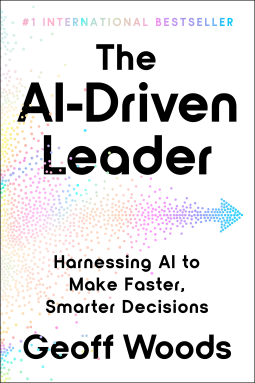
The AI-Driven Leader
Harnessing AI to Make Faster, Smarter Decisions
This title was previously available on NetGalley and is now archived.
Send NetGalley books directly to your Kindle or Kindle app
1
To read on a Kindle or Kindle app, please add kindle@netgalley.com as an approved email address to receive files in your Amazon account. Click here for step-by-step instructions.
2
Also find your Kindle email address within your Amazon account, and enter it here.
Pub Date Jul 7 2026 | Archive Date Jul 11 2026

Talking about this book? Use #TheAIDrivenLeader #NetGalley. More hashtag tips!
Description
The difference between growing your business and going out of business is your ability to think strategically.
The problem is, most leaders are stuck in the operational weeds, struggling to find the time to make better strategic decisions. This challenge is only heightened by the rise of AI. While you know AI is the future, current demands leave you with no time to explore its benefits. Meanwhile, your competition is gaining an edge by integrating AI. The time to act is now.
In The AI-Driven Leader, you’ll learn how to:
- Escape operational overwhelm and lead with strategic clarity (Chapter 3)
- Collapse the time it takes to turn data into decisions (Chapter 7)
- Transform your decision-making with AI for strategic advantage (Chapter 9)
- 10x the impact of every employee (Chapter 12)
- Apply real-world examples and prompts to get immediate results (every chapter)
Your company can adopt AI now and see immediate returns. The AI-Driven Leader provides clear guidance on where to begin, helping you achieve rapid results. With this book, you'll learn how to harness AI as your strategic Thought Partner, enabling you to grow your business, outpace the competition, and get more done in less time.
Praise for The AI-Driven Leader
“With Geoff’s guidance, our market cap soared from $750 million to $12 billion.”
- Naveen Jindal, Chairman Jindal Steel & Power
“The guidance in this book helped us grow our revenue 600%."
- Jason Bronstad, CEO of Malk Organics
"A must read for any Executive. We collapsed hundreds of hours of work into minutes."
- Grady Davis, Former Vice President of Medtronic
"This book simplifies AI and delivers immediate value. It is an essential read for every leader and their teams."
- Robin Ross, Assistant Vice President of Costco
"Geoff's insights are deeply strategic, guiding leaders to use AI as a tool to achieve business goals without making AI the goal itself."
- Chris Winton, Former Chief People Officer of FedEx & Tesla
Available Editions
| EDITION | Hardcover |
| ISBN | 9798893313109 |
| PRICE | $30.00 (USD) |
| PAGES | 304 |
Available on NetGalley
Available to Buy
Buy on Amazon Buy on BN.com Buy on Bookshop.orgAverage rating from 5 members
Featured Reviews
 Demetris P, Reviewer
Leadership at the Speed of the Next Question
In “The AI-Driven Leader,” Geoff Woods offers a practical, sometimes over-polished, often persuasive guide to thinking with AI without surrendering judgment to it.
By Demetris Papadimitropoulos | June 6th, 2026
Don’t mistake “The AI-Driven Leader” for a book about software, narrowly considered. Geoff Woods has written a sharper instrument than its shelf might imply: part operating manual, part leadership sermon with a consulting badge, part strategy session with the whiteboard still warm. Its subject is AI, but its deeper pressure falls on the chain of attention, permission, and accountability inside a company – who thinks, who scrambles, who asks, who waits, who owns the call when the prompt has finished purring.
Every business book has a fantasy reader, and Woods’s is easy to recognize. This reader is calendar-pinned, underaligned, pursued from meeting to meeting by unread decks like small accusing ghosts. He suspects that some competitor, somewhere, is already using AI for more than polishing emails. Woods does not address this person as a technologist. He addresses him as a leader whose habits now move at dial-up speed in a broadband room.
Much of the book’s voltage arrives in its origin scene. A manufacturing CEO says his company may go bankrupt because a Japanese public company will not restructure its debt; the setting is a YPO forum in Austin, but the mood is closer to a locked ward of executive panic. Woods opens ChatGPT, uses his CRIT™ framework – Context, Role, Interview, Task – and lets AI interview the CEO before suggesting non-obvious strategies. The revelation is not that AI produces a silver-bullet answer. It asks about influential relationships in Japan and helps generate a face-saving debt strategy. A man who says he has not slept in ninety days leaves with hope. From that scene, Woods gives the book its first law: AI earns its keep when it asks the question that reopens a problem everyone had decided was closed.
Elsewhere, the book makes a three-stage migration from self to system. Part 1 moves the leader from operational overwhelm to strategic clarity. Part 2 turns to individual practice: prompts, decisions, analysis, and the habit of testing what a leader thinks he already knows. Part 3 tries to scale that habit into an organization through alignment sessions, first-30-days execution, employee leverage, change management, and repeated prompts that turn strategy into calendar behavior. The conclusion then tightens the question: when the task list starts changing, what remains of the person who used to mistake the task list for the self?
The central instruction could fit on the sticky note Woods nearly hands you. Stop asking only, “How can I do this?” Start asking, “How can AI help me do this?” As a slogan, it risks sounding like laminated-office wisdom; as a discipline, it is sturdier. Woods is trying to change what a leader does in the pause after “I don’t know.” The old sequence is often drift, delay, meeting, meeting about the meeting, deck. Woods’s sequence is cleaner: make AI ask the next useful question.
Rather than lingering over AI’s mysteries, Woods teaches a protocol. His most durable device is CRIT™, and the “Interview” step is the hinge on which the method swings: it stops the leader from treating AI as a vending machine for first drafts and asks the system to pull context into the light. The Interviewer, Communicator, and Challenger personas extend the same lesson. Do not ask the machine merely to answer. Ask it to press. That is where “The AI-Driven Leader” becomes more interesting than a prompt pantry.
In that sense, Woods sits near “The ONE Thing” by Gary Keller and Jay Papasan and “Co-Intelligence” by Ethan Mollick, though his attention keeps returning to the rooms where executives actually lose time: board prep, stakeholder alignment, one-on-ones, quarterly reviews, strategic planning. Like Keller and Papasan, he is absorbed by the disproportionate value of the most important work. Like Mollick, he sees AI as collaborator rather than gadget. But Woods is less fascinated by the technology’s oddness than by its use. He is not asking the machine to be wondrous. He is asking it to help you stop attending the wrong meeting.
Perhaps inevitably, the prose has the strengths and irritations of a good executive off-site: efficient, branded, over-rehearsed in places, and determined to send everyone home with next steps. The sentences are short to medium-length, clean, directive, and brisk. Woods likes rhetorical questions, imperatives, and portable oppositions: driver’s seat or passenger seat, strategy first or technology second, 20% priorities or 80% tasks. The diction is managerial, plain, and practical: harness, align, execute, collapse, drive, deliver, supercharge. These are not words one visits for melody, but they do work. The prose does not shimmer; it ushers.
A certain charm comes from the way Woods gives handles to managerial fog. The “driver’s seat” metaphor is plain but effective. The leader as “composer” and “conductor” of teams and technology is not thrilling, but it carries weight. The “AI Empowerment Curve” turns discomfort into a training path: starting point, lightbulb moment, reality check, momentum, acceleration, expansion. Woods is good at staging those little ignitions, the moment AI stops being an abstract threat and becomes the thing that asks the question no one in the room quite had. He is less inclined to stay with the smoke.
Part of the momentum comes from a chapter design that is almost metronomic. A story opens the door. A principle enters. A framework arranges the chairs. A prompt invites the reader to try it. A “20% from this chapter” recap tidies the room. The architecture is not begging for applause; it is setting up folding chairs and getting to work. Woods knows his reader may be reading between flights, board calls, and the psychic lint of Slack. The structure discovers little in real time; it is built to make behavior repeatable.
As a result, the appendix is not extra furniture. It is the workshop floor. The prompts for strategic planning, stakeholder mapping, board simulation, performance reviews, calendar alignment, one-on-ones, and role prioritization show the book becoming what it has argued for. Here the book stops arguing and starts assigning. The reader is handed a set of questions and told, more or less, to stop admiring the hammer and hang the shelf.
Do notice, though, what the book is smuggling under its hood. AI is the ostensible subject; permission to think and the obligation to arrive with options are the hidden ones. Woods wants leaders to stop being answer machines and employees to stop being task receivers. His idea of “thinking leverage” is one of the sharper contributions here: if knowledge work is changing, then the standard for a strong employee is no longer only completion but judgment, prioritization, and the ability to bring three possible solutions before knocking on the door. AI is the lever, but the workplace question is older: who is expected to bring thought rather than obedience?
In Marianella’s story, that question finds its clearest human-scale proof. Woods asks his assistant to use AI to imagine how she might bring ten to one hundred times more value to the company. She returns with a redesigned role: the work she should double down on, the work she should stop doing, the tasks AI could augment or automate, and a prompt designed to make Woods himself more effective. The scene matters because she does not simply move faster through the same job. She rewrites the job, then rewrites the terms by which her boss spends his own time. The assistant is no longer just efficient. She is dangerous to old assumptions in exactly the way Woods wants.
More troubling is the book’s romance with compression. Woods is fond of collapse: months into hours, weeks into minutes, hundreds of hours into minutes. Sometimes the excitement is warranted. A sixty-six-page board deck can be interrogated faster. A first draft can appear quickly. A stakeholder simulation can sharpen a conversation before anyone enters the room. But compression can begin judgment; it cannot replace it. A faster answer may be a better starting line. It is not automatically a better finish.
In fairness, Woods repeatedly says as much. His insistence that the human remains the “Thought Leader” is not ornamental. He warns about hallucinations, bias, privacy, job displacement, machine relationships, regulatory risk, and the danger of outsourcing judgment. He tells readers to verify, ask for sources, and remain responsible for the final call. The problem is not that Woods ignores the risks; it is that he files them too quickly. He knows the meeting-room version of resistance – worry, delay, polite nodding, vague agreement. He is less patient with the possibility that resistance may sometimes be wisdom in an inconvenient coat.
This is the dividing line in “The AI-Driven Leader.” For an executive who has been waiting for an accessible way to begin, the book may feel clarifying, even liberating. For a reader more concerned with governance, labor anxiety, surveillance, model error, institutional politics, or the subtler forms of managerial pressure, it may feel too smooth. Woods’s confidence is energizing, but it can sand down the grain of the problems he names. His faith is sincere: strong leaders, acting with empathy and standards, can keep AI adoption humane. He spends less time asking what happens when strong leaders disagree about what “humane” requires.
Readers can feel the showroom door opening whenever the book points beyond itself. The pages frequently point to AI Leadership, AiLeadership.com, the AI Thought Partner™, and Woods’s advisory work. This gives the examples texture and explains the operating model behind the advice. It also keeps the hinge oiled for a sales conversation. Business books often do this; the genre has never been a monastery. Still, the effect matters. The strongest pages feel like counsel earned in rooms where the numbers are ugly and the calendar has no mercy. The weaker pages feel like the elegant antechamber to a sales conversation.
One of Woods’s sharpest moves is making AI adoption feel less like tool experimentation and more like leadership discipline. Many leaders do not need another breathless catalog of platforms. They need a way to use AI without letting the machine launder responsibility. Woods gives them one. CRIT™, the Challenger persona, stakeholder simulations, quarterly review prompts, calendar-priority questions, and one-on-one prompts all have the virtue of being usable by noon. One does not leave the book haloed with insight; one leaves with assignments.
Perhaps the book would be stronger if the famous examples did less of the lifting. Microsoft, Nokia, Domino’s, Steve Jobs and the iPhone, and Amundsen and Scott are all legible, but many feel drawn from the familiar executive parable shelf, polished smooth by prior use. The fresher material comes from Woods’s direct advisory experience: the anxious CEO, the activist board, the Herbalife alignment exercise, the Jindal deck, Marianella’s role redesign. Those moments have fingerprints on them. More rooms like that and fewer polished legends would have made the book less universal in the usual way and more convincing in the particular way.
One cost is hard to avoid: repetition. “Thought Leader,” “Thought Partner,” “driver’s seat,” “lightbulb moment,” “20%,” “strategy first; technology second” – these phrases lodge because Woods installs them carefully. As training, repetition is muscle memory; as reading, it can become calisthenics. By the final third, the book sometimes feels like a set of strong cards being reshuffled. The ideas remain good; the pleasure of discovery thins.
Useful in the way Woods most prizes, “The AI-Driven Leader” sits firmly in four-star territory: 81/100, which corresponds to a Goodreads-compatible 4/5 stars. It is too sharp in its method to be dismissed as AI enthusiasm in a blazer. It is also too repetitive, sales-adjacent, and brisk with the harder questions to belong in the highest tier of business writing. It is better as a manual than as a meditation, better as a starting discipline than as a finished philosophy.
Let the reader accept its invitation, then, but keep one hand near the brake. Use AI to ask the sharper question. Let it challenge the plan, simulate the skeptical customer, expose the trade-off in the calendar, and help the employee treated like a task bin discover the strategic part of the job. But do not let the elegance of the prompt become a costume for responsibility. Woods’s best insight is that AI should not take the wheel. It should sit beside you, asking why you are driving this way.
One image from the book keeps returning: the leader in the driver’s seat. The road is faster now, the dashboard brighter, the passenger strangely articulate. The mistake would be to climb into the trunk or hand over the keys. The better possibility is more demanding and more humane: stay awake, keep your hands on the wheel, and let the machine ask why you took this road in the first place.
Still, the feeling it leaves should be less suspicion than disciplined permission. Woods’s book is not the last word on AI-era leadership, and it is not trying to be the most searching one. It is a capable, sometimes over-polished companion for the leader who knows the old meeting rhythm is failing and wants a way to begin without pretending the machine can absolve him. The cleanest praise is the one Woods would probably prefer: practical. This book will not drive for you, but it may keep you from staring at the map while the road changes under the wheels.
 Melanie G, Reviewer
With so much discussion around AI right now, I was curious to see how The AI-Driven Leader would approach the topic. What I appreciated is that the book focuses less on the technology itself and more on how leaders can use AI as a tool for better decision-making. The author spends time exploring practical applications and encourages readers to think about where AI can support their work rather than replace human judgment.
Readers who liked this book also liked:

Gaëlle Nohant
General Fiction (Adult), Historical Fiction, Religion & Spirituality





Publishers Lunch
General Fiction (Adult), Nonfiction (Adult), Teens & YA