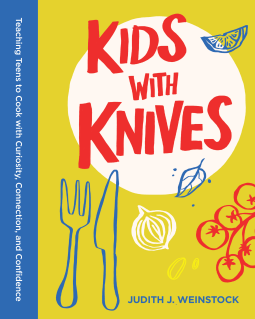
Kids with Knives
Teaching Teens to Cook with Curiosity, Connection, and Confidence
Sign In or Register Now to see if this title is available for request.
Buy on BN.com Buy on Bookshop.orgSend NetGalley books directly to your Kindle or Kindle app
1
To read on a Kindle or Kindle app, please add kindle@netgalley.com as an approved email address to receive files in your Amazon account. Click here for step-by-step instructions.
2
Also find your Kindle email address within your Amazon account, and enter it here.
Pub Date Nov 10 2026 | Archive Date Nov 6 2026
Girl Friday Productions | GFB
Talking about this book? Use #KidswithKnives #NetGalley. More hashtag tips!
Description
Give your teen the gift of confidence in the kitchen.
Do you want to teach your teenager to cook but don't quite know where to start? Kids with Knives is a cookbook for parents and instructors looking to teach young people—not just to follow a recipe, but to discover together where food comes from, why it matters, and how cooking connects us to each other and to the world.
Kids with Knives makes cooking together fun—joyful, surprising, messy, and inspiring. With inviting recipes and rich educational content, chef Judith J. Weinstock’s passion for food and depth of experience comes through on every page. You’ll discover:
- more than one hundred well-tested, teen-approved recipes, including artisan breads, muffins, one-pot meals, soups, salads, sauces, and classic desserts;
- basics on safety and setting up your kitchen to help you get started;
- “teaching tips” with specific guidance on ingredients, tools, and techniques;
- “At the Table” discussion questions to spark meaningful conversations with teens about their food and how it’s made;
- “Intermezzo” sidebars that dive deeper into global food history and culture; and
- “Try This” exercises for hands-on learning to reinforce new skills.
Kids with Knives is a cookbook with real heart, designed to bring parents and teens together—not only to make a meal, but to make a lasting connection.
A Note From the Publisher
https://www.goodreads.com/book/show/256709445-kids-with-knives?from_search=true&from_srp=true&qid=6SzuhoDMTT&rank=1
Judith J. Weinstock is a chef with decades of experience in restaurants and catering. For the past twenty years, she’s taught an integrated culinary arts program for high schoolers, combining history, economics, agriculture/culture, food politics, chemistry, and nutrition with cooking. Weinstock is the author of Kingston Hotel Cafe Cookbook (Sasquatch Books) and coauthor of The Streamliner Diner Cookbook (Ten Speed Press). She lives in Indianola, Washington.
Advance Praise
“Kids with Knives is an inspiring cookbook that pairs useful kitchen knowledge with a call to foster community building at one’s table.” —Foreword Clarion Review
"The instruction reads like standing next to her at a cutting board. . . . a five-star teaching manual." —Seattle Book Review
“In Kids with Knives, Weinstock takes us into her kitchen, where for decades she has nurtured young people, teaching teens about the joys and rewards of cooking. With dozens of irresistible recipes, concise and appealing lessons about the history of culture and food, and engaging questions about how we understand and relate to what we eat, Weinstock offers an essential guide. Kids with Knives whets your appetite for bringing cooking and food to the heart of community and togetherness.” —John Pierce, editor and copublisher, Empty Bowl Press
“A truly extraordinary book celebrating the author’s love of cooking. A deep dive into the historic origin of the world’s varied foods. Appealing recipes for the world’s most distinctive delicious cuisines. And an exposure of the corruption of the food system by global corporate monopolies. You want it? Judith Weinstock covers it in fascinating, historically accurate detail.” —David C. Korten, author of When Corporations Rule the World and The Great Turning: From Empire to Earth Community
Marketing Plan
- NetGalley campaign
- Targeted NetGalley eblast
- A+ content
- Edelweiss listing
- Editorial reviews
- Ebook discount promotion
- Book award submission
- NetGalley campaign
- Targeted NetGalley eblast
- A+ content
- Edelweiss listing
- Editorial reviews
- Ebook discount promotion
- Book award submission
Available Editions
| EDITION | Paperback |
| ISBN | 9781967510825 |
| PRICE | $21.95 (USD) |
| PAGES | 198 |
Available on NetGalley
Available to Buy
Buy on BN.com Buy on Bookshop.orgBISAC Codes
Average rating from 14 members
Featured Reviews
 Marcia S, Reviewer
"Kids with Knives" is a celebration of food - from historical origins and cultural significance to kitchen chemistry that introduces simple, delicious global cuisine to teen chefs. The recipes provide a solid background in baking and in preparing soups, salads and one dish meals that will carry young cooks off to college and beyond. "At the Table" sections include questions that spark conversation and awareness about our dependence on food. The author honors humanity and builds community one recipe at a time!
 Shelley W, Reviewer
Kids with Knives by Judith Weinstock is designed for people who love and work with teens including teachers, parents, and grandparents. By using the educational tools and questions included along with all the fascinating fun facts – this book will appeal not only to teens – but to everyone! Kids with Knives fits into a “food first” philosophy that uses wonderful recipes to make healthy food and cooking an enjoyable experience with potentially long-term positive health outcomes. As a nutritionist, I will recommend this to my young clients who need to understand the powerful consequences of the food they eat.
The layout of the book is easy to follow and is different than other cookbooks. The organization into basics – such as breads, muffins, one-pot meals, etc, -lets us know that thinking in these terms leads us to good foods, healthy eating choices, and recipes that can be simple and delicious or made more complex for the sophisticated pallet. Examples are the bread or muffin recipes – from the simple to the more flavorful ingredients – teaches us to use some creativity to expand possibilities. The one pot meals and soups show us healthy and tasty ways to get ingredients that together create super nutritious meals. And what a wonderful way to help notoriously poor teen age eaters enjoy salads and different dressings and sauces to broaden their taste buds. And the pesto chapter is filled with new ideas for so many who have always thought of pesto as only basil based.
Weinstock embraces our need for sweets in our lives and addresses desserts from a healthy perspective. Homemade foods are always healthier than restaurant or packaged/processed foods – and dessert is no exception This book gave me new insight into the creativity of cooking. What a gift for teens and those who interact with them to expand their understanding, skills, and enjoyment of food while protecting the earth and themselves through best choices.
 Librarian 735259
This seems like a great book but was not exactly what I was expecting. It is much more academic in nature, and the "kids" in question are more likely to be older teens. I read a great deal of the book before it got to anything resembling what I had been expecting. Don't get me wrong, it is well-researched and interesting, but I think anyone who is looking for ideas of what to cook with kids who are new in the kitchen will be confused or disappointed by this title. I think the description did not make it super clear what was in the book.
Educator 1083804
Excellent read and filed with many straightforward and fun sounding recipes. This would be a great addition to any home and I plan to add to my classroom library!
Elia R, Reviewer
This book has a strong educational focus and teaches many cooking skills. What surprised me the most was that it does not include many photos or illustrations. It is a very informative book with a more serious approach.
It is aimed at teenagers who already have some independence and want to feel more confident in the kitchen. It also explains where food comes from and helps readers become more familiar with cooking.
The contents are well organised and move from simpler topics to more complex ones. I liked that the book gives some advice before you start, such as keeping your work area clean, asking about food allergies or dietary restrictions if you are cooking with friends, and preparing a container for food waste.
I think this book is interesting because it sees teenagers as people who can cook on their own, not just as someone helping an adult in the kitchen. Not every recipe is easy, though. Many of them are more difficult than I expected.
Zachary F, Media/Journalist
Kids with Knives is the book I wish I had in my kitchen growing up.
Each section of the book is carefully crafted with one-page recipes, concise histories, and honest and engaging questions to create conversation around the table. What comes through most in these recipes -- for things like bagels, pesto and zucchini-almond cake -- is not that skill or knowledge are required to cook, but that curiosity and care around ingredients, techniques, and history are truly what make the act of cooking together special.
Weinstock fills an important gap in the literature of cookbooks, priotitizing wonder and curiosity in the same way that others focus on tablespoons and temperatures. Kids with Knives has the power to create special memories in the minds of cooks young and old.
Jill S, Reviewer
I found Kids with Knives to be eminently readable with enticing recipes and interesting information about the historical and global connections of where our food comes from and most importantly why we should care. It is an entertaining mix of recipes, food preparation, historical aspects of how plants and spices affected the process of colonization and the wonder of the natural world. The book invites the reader to share meaningful and enjoyable time in the kitchen with a teenager to create, play and enjoy making tasty food together. I particularly enjoyed the interspersed "fun facts" in the various sections and the humorous food quotes scattered throughout. I plan to use it for sharing special time with my grandchildren.
Reviewer 2129385
⭐⭐⭐⭐ 4/5
📱 Format: eBook ARC
Kids with Knives feels like a grown-up cookbook made for young cooks, and I’m a fan!
One thing I think parents should know going in: I wouldn’t consider this a beginner cookbook. This feels better suited to a child who has already spent some time in the kitchen helping with prep and has a basic understanding of cooking. For my daughter, I know she’d be able to follow along, but she’s had that previous kitchen experience.
The book does start with the basics, beginning with things like bread, but it evolves pretty quickly from there. The recipes aren’t presented with step-by-step photos, and while I would have loved to see more photos of the finished dishes, I don’t think that takes away from what the book does well. How much parental guidance is needed will really depend on the child’s age and experience in the kitchen.
I especially loved the variety of recipes. There’s a nice combination of familiar favorites alongside recipes and flavors from other countries, which we love! The book also incorporates education beyond the recipes, including information about spices and where they come from, kitchen basics, and even making clean-up part of the process.
And we put it to the test! My daughter and I made the blueberry muffins, and we loved them. 🫐 She’s already excited to make more and has picked the pho to try next! 🍜
Final Verdict: This isn’t necessarily a first cookbook for a child who’s never been involved in cooking, but for a young cook who already understands some kitchen basics and is ready to do more, I think it’s a great next step. It offers real recipes, introduces different foods and cultures, and encourages kids to continue building their kitchen skills. I’m a fan! 4 stars.
Thank you to NetGalley and Girl Friday Productions for providing this eBook ARC in exchange for my honest review.
 Caitlin W, Reviewer
When I was going through this cookbook, at first I was a bit confused as to how a teen could easily navigate this book. However when I read the synopsis again I realized that this is a book for adults who are teaching teens to cook and about food. Then it made more sense from that lense.
If you want to teach more about the background of cooking and food, this would be a good book to use. I would not say that this is a beginner’s cookbook though. I did like that there are lots of fun facts about food and cooking that I enjoyed reading and quite a few things I didn’t know myself.
There are a lot of really good baking recipes, some tried and true favorites and also some new flavors I haven’t tried before. I also appreciated the notes on making a recipe gluten free. I would say that the non-baking related recipes are not super basic and might not have immediate appeal to a teen who doesn’t have a wide palate
My biggest issue is the lack of photos. The ARC I received is in e-reader version and there were some gray-shaped areas where I thought perhaps a photo might be placed? Though I am not sure. I would say though that with kids especially today, having visuals is a necessity.
As someone who grew up watching Food Network and learned to cook by visuals, having photos feels essential. In fact, I don’t like buying cookbooks without photos because I like to see what I am going to be making (especially if I have never heard of it).
Thank you to NetGalley and Girl Friday Productions for the ARC e-book!
 kieteldood ., Reviewer
<i>Kids with Knives</i> is a great source of basic recipes for cooks of various ages and experience levels. With over a decade of experience teaching middle-school Foods (cooking), I found several recipes that I could see myself making with my students, particularly those in the older grades. Personally, I would recommend most of these recipes for Grade 8 and up if being used in a classroom setting.
The book also contains a wealth of information about the history, culture, and global connections behind the foods featured in each chapter. This information could easily be turned into engaging theory lessons to complement hands-on cooking activities. It is clear that the author is passionate about food and enthusiastic about sharing that love with young cooks.
However, when introducing children to cooking, it is important to start with the fundamentals of food preparation. There were several topics I felt should have been covered, including proper measuring techniques; basic cooking terminology, techniques, and knife cuts; types of kitchen equipment; how to read a recipe; mise en place; and the functions of different ingredients. I also would have liked to see photographs of the finished recipes, as these help young cooks visualize what their final products should look like. Additionally, the recipes did not include preparation and cooking times.
One of the biggest challenges for cooking teachers is finding recipes that students can complete within a limited class period. In my experience, a typical Foods class lasts between 50 minutes and an hour (although usually longer at a high school level). During that time, students must watch demonstrations, prepare their workspaces, make their recipes, eat their creations, and clean up. Every minute counts, so having a clear idea of how long a recipe will take is essential when planning lessons.
I would recommend this book to teachers who already have well-established lessons for teaching the basics of cooking but are looking for additional recipes to incorporate into their existing rotation. I particularly appreciated the diversity of cultures represented in the recipes, and I think many could be completed within a single class period or divided across two classes, with one dedicated to preparation and the other to cooking. This book would also be a great resource for older teens and other beginner cooks who want to expand their skills, provided they already have some foundational cooking experience.
<b>Review of ARC received from NetGalley</b>
Librarian 1649648
Thank you to NetGalley for the advanced copy! As advertised, this was an instruction manual for adults on how to educate teens on mindful global connectivity and awareness of food production. In addition to recipes, it included lessons, assignments, and discussion questions.
The recipes were great, with clear instructions and portion sizes nicely detailed. I also loved that the author sprinkled in fun facts about each recipe. However, I wish the recipes had included estimated times for prep and/or cooking - they did not include either.
Reviewer 1503116
What Is This Book?
There is a wonderfully provocative confidence about calling a book Kids with Knives. It immediately suggests that young people might be capable of rather more than adults sometimes allow.
Judith J. Weinstock's book is ostensibly about teaching teenagers to cook. It contains more than one hundred recipes alongside guidance on kitchen safety, ingredients, tools and techniques. But very quickly it becomes apparent that Weinstock has something considerably more ambitious in mind.
She does not simply want teenagers to learn how to follow recipes. She wants them to understand food: where it comes from, how it is produced, what it means culturally and economically, and how the choices we make about food connect us with people and places far beyond our own kitchens.
Her decades of experience in food and twenty years teaching culinary arts to high-school students give the book a substantial practical foundation.
But it is her underlying philosophy that makes Kids with Knives particularly interesting.
More Than Learning to Cook
Weinstock's preface helps explain why food carries so much meaning for her.
Growing up as one of nine children in a family with limited financial resources, she learned early that knowing how to cook was not merely an enjoyable skill. She describes it as a matter of practical necessity.
By ten she was cooking fried rice. At thirteen she was volunteering in a restaurant, and her teenage years subsequently took her through restaurant work and cooking experiences much further afield.
What emerges from her account is an understanding of cooking as agency.
Knowing how to feed yourself changes something. A young person who can look at ingredients and turn them into a meal possesses a practical confidence that cannot be learnt simply by watching someone else cook.
That makes the book's subtitle particularly apt. Curiosity, connection and confidence are not extras added to the recipes. They are really the point of the book.
Curiosity in the Kitchen
One of the things I particularly like about Weinstock's approach is how large she makes the kitchen.
Food becomes an entry point into chemistry, agriculture, economics, history, culture, nutrition and politics.
Alongside the recipes are “Intermezzo” sections exploring food history and culture, “Try This” activities allowing young cooks to experiment, and teaching tips that help adults explain ingredients, tools and techniques.
This feels much closer to education than simply learning recipes.
A teenager can learn to make bread by following instructions. But understanding why bread behaves as it does, where its ingredients have come from or why different cultures make bread differently opens up an entirely different kind of learning.
Curiosity makes a much better teacher than simply getting the right answer.
Cooking Together, Connecting Together
There is another strand running through the book which I found particularly attractive: food as relationship.
Weinstock describes growing up around a table that somehow expanded to accommodate family, friends and people who needed somewhere to belong. Food was not simply fuel. It created community.
The book's “At the Table” questions deliberately continue that tradition by encouraging conversation while people eat what they have prepared.
There is something rather lovely about that.
Teenagers and adults sitting opposite one another for the explicit purpose of “having a meaningful conversation” can feel horribly artificial. Put them beside one another chopping vegetables, making bread or clearing up the resulting chaos, and conversation has room to emerge naturally.
Cooking together gives everyone something to do while they talk.
Perhaps learning to make dinner and learning to know one another better need not be separate activities.
Confidence, Failure and the Burnt Bits
Teaching somebody to cook also requires one particularly difficult skill from the adult: knowing when to step back.
Bread will occasionally fail. Things will be chopped unevenly. Something will probably burn. The finished result may bear only a passing resemblance to the photograph.
And that is all right.
There is a difference between teaching young people independence and doing something alongside them while quietly ensuring they do everything our way.
The philosophy behind Kids with Knives seems to take young people's capability seriously. Its title itself captures something of that trust.
Naturally, a book involving young people and kitchen equipment needs good attention to safety, and the inclusion of material on setting up and working safely in a kitchen is important.
But confidence only develops when young people eventually get to do things themselves.
Sometimes the burnt bits are part of the lesson.
Does It Work in a Real Kitchen?
This is the crucial question for any practical cookbook.
The breadth here is promising. There are breads, muffins, soups, salads, sauces, one-pot meals and desserts, alongside teaching material and exercises.
More importantly, this is written for the adult teaching the young person, rather than pretending that teaching happens automatically when two people are handed a recipe.
That distinction matters.
A competent cook can perform kitchen tasks instinctively and forget just how much knowledge has become automatic. Why this knife? Why that temperature? What does “done” actually look like?
Weinstock's teaching experience appears central to the concept of the book. She is interested not only in what young people should cook but in how we teach them to become cooks.
What Gave Me Pause?
Weinstock's ambitions stretch well beyond cooking, and that is both the book's attraction and something worth considering.
Her preface connects food with poverty, food security, environmental and political questions, and her experiences travelling with students in India.
Those are significant subjects. They can deepen a young person's understanding that food choices do not exist in isolation.
But they also require sensitivity. There is always a danger of moving too quickly from another person's poverty or hardship to a lesson for ourselves.
I would want those sections to preserve complexity and encourage genuine questioning rather than providing young people with ready-made conclusions.
And perhaps that is the test of the book's own commitment to curiosity: teenagers should be allowed to disagree with their teacher.
Would I Actually Use It?
Yes, and not simply for the recipes.
I like the idea of a cookbook which recognises cooking as one of those rare activities where practical competence, creativity, science, culture, responsibility and conversation can occupy the same space.
There is potential here for homes, youth settings and anywhere adults are helping teenagers acquire genuine life skills.
And the adult might learn something too.
The Verdict
Kids with Knives appears to begin with a straightforward proposition: let's teach teenagers to cook.
But underneath that sits a much bigger question.
What happens when we trust young people with meaningful skills and genuine responsibility?
Weinstock's answer reaches beyond producing a successful loaf of bread or a decent bowl of soup. Cooking can help young people become curious about their world, confident in their own abilities and conscious of the connections between what sits on their plate and the lives of others.
And then, of course, everybody gets to eat.
That seems a rather good way to learn.
Readers who liked this book also liked:






Thom S. Rainer
Christian, Nonfiction (Adult), Religion & Spirituality