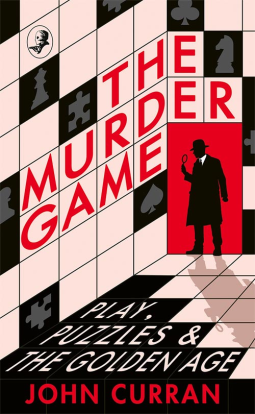
The Murder Game
Play, Puzzles and The Golden Age
This title was previously available on NetGalley and is now archived.
Send NetGalley books directly to your Kindle or Kindle app
1
To read on a Kindle or Kindle app, please add kindle@netgalley.com as an approved email address to receive files in your Amazon account. Click here for step-by-step instructions.
2
Also find your Kindle email address within your Amazon account, and enter it here.
Pub Date Jan 27 2026 | Archive Date Feb 17 2026
Talking about this book? Use #TheMurderGame #NetGalley. More hashtag tips!
Description
From The Murder of Roger Ackroyd to Magpie Murders, and related diversions including cryptic crosswords and Cain’s Jawbone, The Murder Game examines the games authors played with their readers and the importance of puzzles in Golden Age whodunits.
With books flourishing in the 1920s and ’30s like never before, no genre was more innovative or popular than detective fiction. It was an era that saw the emergence of Agatha Christie, Dorothy L. Sayers, John Dickson Carr, Ellery Queen and dozens of other authors who became household names for a generation of readers.
The Golden Age of Detection has enjoyed a great resurgence of interest in recent years, with publishers mining back catalogues to bring the best of yesteryear to very receptive new audiences. What is it about a literary movement that took off in the 1920s that still appeals to book lovers in the 2020s?
In this authoritative new study, John Curran reveals that it is the ludic qualities of classic crime fiction that continue to intrigue. At its heart is the ‘whodunit’ game between writer and reader, but there is also the game between detective and murderer, between publisher and book-buyer, even between the writers themselves.
Coinciding with an increase in leisure time and literacy, the Golden Age also saw the development of the crossword, the growth of bridge and Mahjong, the enduring popularity of jigsaws and the emergence of Cluedo – all activities requiring the ‘little grey cells’. The Murder Game considers all of these, and many other sporting and competitive recreations, helping to explain the reading public’s ongoing love affair with the Golden Age.
Available Editions
| EDITION | Hardcover |
| ISBN | 9780008679880 |
| PRICE | $30.00 (USD) |
| PAGES | 480 |
Available on NetGalley
Available to Buy
Buy on BN.com Buy on Bookshop.orgAverage rating from 14 members
Featured Reviews
 Moira F, Reviewer
The Murder Game is a fascinating exploration of Golden-Age detective fiction, shining a light on how puzzle, play, and craft intertwine in the whodunit tradition. Curran clearly knows his material inside and out, drawing connections between the games authors play with readers, the mechanics of mystery, and the cultural moment that gave rise to these classic crime novels.
What works best is the book’s balance between scholarship and readability. The historical context is rich without becoming dense, and the insights into how crime-writers constructed their puzzles—and the expectations they set for readers—make the genre come alive in a new way. It gives you both a deep appreciation for the works of Christie, Sayers and their peers, and a fresh sense of how those novels still engage us.
If I have one caveat, it’s that the level of detail and the breadth of references occasionally tip into specialist territory—readers less familiar with the genre’s history may find themselves pausing to keep up. That said, it doesn’t detract from the overall pleasure of reading this book.
Overall, The Murder Game is an illuminating, richly textured read that will appeal both to longtime mystery fans and those curious about how the genre’s mechanics work: clever, well-written, and rewarding.
 Reviewer 1875710
A highly detailed, entertaining look at the birth and evolution of Golden Age detective fiction. While readers unfamiliar with the major authors and works of the genre may feel overwhelmed at times by the specifics (and there are many!), Curran offers readers much to appreciate and savor. He assumes readers who enjoy classic detective mysteries and puzzles will relish all of the details, and he's not wrong. One of the best aspects of the book is the discussion of the gamesmanship of dozens of authors.
Verdict: Highly recommended for lovers of the genre. A great holiday gift!
 Megan B, Reviewer
As someone who loves history in about every era ever recorded, I have to say this is one of the best Golden Age focused historical accounts I've read in quite some time! Focus on games and mystery throughout the 1920's and 1930's reminds me of the old detective noir stories and radio programs that I enjoyed devouring as a child. In some places, the information feels a bit dry especially for some readers who aren't used to that type of writing voice but I didn't mind it in the least.
I highly recommend this book to anyone who loves history, games and mystery! This would make a fantastic gift for any bookworm out there!
I would love to take this opportunity to thank the author, publisher and NetGalley for letting me check out this ARC book in exchange for an honest review.
 Elisa R, Reviewer
Fair Play mysteries are making a comeback thanks to authors like Anthony Horowitz and Benjamin Stevenson. In this book, Curran goes back to the basics, the first and the greatest, to investigate why and how they created classics that are still widely read today. It’s just not easy to determine the audience this was written for. Definitely not for casual readers. I’m a huge fan of the classics and have read many of the books he analyzes, but definitely not all of them. There are a lot of spoilers, some are clearly marked but not all. Curran digs so deeply into the format, tricks and games, that it feels like reading someone’s doctoral dissertation. Some parts were fun, like the initiation ritual to the Detection Club, and I loved revisiting a few favorites. I also enjoyed the parts where he explores whodunits that broke the rules, but then there came a series of lists of novels (for example: where the detective was the killer, where the butler did it or where the baddie was an evil twin). When the reference was a whodunit that I’ve read (sometimes more than once), I was fascinated. The rest of the time, I just Googled the ones that sounded more interesting and added them to my TBR. I’m not an expert, but I’ve read more classics than regular readers, and felt completely over my head, that’s why I’m not sure who the target audience is, unless it’s college professors who specialize in the period. Some parts get five stars, others three so I’m rounding up because it’s really well researched.
I chose to read this book and all opinions in this review are my own and completely unbiased. Thank you, NetGalley/Harper 360.
Anne M, Reviewer
n his new book, The Murder Game, John Curran goes on a quest to write a book that focuses on the early mystery novel and its love of the game. Beginning with the always tricky question of defining the Golden Age of the mystery (everyone agrees it starts around the first World War but endings vary. Curran ends up not choosing a date but saying it is more of a vibe than a specific time period), Curran explores what games mystery writers play, why, and with whom.
Ranging from the obvious: can the author keep the reader from figuring out the ending while presenting all the clues; to the more unique: acutally having puzzles within the book whose answers help readers figure out "whodunit"; to the brief stint in the 1930s of full on game kits including physical clues and suspect files, Curran surveys the range. He talks about when "rules" developed and how authors worked with or broke the rules (Agatha Christie was a constant rule bender if not full on rule breaker).
At its heart, this is a survey, with references to the books that fit whatever Curran happens to be talking about. The can make for sometimes lengthy lists or dry spells when reading and the book definitely went a bit long, even for me. There are spoilers, many of which he flags ahead of time, but the reader should be warned that if you haven't already read particular books you'll at least be getting hints and might want to skip some sections if you don't want to know what happens in certain books before you've read them.
Who is the audience for The Murder Game? This is not a book for the casual reader. But someone fascinated with the history of the development of the genre; a fan of Martin Edwards' fantastic nonfiction books The Golden Age of Murder and The Life of Crime; a professor of writing; or a student of the Golden Age of mysteries will absolutely need John Curran's The Murder Game in their collection.
I received an ARC in exchange for an honest review
 joyce l, Reviewer
Those who feel an affection for the Golden Age of mystery fiction may enjoy spending time with this book. It is written by an Agatha Christie scholar.
This book is packed with examples of works from that time period which was roughly between 1920 and 1945. There is also much detail of what the titles of that time exemplified, as for example, offering all the clues to the reader who might then try (often unsuccessfully) to solve the puzzle while reading.
Those unfamiliar with the time period may decide to try books by Christie, Sayers and others. Those who have read in the genre will get many of the references and will welcome some additional insights.
I do think that this book may feel a bit dense at times for the general reader. This may be due to the deep dive that the author takes. Readers will decide for themselves if this is a plus or a bit of a challenge.
Many thanks to NetGalley and Harper 360 for this title. All thoughts are my own.
Librarian 14784
What a resource for the golden age mystery fan. By turns very readable and very scholarly, The Murder Game takes a deep dive into the art and craft of puzzles and games within mystery stories, specifically the development of the author's fair play game with the reader: if all of the information is provided, will they figure out the solution before it's revealed? In addition to an overview of the genre and its history, the book also details the many variations found within mysteries and sections often include lists of authors and books fitting each category, very useful for readers looking for new recommendations. Several chapters in which the author's "game" with the reader is explored clue by clue are featured as well, for those who want to confirm their close attention to the details. Curran's affection and appreciation for golden age authors and their works shines throughout. Do be mindful of spoilers, though!
Readers who liked this book also liked:

Amber Emily Smith
Biographies & Memoirs, Christian, Religion & Spirituality


Silvia Moreno-Garcia
Historical Fiction, Literary Fiction, Sci Fi & Fantasy
Rachel Joyce
Historical Fiction, Literary Fiction, Women's Fiction




Anna-Marie Fahmy; Andrew Fahmy
Crafts & Hobbies, Outdoors & Nature, Parenting, Families, Relationships