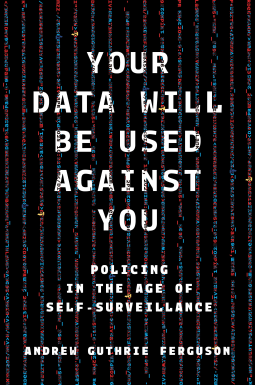
Your Data Will Be Used Against You
Policing in the Age of Self-Surveillance
This title was previously available on NetGalley and is now archived.
Send NetGalley books directly to your Kindle or Kindle app
1
To read on a Kindle or Kindle app, please add kindle@netgalley.com as an approved email address to receive files in your Amazon account. Click here for step-by-step instructions.
2
Also find your Kindle email address within your Amazon account, and enter it here.
Pub Date Mar 17 2026 | Archive Date Mar 30 2026
Talking about this book? Use #YourDataWillBeUsedAgainstYou #NetGalley. More hashtag tips!
Description
Interrogates how digital self-surveillance can be turned against us by police, prosecutors, and political whims
For consumers living in a digitally-connected world, smart technologies have built an inescapable trap of digital self-surveillance. Smart cars, smart homes, smart watches, and smart medical devices track our most private activities and intimate patterns. While these devices allow users to receive personal insights by monitoring their every move, that data can be accessed by police and prosecutors looking to find incriminating clues. Digital technology exposes everyone, everywhere, all at once, and we have few laws to regulate it.
In Your Data Will Be Used Against You, Andrew Guthrie Ferguson warns us of how the rise of sensor-driven technology, social media monitoring, and artificial intelligence can be weaponized against democratic values and personal freedoms. At the same time, that data will solve crimes, radically transforming how criminal cases are prosecuted. Ferguson explores how this proliferation of private data in combination with public surveillance networks promises new ways to solve previously unsolvable crimes, but also leaves us vulnerable to governmental overreach and abuse. He argues for legal interventions that address the threat of digital self-surveillance and provides concrete suggestions about how legislators, judges, and communities should respond.
As consumers, citizens, and potential subjects of surveillance, the questions in this book must be confronted now, before the trap of surveillance captures us completely. Providing a stark warning of the dangers of digital self-surveillance, Your Data Will be Used Against You is a defense of civil liberties against the growing threat of data-driven policing.
A Note From the Publisher
George Washington University Law School. He is a national expert on
new surveillance technologies, policing, and criminal justice. He is the
author of the 2018 PROSE Award winning book, The Rise of Big Data
Policing. He is an elected member of the American Law Institute.
Advance Praise
“As Virgil guided Dante through Hell, so too does Ferguson guide us through the world of digital informants and the inadequate legal regime that enables it. Your Data Will Be Used Against You is essential and a bright flashing warning sign articulating the vulnerability we all live with, the inability of the current legal system to protect us, and the loaded gun this system represents to would-be tyrants whether they wear a badge or make the laws.” —Matthew Guariglia, author of Police and the Empire City: Race and the Origins of Modern Policing in New York
“If you have a phone and do not live entirely off the grid in the wild, then you have to read this book. Just about everything you do can be potentially used as evidence in our rapidly digitizing courts, Andrew Guthrie Ferguson details in this compelling, important and highly readable new book.” —Brandon Garrett, Duke University School of Law
“Andrew G. Ferguson has again delivered a tour de force, reminding all of us of the dangers of the pervasive surveillance state. Worse still, it’s all become frighteningly commonplace, largely without our knowledge.” —Cyrus Farivar, author of Habeas Data: Privacy vs. the Rise of Surveillance Tech
“Andrew Ferguson has done it again. His last book, The Rise of Big Data Policing, opened our eyes to the expanding world of digital surveillance. But technology has not stood still – not hardly – and Ferguson has captured the promise but also the perils in this latest volume. The short of it is that the accumulation of all the data about all of us puts way too much power in government hands and the protections are way too insufficient. We see that daily in the news, as the government mines location, social media, and much, much more. Highly readable, incredibly educational, and urgent and attention getting, this is a must read.” —Barry Friedman, New York University School of Law
Available Editions
| EDITION | Other Format |
| ISBN | 9781479838288 |
| PRICE | $35.00 (USD) |
| PAGES | 320 |
Available on NetGalley
Available to Buy
Buy on Amazon Buy on BN.com Buy on Bookshop.orgAverage rating from 23 members
Featured Reviews
 Christopher W, Reviewer
Your Data Will Be Used Against You by Andrew Guthrie Ferguson is an eye-opening exploration of how modern technology has turned our everyday devices into tools of surveillance. Ferguson clearly lays out how smart cars, watches, and home assistants quietly record our movements and habits, often under the guise of convenience and personalization. I found it especially powerful how he connected these technologies to the legal system, showing how data that feels private can easily be accessed and used by law enforcement. The examples he gives, from Google tracking locations to doorbell cameras providing footage to police, drive home just how little control we truly have once our information is collected.
What I appreciated most was that Ferguson doesn’t just sound the alarm. He also offers a path forward by presenting five practical ways individuals and communities can push back against digital surveillance, from supporting privacy-focused technology to electing representatives who value civil liberty over profit and policing. His perspective as a lawyer gives the book real weight, but his tone remains accessible and grounded. I finished it feeling more informed and more aware but also empowered to make better choices in my digital life.
 Rose T, Reviewer
This is a clear, practical walk through how your information moves and how that movement affects real decisions. The book is strongest when it sits inside ordinary moments and follows the chain from data to consequence. A rental application becomes a portrait stitched from old addresses, court records, and social connections. A job screening pulls from personality quizzes, keystroke timing, and attendance history. School discipline, health insurance approvals, and even retail theft prevention get the same treatment. The writing is calm and direct. Jargon is translated into plain terms, and each chapter ends with a few concrete steps you can actually try, which kept me engaged. I also liked the focus on who benefits, who is harmed, and why “neutral” systems produce uneven results. The central idea is simple and it holds: the more your data is collected, the more it will be used to sort you, often outside your view.
A few chapters circle similar risks, especially around background checks and risk scores, and the examples lean U.S. based, but the guidance still travels well. I would have liked more side by side comparisons that show how two people with similar facts can be treated differently depending on the dataset in play, since those contrasts help non-experts see the stakes. Even so, the mix of case studies and step by step advice makes this easy to recommend to general readers, parents, teachers, and anyone who fills out forms for a living. It’s practical without panic, which is rare for books in this space. I finished with a short list of habits to adopt and a better sense of which questions to ask when a system says no
 Reviewer 1168388
Most of this book had me cheering for how surveillance technology has caught murderers and thieves to ensure that justice is served. However, it’s scary to think this same surveillance technology can be used against anyone who an extremist government decides is a criminal (e.g., someone who goes to a protest or place of worship). It’s also concerning how innocent people’s data has been accessed to assist in crime-solving, even if the ends might seem to justify the means. And of course, most Americans have willingly opted into this surveillance technology via our smartphones, cars, smart watches, and/or Alexa - and it’s increasingly difficult to avoid it.
This comprehensively-researched book does suggest some solutions. (Seriously - this book has an incredible amount of resources, all properly cited.) I was hoping this book would have a list of practical solutions to reduce how much of our data we give away, but I’m sure I can find that elsewhere. It primarily advocates for supporting politicians and organizations that will push for legal protection. If it happens, that would get to the real heart of the issue.
I hope predators continue to get caught, but I also hope this book will be a wake-up call for everyone else. You might think you have nothing to hide - but what if one day, the police or government decide differently?
Thank you to NetGalley and NYU Press for the free eARC.
This review will be posted to Goodreads and Amazon within one week of the book’s publication date if not earlier.
 Julie O, Reviewer
What an encompassing, interesting read. There are so many facets to this book, so many elements that had me wanting to change as much as I can. Not for the legal aspects, but for the privacy.
This is well written, succinct and easy to read. It explains so well what technology is doing and the amazing things it has achieved and the way that the Government is using it to keep citizens safe..
Readers who liked this book also liked:












Marschall Runge
Computers & Technology, Health, Mind & Body, Nonfiction (Adult)